> ## Documentation Index
> Fetch the complete documentation index at: https://aegean.ai/llms.txt
> Use this file to discover all available pages before exploring further.
# Behavioral Cloning
> End-to-end imitation learning with Gymnasium CarRacing-v3, train a driving policy from demonstrations, observe distribution shift, and fix it with DAgger.
 # Behavioral Cloning with CarRacing-v3
Behavioral cloning (BC) is the simplest form of imitation learning: collect expert demonstrations, then train a policy via supervised learning to map observations to actions. It is the starting point for understanding why imitation learning works, and why it fails.
In this section you will:
1. Train an expert policy using PPO
2. Collect expert driving demonstrations
3. Train a BC policy via supervised learning on the expert's data
4. Observe **distribution shift**, the core failure mode of BC
5. Fix it with **DAgger** (Dataset Aggregation)
**Environment:** [CarRacing-v3](https://gymnasium.farama.org/environments/box2d/car_racing/), a continuous-control driving task where the agent observes a 96×96 RGB top-down view of a procedurally generated race track and outputs steering, throttle, and brake.
## Setup
```python theme={null}
!pip install -q "gymnasium[box2d]" stable-baselines3 swig rich tqdm
```
```python theme={null}
import gymnasium as gym
import numpy as np
import matplotlib.pyplot as plt
import torch
import torch.nn as nn
import torch.optim as optim
from torch.utils.data import DataLoader, TensorDataset
from stable_baselines3 import PPO
from stable_baselines3.common.vec_env import DummyVecEnv, SubprocVecEnv
from stable_baselines3.common.evaluation import evaluate_policy
SEED = 42
np.random.seed(SEED)
torch.manual_seed(SEED)
device = torch.device("cuda" if torch.cuda.is_available() else "cpu")
print(f"Device: {device}")
```
```output theme={null}
Device: cuda
```
## Step 1: Create the environment
```python theme={null}
def make_env():
return gym.make("CarRacing-v3", continuous=True, render_mode="rgb_array")
# Parallel envs for fast PPO rollout collection
N_TRAIN_ENVS = 8
train_venv = SubprocVecEnv([make_env for _ in range(N_TRAIN_ENVS)])
# Single env for evaluation and demo collection (simpler to read)
venv = DummyVecEnv([make_env])
print(f"Train envs: {N_TRAIN_ENVS} parallel (SubprocVecEnv)")
print(f"Eval env: 1 (DummyVecEnv)")
print(f"Observation: {venv.observation_space}")
print(f"Action: {venv.action_space}")
```
```output theme={null}
Train envs: 8 parallel (SubprocVecEnv)
Eval env: 1 (DummyVecEnv)
Observation: Box(0, 255, (96, 96, 3), uint8)
Action: Box([-1. 0. 0.], 1.0, (3,), float32)
```
```output theme={null}
/home/pantelis.monogioudis/repos/eng-ai-agents/.venv/lib/python3.12/site-packages/pygame/pkgdata.py:25: UserWarning: pkg_resources is deprecated as an API. See https://setuptools.pypa.io/en/latest/pkg_resources.html. The pkg_resources package is slated for removal as early as 2025-11-30. Refrain from using this package or pin to Setuptools<81.
from pkg_resources import resource_stream, resource_exists
/home/pantelis.monogioudis/repos/eng-ai-agents/.venv/lib/python3.12/site-packages/pygame/pkgdata.py:25: UserWarning: pkg_resources is deprecated as an API. See https://setuptools.pypa.io/en/latest/pkg_resources.html. The pkg_resources package is slated for removal as early as 2025-11-30. Refrain from using this package or pin to Setuptools<81.
from pkg_resources import resource_stream, resource_exists
/home/pantelis.monogioudis/repos/eng-ai-agents/.venv/lib/python3.12/site-packages/pygame/pkgdata.py:25: UserWarning: pkg_resources is deprecated as an API. See https://setuptools.pypa.io/en/latest/pkg_resources.html. The pkg_resources package is slated for removal as early as 2025-11-30. Refrain from using this package or pin to Setuptools<81.
from pkg_resources import resource_stream, resource_exists
/home/pantelis.monogioudis/repos/eng-ai-agents/.venv/lib/python3.12/site-packages/pygame/pkgdata.py:25: UserWarning: pkg_resources is deprecated as an API. See https://setuptools.pypa.io/en/latest/pkg_resources.html. The pkg_resources package is slated for removal as early as 2025-11-30. Refrain from using this package or pin to Setuptools<81.
from pkg_resources import resource_stream, resource_exists
/home/pantelis.monogioudis/repos/eng-ai-agents/.venv/lib/python3.12/site-packages/pygame/pkgdata.py:25: UserWarning: pkg_resources is deprecated as an API. See https://setuptools.pypa.io/en/latest/pkg_resources.html. The pkg_resources package is slated for removal as early as 2025-11-30. Refrain from using this package or pin to Setuptools<81.
from pkg_resources import resource_stream, resource_exists
/home/pantelis.monogioudis/repos/eng-ai-agents/.venv/lib/python3.12/site-packages/pygame/pkgdata.py:25: UserWarning: pkg_resources is deprecated as an API. See https://setuptools.pypa.io/en/latest/pkg_resources.html. The pkg_resources package is slated for removal as early as 2025-11-30. Refrain from using this package or pin to Setuptools<81.
from pkg_resources import resource_stream, resource_exists
/home/pantelis.monogioudis/repos/eng-ai-agents/.venv/lib/python3.12/site-packages/pygame/pkgdata.py:25: UserWarning: pkg_resources is deprecated as an API. See https://setuptools.pypa.io/en/latest/pkg_resources.html. The pkg_resources package is slated for removal as early as 2025-11-30. Refrain from using this package or pin to Setuptools<81.
from pkg_resources import resource_stream, resource_exists
/home/pantelis.monogioudis/repos/eng-ai-agents/.venv/lib/python3.12/site-packages/pygame/pkgdata.py:25: UserWarning: pkg_resources is deprecated as an API. See https://setuptools.pypa.io/en/latest/pkg_resources.html. The pkg_resources package is slated for removal as early as 2025-11-30. Refrain from using this package or pin to Setuptools<81.
from pkg_resources import resource_stream, resource_exists
/home/pantelis.monogioudis/repos/eng-ai-agents/.venv/lib/python3.12/site-packages/pygame/pkgdata.py:25: UserWarning: pkg_resources is deprecated as an API. See https://setuptools.pypa.io/en/latest/pkg_resources.html. The pkg_resources package is slated for removal as early as 2025-11-30. Refrain from using this package or pin to Setuptools<81.
from pkg_resources import resource_stream, resource_exists
```
## Step 2: Train an expert policy
We train an expert using PPO. In a real setting you might use a pre-trained checkpoint or human teleoperation. Here PPO acts as our "expert driver."
**Note:** Training for 200k timesteps takes \~5-10 minutes on CPU.
```python theme={null}
from stable_baselines3.common.callbacks import BaseCallback
class TrainingMetricsCallback(BaseCallback):
"""Capture key PPO training metrics after each rollout for later plotting."""
def __init__(self):
super().__init__()
self.timesteps = []
self.std = []
self.value_loss = []
self.explained_variance = []
self.entropy_loss = []
self.policy_gradient_loss = []
self.approx_kl = []
self.clip_fraction = []
def _on_step(self) -> bool:
return True
def _on_rollout_end(self) -> None:
# Pull metrics from the SB3 logger after each rollout-and-update
log = self.logger.name_to_value
self.timesteps.append(self.num_timesteps)
# std is stored under "train/std" once a Gaussian distribution is used
self.std.append(log.get("train/std", float("nan")))
self.value_loss.append(log.get("train/value_loss", float("nan")))
self.explained_variance.append(log.get("train/explained_variance", float("nan")))
self.entropy_loss.append(log.get("train/entropy_loss", float("nan")))
self.policy_gradient_loss.append(log.get("train/policy_gradient_loss", float("nan")))
self.approx_kl.append(log.get("train/approx_kl", float("nan")))
self.clip_fraction.append(log.get("train/clip_fraction", float("nan")))
expert = PPO(
"CnnPolicy",
train_venv,
verbose=0,
seed=SEED,
n_steps=512,
batch_size=256,
n_epochs=10,
learning_rate=3e-4,
)
metrics_cb = TrainingMetricsCallback()
# 200k total timesteps across 8 parallel envs = 25k env steps wall-clock
expert.learn(total_timesteps=200_000, progress_bar=True, callback=metrics_cb)
print("Expert training complete")
```
```output theme={null}
/home/pantelis.monogioudis/repos/eng-ai-agents/.venv/lib/python3.12/site-packages/rich/live.py:260: UserWarning:
install "ipywidgets" for Jupyter support
warnings.warn('install "ipywidgets" for Jupyter support')
```
```output theme={null}
Expert training complete
```
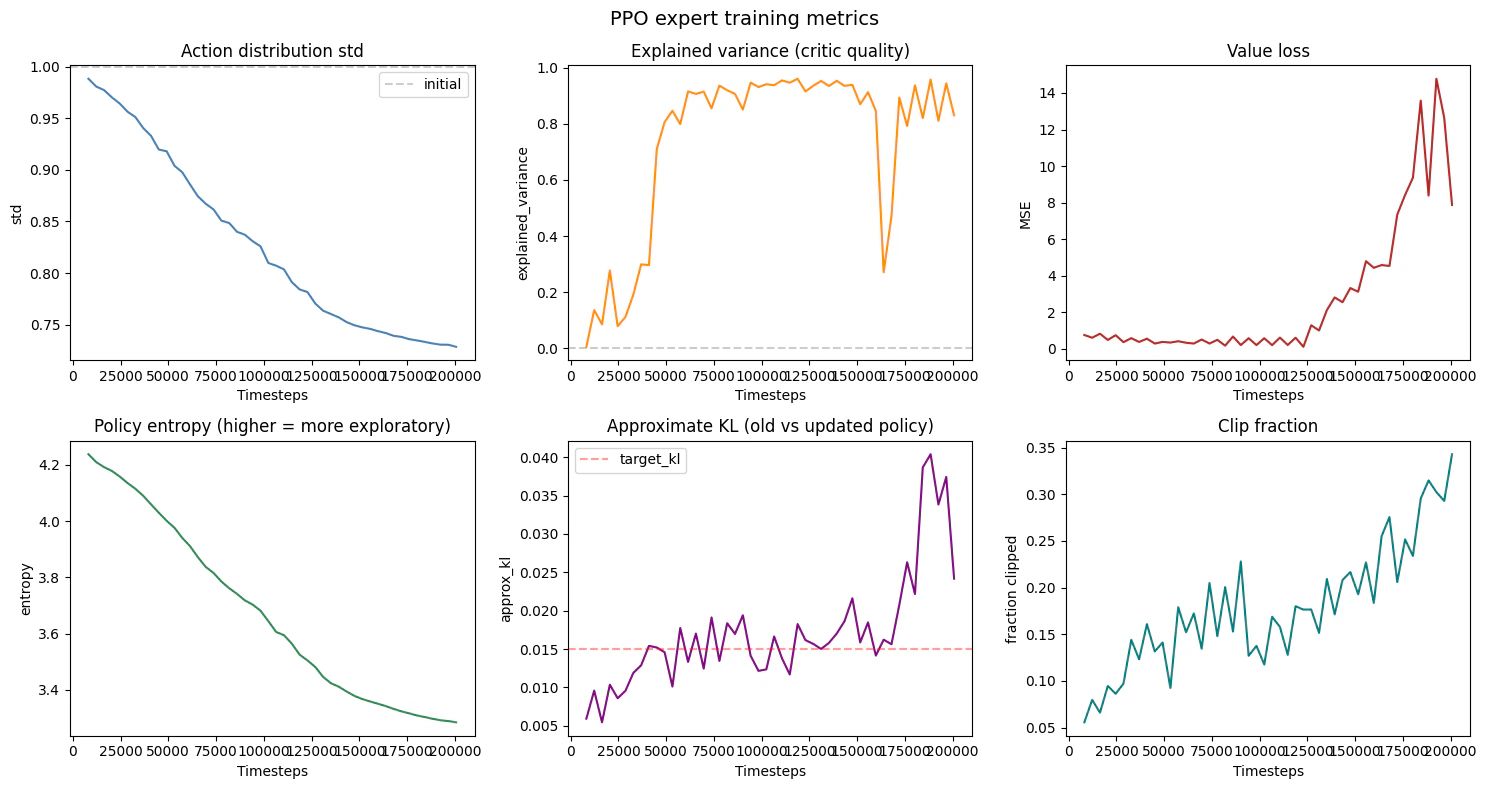
### Reading PPO training output
PPO logs a block of metrics after each rollout-and-update iteration. With `verbose=1` you would see something like this:
```
-----------------------------------------
| time/ | |
| fps | 124 |
| iterations | 2 |
| time_elapsed | 16 |
| total_timesteps | 2048 |
| train/ | |
| approx_kl | 0.007264021 |
| clip_fraction | 0.0696 |
| clip_range | 0.2 |
| entropy_loss | -4.25 |
| explained_variance | 0.0162 |
| learning_rate | 0.0003 |
| loss | 0.393 |
| n_updates | 10 |
| policy_gradient_loss | -0.00708 |
| std | 0.994 |
| value_loss | 0.811 |
-----------------------------------------
```
PPO uses a **diagonal Gaussian action distribution** for continuous control: the CNN outputs the *mean* of each action dimension, and the *standard deviation* (`std`) is a separate learned parameter (state-independent `log_std`). Actions are sampled from `Normal(mean, std)` at training time and set to `mean` at evaluation time when `deterministic=True`. There is no diffusion head, modern diffusion-based action heads (Chi et al. 2023) are an alternative used in some manipulation BC systems, but they are not required for continuous control and SB3 PPO does not use them.
Each metric and the trend you should expect during a healthy run:
| Metric | Meaning | Healthy trend |
| ---------------------- | -------------------------------------------------------------------------- | --------------------------------------------------------- |
| `fps` | Environment steps per second across all parallel workers | Roughly constant; depends on hardware |
| `total_timesteps` | Cumulative env steps consumed | Monotonic |
| `approx_kl` | KL between old and updated policy after the gradient steps | Stays below \~0.02; spikes mean the policy moved too far |
| `clip_fraction` | Fraction of samples whose probability ratio was clipped by PPO's surrogate | 0.0 - 0.3 is normal; >0.5 means too-aggressive updates |
| `entropy_loss` | Negative entropy of the action distribution (PPO maximises entropy) | Becomes less negative as the policy commits |
| `explained_variance` | How well the value head predicts returns | Should rise from 0 toward 0.5 - 0.9 |
| `policy_gradient_loss` | Clipped surrogate loss being minimised | Small magnitude, can be slightly negative |
| `std` | Standard deviation of the Gaussian action distribution | Drops from \~1.0 toward \~0.1 - 0.3 as the policy commits |
| `value_loss` | MSE between value head prediction and actual return | Decreases as `explained_variance` rises |
The next cell plots these metrics over the course of training using the data captured by the callback above.
```python theme={null}
fig, axes = plt.subplots(2, 3, figsize=(15, 8))
ts = metrics_cb.timesteps
axes[0, 0].plot(ts, metrics_cb.std, color="steelblue")
axes[0, 0].set_title("Action distribution std")
axes[0, 0].set_xlabel("Timesteps")
axes[0, 0].set_ylabel("std")
axes[0, 0].axhline(y=1.0, color="gray", linestyle="--", alpha=0.4, label="initial")
axes[0, 0].legend()
axes[0, 1].plot(ts, metrics_cb.explained_variance, color="darkorange")
axes[0, 1].set_title("Explained variance (critic quality)")
axes[0, 1].set_xlabel("Timesteps")
axes[0, 1].set_ylabel("explained_variance")
axes[0, 1].axhline(y=0.0, color="gray", linestyle="--", alpha=0.4)
axes[0, 2].plot(ts, metrics_cb.value_loss, color="firebrick")
axes[0, 2].set_title("Value loss")
axes[0, 2].set_xlabel("Timesteps")
axes[0, 2].set_ylabel("MSE")
axes[1, 0].plot(ts, [-e for e in metrics_cb.entropy_loss], color="seagreen")
axes[1, 0].set_title("Policy entropy (higher = more exploratory)")
axes[1, 0].set_xlabel("Timesteps")
axes[1, 0].set_ylabel("entropy")
axes[1, 1].plot(ts, metrics_cb.approx_kl, color="purple")
axes[1, 1].set_title("Approximate KL (old vs updated policy)")
axes[1, 1].set_xlabel("Timesteps")
axes[1, 1].set_ylabel("approx_kl")
axes[1, 1].axhline(y=0.015, color="red", linestyle="--", alpha=0.4, label="target_kl")
axes[1, 1].legend()
axes[1, 2].plot(ts, metrics_cb.clip_fraction, color="teal")
axes[1, 2].set_title("Clip fraction")
axes[1, 2].set_xlabel("Timesteps")
axes[1, 2].set_ylabel("fraction clipped")
fig.suptitle("PPO expert training metrics", fontsize=14)
plt.tight_layout()
plt.show()
```
# Behavioral Cloning with CarRacing-v3
Behavioral cloning (BC) is the simplest form of imitation learning: collect expert demonstrations, then train a policy via supervised learning to map observations to actions. It is the starting point for understanding why imitation learning works, and why it fails.
In this section you will:
1. Train an expert policy using PPO
2. Collect expert driving demonstrations
3. Train a BC policy via supervised learning on the expert's data
4. Observe **distribution shift**, the core failure mode of BC
5. Fix it with **DAgger** (Dataset Aggregation)
**Environment:** [CarRacing-v3](https://gymnasium.farama.org/environments/box2d/car_racing/), a continuous-control driving task where the agent observes a 96×96 RGB top-down view of a procedurally generated race track and outputs steering, throttle, and brake.
## Setup
```python theme={null}
!pip install -q "gymnasium[box2d]" stable-baselines3 swig rich tqdm
```
```python theme={null}
import gymnasium as gym
import numpy as np
import matplotlib.pyplot as plt
import torch
import torch.nn as nn
import torch.optim as optim
from torch.utils.data import DataLoader, TensorDataset
from stable_baselines3 import PPO
from stable_baselines3.common.vec_env import DummyVecEnv, SubprocVecEnv
from stable_baselines3.common.evaluation import evaluate_policy
SEED = 42
np.random.seed(SEED)
torch.manual_seed(SEED)
device = torch.device("cuda" if torch.cuda.is_available() else "cpu")
print(f"Device: {device}")
```
```output theme={null}
Device: cuda
```
## Step 1: Create the environment
```python theme={null}
def make_env():
return gym.make("CarRacing-v3", continuous=True, render_mode="rgb_array")
# Parallel envs for fast PPO rollout collection
N_TRAIN_ENVS = 8
train_venv = SubprocVecEnv([make_env for _ in range(N_TRAIN_ENVS)])
# Single env for evaluation and demo collection (simpler to read)
venv = DummyVecEnv([make_env])
print(f"Train envs: {N_TRAIN_ENVS} parallel (SubprocVecEnv)")
print(f"Eval env: 1 (DummyVecEnv)")
print(f"Observation: {venv.observation_space}")
print(f"Action: {venv.action_space}")
```
```output theme={null}
Train envs: 8 parallel (SubprocVecEnv)
Eval env: 1 (DummyVecEnv)
Observation: Box(0, 255, (96, 96, 3), uint8)
Action: Box([-1. 0. 0.], 1.0, (3,), float32)
```
```output theme={null}
/home/pantelis.monogioudis/repos/eng-ai-agents/.venv/lib/python3.12/site-packages/pygame/pkgdata.py:25: UserWarning: pkg_resources is deprecated as an API. See https://setuptools.pypa.io/en/latest/pkg_resources.html. The pkg_resources package is slated for removal as early as 2025-11-30. Refrain from using this package or pin to Setuptools<81.
from pkg_resources import resource_stream, resource_exists
/home/pantelis.monogioudis/repos/eng-ai-agents/.venv/lib/python3.12/site-packages/pygame/pkgdata.py:25: UserWarning: pkg_resources is deprecated as an API. See https://setuptools.pypa.io/en/latest/pkg_resources.html. The pkg_resources package is slated for removal as early as 2025-11-30. Refrain from using this package or pin to Setuptools<81.
from pkg_resources import resource_stream, resource_exists
/home/pantelis.monogioudis/repos/eng-ai-agents/.venv/lib/python3.12/site-packages/pygame/pkgdata.py:25: UserWarning: pkg_resources is deprecated as an API. See https://setuptools.pypa.io/en/latest/pkg_resources.html. The pkg_resources package is slated for removal as early as 2025-11-30. Refrain from using this package or pin to Setuptools<81.
from pkg_resources import resource_stream, resource_exists
/home/pantelis.monogioudis/repos/eng-ai-agents/.venv/lib/python3.12/site-packages/pygame/pkgdata.py:25: UserWarning: pkg_resources is deprecated as an API. See https://setuptools.pypa.io/en/latest/pkg_resources.html. The pkg_resources package is slated for removal as early as 2025-11-30. Refrain from using this package or pin to Setuptools<81.
from pkg_resources import resource_stream, resource_exists
/home/pantelis.monogioudis/repos/eng-ai-agents/.venv/lib/python3.12/site-packages/pygame/pkgdata.py:25: UserWarning: pkg_resources is deprecated as an API. See https://setuptools.pypa.io/en/latest/pkg_resources.html. The pkg_resources package is slated for removal as early as 2025-11-30. Refrain from using this package or pin to Setuptools<81.
from pkg_resources import resource_stream, resource_exists
/home/pantelis.monogioudis/repos/eng-ai-agents/.venv/lib/python3.12/site-packages/pygame/pkgdata.py:25: UserWarning: pkg_resources is deprecated as an API. See https://setuptools.pypa.io/en/latest/pkg_resources.html. The pkg_resources package is slated for removal as early as 2025-11-30. Refrain from using this package or pin to Setuptools<81.
from pkg_resources import resource_stream, resource_exists
/home/pantelis.monogioudis/repos/eng-ai-agents/.venv/lib/python3.12/site-packages/pygame/pkgdata.py:25: UserWarning: pkg_resources is deprecated as an API. See https://setuptools.pypa.io/en/latest/pkg_resources.html. The pkg_resources package is slated for removal as early as 2025-11-30. Refrain from using this package or pin to Setuptools<81.
from pkg_resources import resource_stream, resource_exists
/home/pantelis.monogioudis/repos/eng-ai-agents/.venv/lib/python3.12/site-packages/pygame/pkgdata.py:25: UserWarning: pkg_resources is deprecated as an API. See https://setuptools.pypa.io/en/latest/pkg_resources.html. The pkg_resources package is slated for removal as early as 2025-11-30. Refrain from using this package or pin to Setuptools<81.
from pkg_resources import resource_stream, resource_exists
/home/pantelis.monogioudis/repos/eng-ai-agents/.venv/lib/python3.12/site-packages/pygame/pkgdata.py:25: UserWarning: pkg_resources is deprecated as an API. See https://setuptools.pypa.io/en/latest/pkg_resources.html. The pkg_resources package is slated for removal as early as 2025-11-30. Refrain from using this package or pin to Setuptools<81.
from pkg_resources import resource_stream, resource_exists
```
## Step 2: Train an expert policy
We train an expert using PPO. In a real setting you might use a pre-trained checkpoint or human teleoperation. Here PPO acts as our "expert driver."
**Note:** Training for 200k timesteps takes \~5-10 minutes on CPU.
```python theme={null}
from stable_baselines3.common.callbacks import BaseCallback
class TrainingMetricsCallback(BaseCallback):
"""Capture key PPO training metrics after each rollout for later plotting."""
def __init__(self):
super().__init__()
self.timesteps = []
self.std = []
self.value_loss = []
self.explained_variance = []
self.entropy_loss = []
self.policy_gradient_loss = []
self.approx_kl = []
self.clip_fraction = []
def _on_step(self) -> bool:
return True
def _on_rollout_end(self) -> None:
# Pull metrics from the SB3 logger after each rollout-and-update
log = self.logger.name_to_value
self.timesteps.append(self.num_timesteps)
# std is stored under "train/std" once a Gaussian distribution is used
self.std.append(log.get("train/std", float("nan")))
self.value_loss.append(log.get("train/value_loss", float("nan")))
self.explained_variance.append(log.get("train/explained_variance", float("nan")))
self.entropy_loss.append(log.get("train/entropy_loss", float("nan")))
self.policy_gradient_loss.append(log.get("train/policy_gradient_loss", float("nan")))
self.approx_kl.append(log.get("train/approx_kl", float("nan")))
self.clip_fraction.append(log.get("train/clip_fraction", float("nan")))
expert = PPO(
"CnnPolicy",
train_venv,
verbose=0,
seed=SEED,
n_steps=512,
batch_size=256,
n_epochs=10,
learning_rate=3e-4,
)
metrics_cb = TrainingMetricsCallback()
# 200k total timesteps across 8 parallel envs = 25k env steps wall-clock
expert.learn(total_timesteps=200_000, progress_bar=True, callback=metrics_cb)
print("Expert training complete")
```
```output theme={null}
/home/pantelis.monogioudis/repos/eng-ai-agents/.venv/lib/python3.12/site-packages/rich/live.py:260: UserWarning:
install "ipywidgets" for Jupyter support
warnings.warn('install "ipywidgets" for Jupyter support')
```
```output theme={null}
Expert training complete
```
### Reading PPO training output
PPO logs a block of metrics after each rollout-and-update iteration. With `verbose=1` you would see something like this:
```
-----------------------------------------
| time/ | |
| fps | 124 |
| iterations | 2 |
| time_elapsed | 16 |
| total_timesteps | 2048 |
| train/ | |
| approx_kl | 0.007264021 |
| clip_fraction | 0.0696 |
| clip_range | 0.2 |
| entropy_loss | -4.25 |
| explained_variance | 0.0162 |
| learning_rate | 0.0003 |
| loss | 0.393 |
| n_updates | 10 |
| policy_gradient_loss | -0.00708 |
| std | 0.994 |
| value_loss | 0.811 |
-----------------------------------------
```
PPO uses a **diagonal Gaussian action distribution** for continuous control: the CNN outputs the *mean* of each action dimension, and the *standard deviation* (`std`) is a separate learned parameter (state-independent `log_std`). Actions are sampled from `Normal(mean, std)` at training time and set to `mean` at evaluation time when `deterministic=True`. There is no diffusion head, modern diffusion-based action heads (Chi et al. 2023) are an alternative used in some manipulation BC systems, but they are not required for continuous control and SB3 PPO does not use them.
Each metric and the trend you should expect during a healthy run:
| Metric | Meaning | Healthy trend |
| ---------------------- | -------------------------------------------------------------------------- | --------------------------------------------------------- |
| `fps` | Environment steps per second across all parallel workers | Roughly constant; depends on hardware |
| `total_timesteps` | Cumulative env steps consumed | Monotonic |
| `approx_kl` | KL between old and updated policy after the gradient steps | Stays below \~0.02; spikes mean the policy moved too far |
| `clip_fraction` | Fraction of samples whose probability ratio was clipped by PPO's surrogate | 0.0 - 0.3 is normal; >0.5 means too-aggressive updates |
| `entropy_loss` | Negative entropy of the action distribution (PPO maximises entropy) | Becomes less negative as the policy commits |
| `explained_variance` | How well the value head predicts returns | Should rise from 0 toward 0.5 - 0.9 |
| `policy_gradient_loss` | Clipped surrogate loss being minimised | Small magnitude, can be slightly negative |
| `std` | Standard deviation of the Gaussian action distribution | Drops from \~1.0 toward \~0.1 - 0.3 as the policy commits |
| `value_loss` | MSE between value head prediction and actual return | Decreases as `explained_variance` rises |
The next cell plots these metrics over the course of training using the data captured by the callback above.
```python theme={null}
fig, axes = plt.subplots(2, 3, figsize=(15, 8))
ts = metrics_cb.timesteps
axes[0, 0].plot(ts, metrics_cb.std, color="steelblue")
axes[0, 0].set_title("Action distribution std")
axes[0, 0].set_xlabel("Timesteps")
axes[0, 0].set_ylabel("std")
axes[0, 0].axhline(y=1.0, color="gray", linestyle="--", alpha=0.4, label="initial")
axes[0, 0].legend()
axes[0, 1].plot(ts, metrics_cb.explained_variance, color="darkorange")
axes[0, 1].set_title("Explained variance (critic quality)")
axes[0, 1].set_xlabel("Timesteps")
axes[0, 1].set_ylabel("explained_variance")
axes[0, 1].axhline(y=0.0, color="gray", linestyle="--", alpha=0.4)
axes[0, 2].plot(ts, metrics_cb.value_loss, color="firebrick")
axes[0, 2].set_title("Value loss")
axes[0, 2].set_xlabel("Timesteps")
axes[0, 2].set_ylabel("MSE")
axes[1, 0].plot(ts, [-e for e in metrics_cb.entropy_loss], color="seagreen")
axes[1, 0].set_title("Policy entropy (higher = more exploratory)")
axes[1, 0].set_xlabel("Timesteps")
axes[1, 0].set_ylabel("entropy")
axes[1, 1].plot(ts, metrics_cb.approx_kl, color="purple")
axes[1, 1].set_title("Approximate KL (old vs updated policy)")
axes[1, 1].set_xlabel("Timesteps")
axes[1, 1].set_ylabel("approx_kl")
axes[1, 1].axhline(y=0.015, color="red", linestyle="--", alpha=0.4, label="target_kl")
axes[1, 1].legend()
axes[1, 2].plot(ts, metrics_cb.clip_fraction, color="teal")
axes[1, 2].set_title("Clip fraction")
axes[1, 2].set_xlabel("Timesteps")
axes[1, 2].set_ylabel("fraction clipped")
fig.suptitle("PPO expert training metrics", fontsize=14)
plt.tight_layout()
plt.show()
```
 ```python theme={null}
expert_reward, expert_std = evaluate_policy(expert, venv, n_eval_episodes=10)
print(f"Expert mean reward: {expert_reward:.1f} +/- {expert_std:.1f}")
```
```output theme={null}
/home/pantelis.monogioudis/repos/eng-ai-agents/.venv/lib/python3.12/site-packages/stable_baselines3/common/evaluation.py:71: UserWarning: Evaluation environment is not wrapped with a ``Monitor`` wrapper. This may result in reporting modified episode lengths and rewards, if other wrappers happen to modify these. Consider wrapping environment first with ``Monitor`` wrapper.
warnings.warn(
```
```output theme={null}
Expert mean reward: 347.3 +/- 223.3
```
## Step 3: Collect expert demonstrations
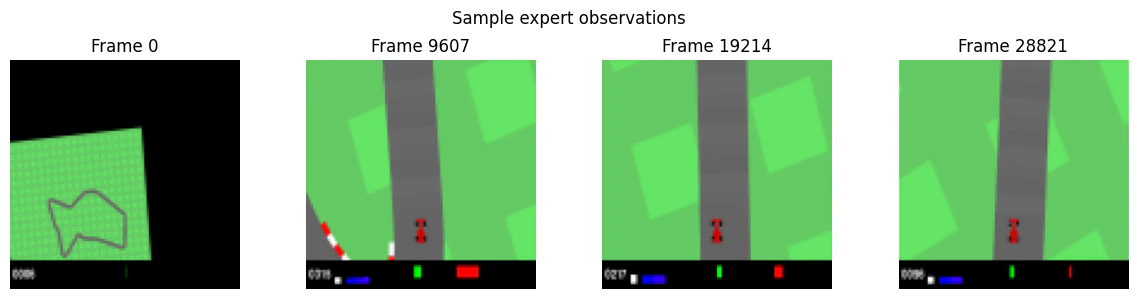
Roll out the expert to collect (observation, action) pairs, this is our training data for behavioral cloning.
```python theme={null}
def collect_demonstrations(policy, venv, n_episodes=50):
"""Collect (obs, action) pairs from a policy."""
all_obs, all_actions = [], []
for ep in range(n_episodes):
obs = venv.reset()
done = False
while not done:
action, _ = policy.predict(obs, deterministic=True)
all_obs.append(obs[0].copy())
all_actions.append(action[0].copy())
obs, reward, done, info = venv.step(action)
return np.array(all_obs), np.array(all_actions)
expert_obs, expert_actions = collect_demonstrations(expert, venv, n_episodes=50)
print(f"Collected {len(expert_obs)} transitions from 50 episodes")
print(f"Observation shape: {expert_obs.shape}")
print(f"Action shape: {expert_actions.shape}")
# Show sample observations
fig, axes = plt.subplots(1, 4, figsize=(12, 3))
for i, ax in enumerate(axes):
idx = i * (len(expert_obs) // 4)
ax.imshow(expert_obs[idx])
ax.set_title(f"Frame {idx}")
ax.axis("off")
fig.suptitle("Sample expert observations")
plt.tight_layout()
plt.show()
```
```output theme={null}
Collected 38431 transitions from 50 episodes
Observation shape: (38431, 96, 96, 3)
Action shape: (38431, 3)
```
```python theme={null}
expert_reward, expert_std = evaluate_policy(expert, venv, n_eval_episodes=10)
print(f"Expert mean reward: {expert_reward:.1f} +/- {expert_std:.1f}")
```
```output theme={null}
/home/pantelis.monogioudis/repos/eng-ai-agents/.venv/lib/python3.12/site-packages/stable_baselines3/common/evaluation.py:71: UserWarning: Evaluation environment is not wrapped with a ``Monitor`` wrapper. This may result in reporting modified episode lengths and rewards, if other wrappers happen to modify these. Consider wrapping environment first with ``Monitor`` wrapper.
warnings.warn(
```
```output theme={null}
Expert mean reward: 347.3 +/- 223.3
```
## Step 3: Collect expert demonstrations
Roll out the expert to collect (observation, action) pairs, this is our training data for behavioral cloning.
```python theme={null}
def collect_demonstrations(policy, venv, n_episodes=50):
"""Collect (obs, action) pairs from a policy."""
all_obs, all_actions = [], []
for ep in range(n_episodes):
obs = venv.reset()
done = False
while not done:
action, _ = policy.predict(obs, deterministic=True)
all_obs.append(obs[0].copy())
all_actions.append(action[0].copy())
obs, reward, done, info = venv.step(action)
return np.array(all_obs), np.array(all_actions)
expert_obs, expert_actions = collect_demonstrations(expert, venv, n_episodes=50)
print(f"Collected {len(expert_obs)} transitions from 50 episodes")
print(f"Observation shape: {expert_obs.shape}")
print(f"Action shape: {expert_actions.shape}")
# Show sample observations
fig, axes = plt.subplots(1, 4, figsize=(12, 3))
for i, ax in enumerate(axes):
idx = i * (len(expert_obs) // 4)
ax.imshow(expert_obs[idx])
ax.set_title(f"Frame {idx}")
ax.axis("off")
fig.suptitle("Sample expert observations")
plt.tight_layout()
plt.show()
```
```output theme={null}
Collected 38431 transitions from 50 episodes
Observation shape: (38431, 96, 96, 3)
Action shape: (38431, 3)
```
 ## Step 4: Train a behavioral cloning policy
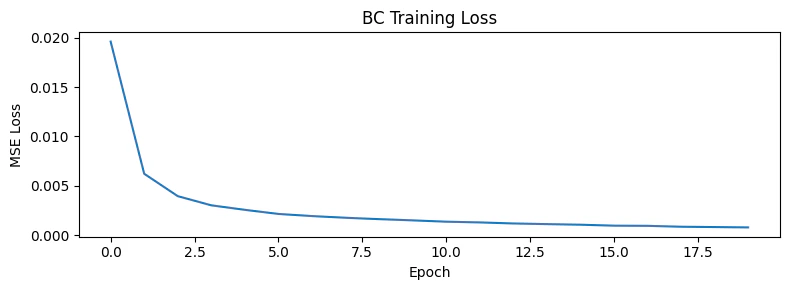
BC is supervised learning: a CNN maps observations to actions, trained with MSE loss against the expert's recorded actions.
```python theme={null}
class BCPolicy(nn.Module):
"""CNN policy that maps 96x96 RGB observations to 3 continuous actions."""
def __init__(self):
super().__init__()
# Input: (batch, 96, 96, 3) -> permute to (batch, 3, 96, 96)
self.features = nn.Sequential(
nn.Conv2d(3, 32, 8, stride=4),
nn.ReLU(),
nn.Conv2d(32, 64, 4, stride=2),
nn.ReLU(),
nn.Conv2d(64, 64, 3, stride=1),
nn.ReLU(),
nn.Flatten(),
)
# Calculate flattened size
with torch.no_grad():
dummy = torch.zeros(1, 3, 96, 96)
n_flat = self.features(dummy).shape[1]
self.head = nn.Sequential(
nn.Linear(n_flat, 256),
nn.ReLU(),
nn.Linear(256, 3), # steering, throttle, brake
nn.Tanh(), # actions in [-1, 1]
)
def forward(self, x):
# x: (batch, H, W, C) uint8 -> (batch, C, H, W) float32
if x.dim() == 3:
x = x.unsqueeze(0)
x = x.permute(0, 3, 1, 2).float() / 255.0
return self.head(self.features(x))
bc_policy = BCPolicy().to(device)
print(f"BC policy parameters: {sum(p.numel() for p in bc_policy.parameters()):,}")
```
```output theme={null}
BC policy parameters: 1,125,539
```
```python theme={null}
# Prepare data
obs_tensor = torch.tensor(expert_obs, dtype=torch.uint8)
act_tensor = torch.tensor(expert_actions, dtype=torch.float32)
dataset = TensorDataset(obs_tensor, act_tensor)
dataloader = DataLoader(dataset, batch_size=64, shuffle=True)
# Train
optimizer = optim.Adam(bc_policy.parameters(), lr=3e-4)
loss_fn = nn.MSELoss()
losses = []
for epoch in range(20):
epoch_loss = 0
for obs_batch, act_batch in dataloader:
obs_batch = obs_batch.to(device)
act_batch = act_batch.to(device)
pred_actions = bc_policy(obs_batch)
loss = loss_fn(pred_actions, act_batch)
optimizer.zero_grad()
loss.backward()
optimizer.step()
epoch_loss += loss.item()
avg_loss = epoch_loss / len(dataloader)
losses.append(avg_loss)
if (epoch + 1) % 5 == 0:
print(f"Epoch {epoch+1:2d}/20 loss={avg_loss:.4f}")
plt.figure(figsize=(8, 3))
plt.plot(losses)
plt.xlabel("Epoch")
plt.ylabel("MSE Loss")
plt.title("BC Training Loss")
plt.tight_layout()
plt.show()
```
```output theme={null}
Epoch 5/20 loss=0.0026
```
```output theme={null}
Epoch 10/20 loss=0.0015
```
```output theme={null}
Epoch 15/20 loss=0.0011
```
```output theme={null}
Epoch 20/20 loss=0.0008
```
## Step 4: Train a behavioral cloning policy
BC is supervised learning: a CNN maps observations to actions, trained with MSE loss against the expert's recorded actions.
```python theme={null}
class BCPolicy(nn.Module):
"""CNN policy that maps 96x96 RGB observations to 3 continuous actions."""
def __init__(self):
super().__init__()
# Input: (batch, 96, 96, 3) -> permute to (batch, 3, 96, 96)
self.features = nn.Sequential(
nn.Conv2d(3, 32, 8, stride=4),
nn.ReLU(),
nn.Conv2d(32, 64, 4, stride=2),
nn.ReLU(),
nn.Conv2d(64, 64, 3, stride=1),
nn.ReLU(),
nn.Flatten(),
)
# Calculate flattened size
with torch.no_grad():
dummy = torch.zeros(1, 3, 96, 96)
n_flat = self.features(dummy).shape[1]
self.head = nn.Sequential(
nn.Linear(n_flat, 256),
nn.ReLU(),
nn.Linear(256, 3), # steering, throttle, brake
nn.Tanh(), # actions in [-1, 1]
)
def forward(self, x):
# x: (batch, H, W, C) uint8 -> (batch, C, H, W) float32
if x.dim() == 3:
x = x.unsqueeze(0)
x = x.permute(0, 3, 1, 2).float() / 255.0
return self.head(self.features(x))
bc_policy = BCPolicy().to(device)
print(f"BC policy parameters: {sum(p.numel() for p in bc_policy.parameters()):,}")
```
```output theme={null}
BC policy parameters: 1,125,539
```
```python theme={null}
# Prepare data
obs_tensor = torch.tensor(expert_obs, dtype=torch.uint8)
act_tensor = torch.tensor(expert_actions, dtype=torch.float32)
dataset = TensorDataset(obs_tensor, act_tensor)
dataloader = DataLoader(dataset, batch_size=64, shuffle=True)
# Train
optimizer = optim.Adam(bc_policy.parameters(), lr=3e-4)
loss_fn = nn.MSELoss()
losses = []
for epoch in range(20):
epoch_loss = 0
for obs_batch, act_batch in dataloader:
obs_batch = obs_batch.to(device)
act_batch = act_batch.to(device)
pred_actions = bc_policy(obs_batch)
loss = loss_fn(pred_actions, act_batch)
optimizer.zero_grad()
loss.backward()
optimizer.step()
epoch_loss += loss.item()
avg_loss = epoch_loss / len(dataloader)
losses.append(avg_loss)
if (epoch + 1) % 5 == 0:
print(f"Epoch {epoch+1:2d}/20 loss={avg_loss:.4f}")
plt.figure(figsize=(8, 3))
plt.plot(losses)
plt.xlabel("Epoch")
plt.ylabel("MSE Loss")
plt.title("BC Training Loss")
plt.tight_layout()
plt.show()
```
```output theme={null}
Epoch 5/20 loss=0.0026
```
```output theme={null}
Epoch 10/20 loss=0.0015
```
```output theme={null}
Epoch 15/20 loss=0.0011
```
```output theme={null}
Epoch 20/20 loss=0.0008
```
 ## Step 5: Evaluate and observe distribution shift
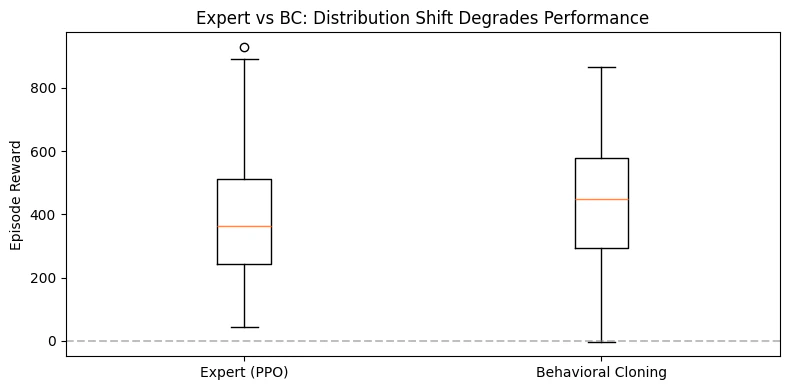
Deploy the BC policy and compare against the expert.
**What you will observe:** the BC policy performs noticeably worse than the expert. On straight sections it may track the road, but on sharp turns it drifts off. Once off-track, it enters states the expert never demonstrated, predictions become unreliable, and the car spirals further off course.
This is **compounding error** from distribution shift: at training time, the policy only saw states along the expert's trajectory. At test time, any small deviation puts the agent in unfamiliar territory.
```python theme={null}
def evaluate_bc(policy, venv, n_episodes=20):
"""Evaluate a PyTorch BC policy in the vectorized env."""
rewards = []
for _ in range(n_episodes):
obs = venv.reset()
total_reward = 0
done = False
while not done:
with torch.no_grad():
obs_t = torch.tensor(obs[0], dtype=torch.uint8).to(device)
action = policy(obs_t).cpu().numpy().flatten()
obs, reward, done, info = venv.step([action])
total_reward += reward[0]
rewards.append(total_reward)
return rewards
def evaluate_sb3(policy, venv, n_episodes=20):
"""Evaluate an SB3 policy."""
rewards = []
for _ in range(n_episodes):
obs = venv.reset()
total_reward = 0
done = False
while not done:
action, _ = policy.predict(obs, deterministic=True)
obs, reward, done, info = venv.step(action)
total_reward += reward[0]
rewards.append(total_reward)
return rewards
expert_rewards = evaluate_sb3(expert, venv, n_episodes=20)
bc_rewards = evaluate_bc(bc_policy, venv, n_episodes=20)
print(f"Expert: {np.mean(expert_rewards):.1f} +/- {np.std(expert_rewards):.1f}")
print(f"BC: {np.mean(bc_rewards):.1f} +/- {np.std(bc_rewards):.1f}")
fig, ax = plt.subplots(figsize=(8, 4))
ax.boxplot([expert_rewards, bc_rewards], labels=["Expert (PPO)", "Behavioral Cloning"])
ax.set_ylabel("Episode Reward")
ax.set_title("Expert vs BC: Distribution Shift Degrades Performance")
ax.axhline(y=0, color="gray", linestyle="--", alpha=0.5)
plt.tight_layout()
plt.show()
```
```output theme={null}
Expert: 416.4 +/- 271.9
BC: 441.7 +/- 239.8
```
```output theme={null}
/tmp/ipykernel_3614068/1622135918.py:38: MatplotlibDeprecationWarning: The 'labels' parameter of boxplot() has been renamed 'tick_labels' since Matplotlib 3.9; support for the old name will be dropped in 3.11.
ax.boxplot([expert_rewards, bc_rewards], labels=["Expert (PPO)", "Behavioral Cloning"])
```
## Step 5: Evaluate and observe distribution shift
Deploy the BC policy and compare against the expert.
**What you will observe:** the BC policy performs noticeably worse than the expert. On straight sections it may track the road, but on sharp turns it drifts off. Once off-track, it enters states the expert never demonstrated, predictions become unreliable, and the car spirals further off course.
This is **compounding error** from distribution shift: at training time, the policy only saw states along the expert's trajectory. At test time, any small deviation puts the agent in unfamiliar territory.
```python theme={null}
def evaluate_bc(policy, venv, n_episodes=20):
"""Evaluate a PyTorch BC policy in the vectorized env."""
rewards = []
for _ in range(n_episodes):
obs = venv.reset()
total_reward = 0
done = False
while not done:
with torch.no_grad():
obs_t = torch.tensor(obs[0], dtype=torch.uint8).to(device)
action = policy(obs_t).cpu().numpy().flatten()
obs, reward, done, info = venv.step([action])
total_reward += reward[0]
rewards.append(total_reward)
return rewards
def evaluate_sb3(policy, venv, n_episodes=20):
"""Evaluate an SB3 policy."""
rewards = []
for _ in range(n_episodes):
obs = venv.reset()
total_reward = 0
done = False
while not done:
action, _ = policy.predict(obs, deterministic=True)
obs, reward, done, info = venv.step(action)
total_reward += reward[0]
rewards.append(total_reward)
return rewards
expert_rewards = evaluate_sb3(expert, venv, n_episodes=20)
bc_rewards = evaluate_bc(bc_policy, venv, n_episodes=20)
print(f"Expert: {np.mean(expert_rewards):.1f} +/- {np.std(expert_rewards):.1f}")
print(f"BC: {np.mean(bc_rewards):.1f} +/- {np.std(bc_rewards):.1f}")
fig, ax = plt.subplots(figsize=(8, 4))
ax.boxplot([expert_rewards, bc_rewards], labels=["Expert (PPO)", "Behavioral Cloning"])
ax.set_ylabel("Episode Reward")
ax.set_title("Expert vs BC: Distribution Shift Degrades Performance")
ax.axhline(y=0, color="gray", linestyle="--", alpha=0.5)
plt.tight_layout()
plt.show()
```
```output theme={null}
Expert: 416.4 +/- 271.9
BC: 441.7 +/- 239.8
```
```output theme={null}
/tmp/ipykernel_3614068/1622135918.py:38: MatplotlibDeprecationWarning: The 'labels' parameter of boxplot() has been renamed 'tick_labels' since Matplotlib 3.9; support for the old name will be dropped in 3.11.
ax.boxplot([expert_rewards, bc_rewards], labels=["Expert (PPO)", "Behavioral Cloning"])
```
 ## Step 6: Fix it with DAgger
[DAgger](https://arxiv.org/abs/1011.0686) (Dataset Aggregation) addresses distribution shift by iteratively collecting new data from the *learner's* trajectory, labeled by the *expert*.
The algorithm:
1. Train an initial BC policy on expert demonstrations
2. Roll out the **learner's** policy in the environment
3. Ask the **expert** to label the states the learner visited (what would you have done here?)
4. Add this new data to the training set
5. Retrain and repeat
```python theme={null}
def dagger_round(bc_policy, expert, venv, n_episodes=10):
"""Run one round of DAgger: roll out the learner, label with expert."""
new_obs, new_actions = [], []
for _ in range(n_episodes):
obs = venv.reset()
done = False
while not done:
# Learner drives
with torch.no_grad():
obs_t = torch.tensor(obs[0], dtype=torch.uint8).to(device)
learner_action = bc_policy(obs_t).cpu().numpy().flatten()
# Expert labels what IT would have done in this state
expert_action, _ = expert.predict(obs, deterministic=True)
new_obs.append(obs[0].copy())
new_actions.append(expert_action[0].copy())
# Learner's action determines next state
obs, reward, done, info = venv.step([learner_action])
return np.array(new_obs), np.array(new_actions)
def train_bc_on_data(bc_policy, all_obs, all_actions, n_epochs=5, lr=1e-4):
"""Retrain BC policy on accumulated data."""
dataset = TensorDataset(
torch.tensor(all_obs, dtype=torch.uint8),
torch.tensor(all_actions, dtype=torch.float32),
)
loader = DataLoader(dataset, batch_size=64, shuffle=True)
optimizer = optim.Adam(bc_policy.parameters(), lr=lr)
loss_fn = nn.MSELoss()
for epoch in range(n_epochs):
for obs_batch, act_batch in loader:
pred = bc_policy(obs_batch.to(device))
loss = loss_fn(pred, act_batch.to(device))
optimizer.zero_grad()
loss.backward()
optimizer.step()
# Start DAgger with the original expert data
all_obs = expert_obs.copy()
all_actions = expert_actions.copy()
# Reset BC policy for fair comparison
dagger_policy = BCPolicy().to(device)
# Initial BC training
train_bc_on_data(dagger_policy, all_obs, all_actions, n_epochs=20, lr=3e-4)
dagger_progress = []
N_ROUNDS = 5
for r in range(N_ROUNDS):
# Collect new data from learner's trajectory, labeled by expert
new_obs, new_actions = dagger_round(dagger_policy, expert, venv, n_episodes=10)
# Aggregate
all_obs = np.concatenate([all_obs, new_obs])
all_actions = np.concatenate([all_actions, new_actions])
# Retrain on full dataset
train_bc_on_data(dagger_policy, all_obs, all_actions, n_epochs=5, lr=1e-4)
# Evaluate
rewards = evaluate_bc(dagger_policy, venv, n_episodes=10)
mean_r = np.mean(rewards)
dagger_progress.append(mean_r)
print(f"DAgger round {r+1}/{N_ROUNDS} data={len(all_obs):,} reward={mean_r:.1f}")
print(f"\nFinal dataset size: {len(all_obs):,} transitions")
```
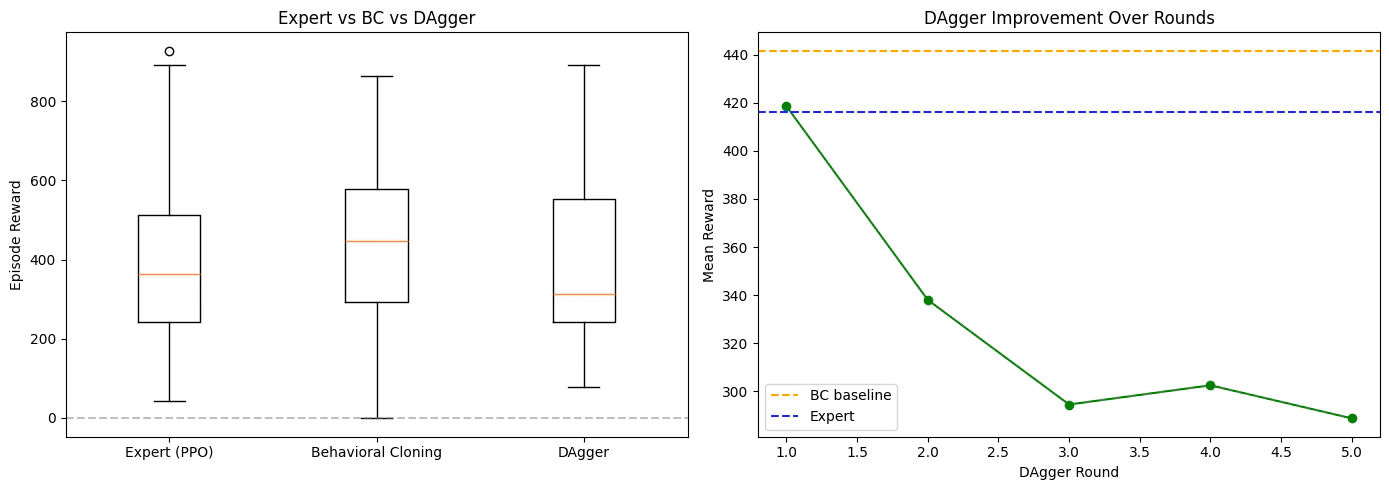
```output theme={null}
DAgger round 1/5 data=45,869 reward=418.6
```
```output theme={null}
DAgger round 2/5 data=54,312 reward=338.0
```
```output theme={null}
DAgger round 3/5 data=62,887 reward=294.5
```
```output theme={null}
DAgger round 4/5 data=71,650 reward=302.5
```
```output theme={null}
DAgger round 5/5 data=80,023 reward=288.8
Final dataset size: 80,023 transitions
```
### Compare all three policies
```python theme={null}
dagger_rewards = evaluate_bc(dagger_policy, venv, n_episodes=20)
print(f"Expert: {np.mean(expert_rewards):.1f} +/- {np.std(expert_rewards):.1f}")
print(f"BC: {np.mean(bc_rewards):.1f} +/- {np.std(bc_rewards):.1f}")
print(f"DAgger: {np.mean(dagger_rewards):.1f} +/- {np.std(dagger_rewards):.1f}")
fig, (ax1, ax2) = plt.subplots(1, 2, figsize=(14, 5))
# Box plot comparison
ax1.boxplot(
[expert_rewards, bc_rewards, dagger_rewards],
labels=["Expert (PPO)", "Behavioral Cloning", "DAgger"],
)
ax1.set_ylabel("Episode Reward")
ax1.set_title("Expert vs BC vs DAgger")
ax1.axhline(y=0, color="gray", linestyle="--", alpha=0.5)
# DAgger learning curve
ax2.plot(range(1, N_ROUNDS + 1), dagger_progress, "o-", color="green")
ax2.axhline(y=np.mean(bc_rewards), color="orange", linestyle="--", label="BC baseline")
ax2.axhline(y=np.mean(expert_rewards), color="blue", linestyle="--", label="Expert")
ax2.set_xlabel("DAgger Round")
ax2.set_ylabel("Mean Reward")
ax2.set_title("DAgger Improvement Over Rounds")
ax2.legend()
plt.tight_layout()
plt.show()
```
```output theme={null}
Expert: 416.4 +/- 271.9
BC: 441.7 +/- 239.8
DAgger: 385.0 +/- 235.1
```
```output theme={null}
/tmp/ipykernel_3614068/1566362.py:10: MatplotlibDeprecationWarning: The 'labels' parameter of boxplot() has been renamed 'tick_labels' since Matplotlib 3.9; support for the old name will be dropped in 3.11.
ax1.boxplot(
```
## Step 6: Fix it with DAgger
[DAgger](https://arxiv.org/abs/1011.0686) (Dataset Aggregation) addresses distribution shift by iteratively collecting new data from the *learner's* trajectory, labeled by the *expert*.
The algorithm:
1. Train an initial BC policy on expert demonstrations
2. Roll out the **learner's** policy in the environment
3. Ask the **expert** to label the states the learner visited (what would you have done here?)
4. Add this new data to the training set
5. Retrain and repeat
```python theme={null}
def dagger_round(bc_policy, expert, venv, n_episodes=10):
"""Run one round of DAgger: roll out the learner, label with expert."""
new_obs, new_actions = [], []
for _ in range(n_episodes):
obs = venv.reset()
done = False
while not done:
# Learner drives
with torch.no_grad():
obs_t = torch.tensor(obs[0], dtype=torch.uint8).to(device)
learner_action = bc_policy(obs_t).cpu().numpy().flatten()
# Expert labels what IT would have done in this state
expert_action, _ = expert.predict(obs, deterministic=True)
new_obs.append(obs[0].copy())
new_actions.append(expert_action[0].copy())
# Learner's action determines next state
obs, reward, done, info = venv.step([learner_action])
return np.array(new_obs), np.array(new_actions)
def train_bc_on_data(bc_policy, all_obs, all_actions, n_epochs=5, lr=1e-4):
"""Retrain BC policy on accumulated data."""
dataset = TensorDataset(
torch.tensor(all_obs, dtype=torch.uint8),
torch.tensor(all_actions, dtype=torch.float32),
)
loader = DataLoader(dataset, batch_size=64, shuffle=True)
optimizer = optim.Adam(bc_policy.parameters(), lr=lr)
loss_fn = nn.MSELoss()
for epoch in range(n_epochs):
for obs_batch, act_batch in loader:
pred = bc_policy(obs_batch.to(device))
loss = loss_fn(pred, act_batch.to(device))
optimizer.zero_grad()
loss.backward()
optimizer.step()
# Start DAgger with the original expert data
all_obs = expert_obs.copy()
all_actions = expert_actions.copy()
# Reset BC policy for fair comparison
dagger_policy = BCPolicy().to(device)
# Initial BC training
train_bc_on_data(dagger_policy, all_obs, all_actions, n_epochs=20, lr=3e-4)
dagger_progress = []
N_ROUNDS = 5
for r in range(N_ROUNDS):
# Collect new data from learner's trajectory, labeled by expert
new_obs, new_actions = dagger_round(dagger_policy, expert, venv, n_episodes=10)
# Aggregate
all_obs = np.concatenate([all_obs, new_obs])
all_actions = np.concatenate([all_actions, new_actions])
# Retrain on full dataset
train_bc_on_data(dagger_policy, all_obs, all_actions, n_epochs=5, lr=1e-4)
# Evaluate
rewards = evaluate_bc(dagger_policy, venv, n_episodes=10)
mean_r = np.mean(rewards)
dagger_progress.append(mean_r)
print(f"DAgger round {r+1}/{N_ROUNDS} data={len(all_obs):,} reward={mean_r:.1f}")
print(f"\nFinal dataset size: {len(all_obs):,} transitions")
```
```output theme={null}
DAgger round 1/5 data=45,869 reward=418.6
```
```output theme={null}
DAgger round 2/5 data=54,312 reward=338.0
```
```output theme={null}
DAgger round 3/5 data=62,887 reward=294.5
```
```output theme={null}
DAgger round 4/5 data=71,650 reward=302.5
```
```output theme={null}
DAgger round 5/5 data=80,023 reward=288.8
Final dataset size: 80,023 transitions
```
### Compare all three policies
```python theme={null}
dagger_rewards = evaluate_bc(dagger_policy, venv, n_episodes=20)
print(f"Expert: {np.mean(expert_rewards):.1f} +/- {np.std(expert_rewards):.1f}")
print(f"BC: {np.mean(bc_rewards):.1f} +/- {np.std(bc_rewards):.1f}")
print(f"DAgger: {np.mean(dagger_rewards):.1f} +/- {np.std(dagger_rewards):.1f}")
fig, (ax1, ax2) = plt.subplots(1, 2, figsize=(14, 5))
# Box plot comparison
ax1.boxplot(
[expert_rewards, bc_rewards, dagger_rewards],
labels=["Expert (PPO)", "Behavioral Cloning", "DAgger"],
)
ax1.set_ylabel("Episode Reward")
ax1.set_title("Expert vs BC vs DAgger")
ax1.axhline(y=0, color="gray", linestyle="--", alpha=0.5)
# DAgger learning curve
ax2.plot(range(1, N_ROUNDS + 1), dagger_progress, "o-", color="green")
ax2.axhline(y=np.mean(bc_rewards), color="orange", linestyle="--", label="BC baseline")
ax2.axhline(y=np.mean(expert_rewards), color="blue", linestyle="--", label="Expert")
ax2.set_xlabel("DAgger Round")
ax2.set_ylabel("Mean Reward")
ax2.set_title("DAgger Improvement Over Rounds")
ax2.legend()
plt.tight_layout()
plt.show()
```
```output theme={null}
Expert: 416.4 +/- 271.9
BC: 441.7 +/- 239.8
DAgger: 385.0 +/- 235.1
```
```output theme={null}
/tmp/ipykernel_3614068/1566362.py:10: MatplotlibDeprecationWarning: The 'labels' parameter of boxplot() has been renamed 'tick_labels' since Matplotlib 3.9; support for the old name will be dropped in 3.11.
ax1.boxplot(
```
 ## Summary
| Policy | Training method | Distribution shift? |
| ---------------------- | ---------------------------------------------------------- | --------------------------------------------------------------- |
| **Expert (PPO)** | RL with environment reward | N/A, defines the target distribution |
| **Behavioral Cloning** | Supervised regression on expert data | Yes, compounds errors on unseen states |
| **DAgger** | Iterative BC with learner-visited states labeled by expert | Mitigated, training distribution converges to test distribution |
The distribution shift problem you observed here, and DAgger's fix of relabeling learner-visited states, reappears throughout robot learning. Later in the course, you will revisit these ideas in the context of world models and VLA architectures, where the same fundamental challenge is addressed at larger scale.
## Further reading
* Bagnell (2015). [An Invitation to Imitation](https://www.ri.cmu.edu/pub_files/2015/3/InvitationToImitation_3_1415.pdf), accessible introduction to the theory
* Ross et al. (2011). [A Reduction of Imitation Learning and Structured Prediction to No-Regret Online Learning](https://arxiv.org/abs/1011.0686), the DAgger paper
* Bojarski et al. (2016). [End to End Learning for Self-Driving Cars](https://arxiv.org/abs/1604.07316), NVIDIA's original end-to-end driving work
* The [imitation library documentation](https://imitation.readthedocs.io/en/latest/tutorials/1_train_bc.html) provides complete tutorials for BC, DAgger, GAIL, and AIRL
***
[Edit this page on GitHub](https://github.com/aegean-ai/eaia/edit/main/src/aiml-common/lectures/imitation-learning/behavioral-cloning/index.mdx) or [file an issue](https://github.com/aegean-ai/eaia/issues/new/choose).
## Summary
| Policy | Training method | Distribution shift? |
| ---------------------- | ---------------------------------------------------------- | --------------------------------------------------------------- |
| **Expert (PPO)** | RL with environment reward | N/A, defines the target distribution |
| **Behavioral Cloning** | Supervised regression on expert data | Yes, compounds errors on unseen states |
| **DAgger** | Iterative BC with learner-visited states labeled by expert | Mitigated, training distribution converges to test distribution |
The distribution shift problem you observed here, and DAgger's fix of relabeling learner-visited states, reappears throughout robot learning. Later in the course, you will revisit these ideas in the context of world models and VLA architectures, where the same fundamental challenge is addressed at larger scale.
## Further reading
* Bagnell (2015). [An Invitation to Imitation](https://www.ri.cmu.edu/pub_files/2015/3/InvitationToImitation_3_1415.pdf), accessible introduction to the theory
* Ross et al. (2011). [A Reduction of Imitation Learning and Structured Prediction to No-Regret Online Learning](https://arxiv.org/abs/1011.0686), the DAgger paper
* Bojarski et al. (2016). [End to End Learning for Self-Driving Cars](https://arxiv.org/abs/1604.07316), NVIDIA's original end-to-end driving work
* The [imitation library documentation](https://imitation.readthedocs.io/en/latest/tutorials/1_train_bc.html) provides complete tutorials for BC, DAgger, GAIL, and AIRL
***
[Edit this page on GitHub](https://github.com/aegean-ai/eaia/edit/main/src/aiml-common/lectures/imitation-learning/behavioral-cloning/index.mdx) or [file an issue](https://github.com/aegean-ai/eaia/issues/new/choose).