> ## Documentation Index
> Fetch the complete documentation index at: https://aegean.ai/llms.txt
> Use this file to discover all available pages before exploring further.
# AR4 Robot Arm Kinematics
> Forward and inverse kinematics of the AR4 six-axis arm using Denavit-Hartenberg parameters, with a bridge from joint angles to motor steps.
The chapter so far built the machinery in the abstract: the [configuration space](/aiml-common/lectures/kinematics/configuration-space/index) a robot lives in, the [homogeneous coordinates](/aiml-common/lectures/kinematics/homogeneous-coordinates/index) that let a single $4\times4$ matrix carry both rotation and translation at once, and the [motion representations](/aiml-common/lectures/kinematics/motion-representations/index) that describe orientation. This section spends that machinery on a real six-axis arm, the **AR4**, and works through its **forward kinematics** (where the hand is, given the joint angles) and **inverse kinematics** (which joint angles place the hand at a desired pose).
*Forward and inverse kinematics of the AR4 arm, by Chris Annin (Annin Robotics), whose open-source Denavit-Hartenberg models this section builds on.*
The AR4 is an open-source arm with **six revolute joints**. Its configuration is a single vector $\mathbf{q} = (q_1,\dots,q_6)$ of joint angles, a point in a six-dimensional configuration space bounded by the mechanical joint limits. Everything below is a function of that vector.
```python theme={null}
import numpy as np
pi = np.pi
```
## Denavit-Hartenberg parameters
A serial arm is a chain of links connected by joints. The Denavit-Hartenberg (DH) convention is the standard bookkeeping that attaches a coordinate frame to every link and summarises the geometry between consecutive frames with just four numbers per joint: the joint angle $\theta$, the link offset $d$, the link length $a$, and the link twist $\alpha$. Each row of the table is nothing more than one homogeneous transform, so the whole arm is the product of six of the $4\times4$ matrices from the [homogeneous coordinates](/aiml-common/lectures/kinematics/homogeneous-coordinates/index) section.
There are two DH conventions in common use, and the AR4 ships with both. **Standard (classic) DH** places each frame at the far end of its link; **modified (Craig) DH** places it at the near end. They describe the same physical arm and produce the same hand pose, but the numbers in the table differ, which is a frequent source of confusion when reading someone else's model. The table below is the AR4 in the standard convention. The $\theta$ column is the fixed offset added to each joint variable, so the joint you command is $q_i$ and the angle the transform sees is $q_i + \theta_i$.
```python theme={null}
# AR4 standard-DH table: columns are (theta_offset, alpha, d, a), angles in radians, lengths in mm.
STD_DH = np.array([
[0.0, -pi/2, 169.77, 64.2], # joint 1
[-pi/2, 0.0, 0.0, 305.0], # joint 2
[ pi, pi/2, 0.0, 0.0], # joint 3
[0.0, -pi/2, 222.63, 0.0], # joint 4
[ pi/2, pi/2, 0.0, 0.0], # joint 5
[0.0, 0.0, 41.0, 0.0], # joint 6
])
# Mechanical joint limits (degrees): (min, max) per joint.
JOINT_LIMITS_DEG = np.array([
[-170, 170], [-42, 90], [-89, 52], [-165, 165], [-105, 105], [-155, 155],
])
```
## The DH transform
For the standard convention, the transform from frame $i-1$ to frame $i$ is a rotation about $z$ by $\theta$, a translation along $z$ by $d$, a translation along $x$ by $a$, and a rotation about $x$ by $\alpha$, composed into the single matrix
$$
A_i=
\begin{bmatrix}
\cos\theta & -\sin\theta\cos\alpha & \sin\theta\sin\alpha & a\cos\theta\\
\sin\theta & \cos\theta\cos\alpha & -\cos\theta\sin\alpha & a\sin\theta\\
0 & \sin\alpha & \cos\alpha & d\\
0 & 0 & 0 & 1
\end{bmatrix}.
$$
The top-left $3\times3$ block is the orientation of link $i$ relative to link $i-1$; the last column is its position. This is exactly the homogeneous transform of the earlier section, specialised to the four DH numbers.
```python theme={null}
def dh_standard(theta, d, a, alpha):
ct, st = np.cos(theta), np.sin(theta)
ca, sa = np.cos(alpha), np.sin(alpha)
return np.array([
[ct, -st * ca, st * sa, a * ct],
[st, ct * ca, -ct * sa, a * st],
[0.0, sa, ca, d],
[0.0, 0.0, 0.0, 1.0],
])
def forward_kinematics(q, dh=STD_DH):
'''Pose of the end-effector frame given joint vector q (radians).'''
T = np.eye(4)
for i in range(6):
theta = q[i] + dh[i, 0]
T = T @ dh_standard(theta, dh[i, 2], dh[i, 3], dh[i, 1])
return T
```
## Forward kinematics
Forward kinematics is the product $T^0_6=A_1 A_2 \cdots A_6$. It maps a point $\mathbf{q}$ in the six-dimensional [configuration space](/aiml-common/lectures/kinematics/configuration-space/index) to a single hand pose: a position and an orientation in the world frame. The map is smooth and, for a given arm, exact, so it is the natural ground truth to check an implementation against. At the home configuration $\mathbf{q}=\mathbf 0$ the AR4 hand sits at a known point, which is what the next cell confirms.
```python theme={null}
q_home = np.zeros(6)
T_home = forward_kinematics(q_home)
print("end-effector position (mm):", np.round(T_home[:3, 3], 2))
print("expected from the AR4 model:", [286.83, 0.0, 433.77])
```
```output theme={null}
end-effector position (mm): [286.83 -0. 433.77]
expected from the AR4 model: [286.83, 0.0, 433.77]
```
## End-effector orientation
The hand pose carries an orientation as well as a position. The rotation block of $T^0_6$ can be read out in any of the [motion representations](/aiml-common/lectures/kinematics/motion-representations/index); a $Z\!-\!Y\!-\!X$ Euler triple (yaw, pitch, roll) is convenient because it matches how the arm's controller reports the tool pose.
```python theme={null}
def euler_zyx_deg(R):
'''Yaw (Rz), pitch (Ry), roll (Rx) in degrees from a rotation matrix.'''
pitch = np.arctan2(-R[2, 0], np.hypot(R[0, 0], R[1, 0]))
yaw = np.arctan2(R[1, 0], R[0, 0])
roll = np.arctan2(R[2, 1], R[2, 2])
return np.rad2deg([yaw, pitch, roll])
print("home orientation (Rz, Ry, Rx) deg:", np.round(euler_zyx_deg(T_home[:3, :3]), 2))
```
```output theme={null}
home orientation (Rz, Ry, Rx) deg: [180. 0. 180.]
```
## Seeing the arm
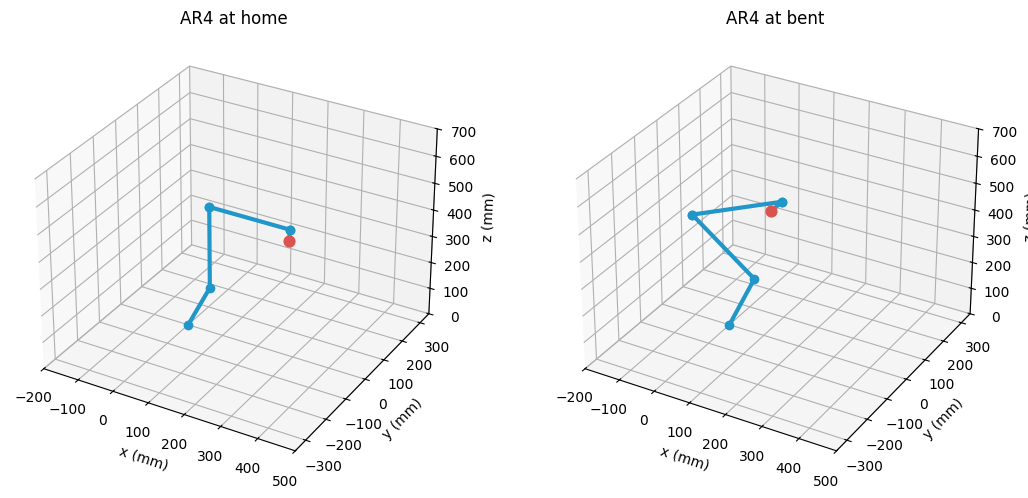
Reading a pose off a matrix is abstract; drawing the arm makes the chain concrete. Taking the running product $A_1, A_1 A_2, \dots$ gives the position of every joint, and connecting them in order traces the physical links from the base to the hand. The figure shows the AR4 at its home pose and at a bent configuration.
```python theme={null}
def joint_positions(q, dh=STD_DH):
'''World positions of the base and each successive joint frame origin.'''
T = np.eye(4)
pts = [T[:3, 3].copy()]
for i in range(6):
theta = q[i] + dh[i, 0]
T = T @ dh_standard(theta, dh[i, 2], dh[i, 3], dh[i, 1])
pts.append(T[:3, 3].copy())
return np.array(pts)
```
## Standard versus modified DH
The same arm, written in the modified (Craig) convention, uses a different table because each frame sits at the near end of its link instead of the far end, and the twist and length of the *previous* link move into each row. The transform is reshaped accordingly. Neither table is more correct; they are two encodings of one geometry, and each reproduces the hand pose its own spreadsheet reports. Recognising which convention a model uses is the practical skill, because mixing the two silently produces a wrong arm.
```python theme={null}
# AR4 modified-DH table: columns (theta_offset, alpha_{i-1}, d, a_{i-1}).
MOD_DH = np.array([
[0.0, 0.0, 169.77, 0.0],
[-pi/2, -pi/2, 0.0, 64.2],
[np.deg2rad(-89), 0.0, 0.0, 305.0],
[0.0, -pi/2, 222.63, 0.0],
[ pi/2, pi/2, 0.0, 0.0],
[ pi, -pi/2, 36.25, 0.0],
])
def dh_modified(theta, d, a, alpha):
ct, st = np.cos(theta), np.sin(theta)
ca, sa = np.cos(alpha), np.sin(alpha)
return np.array([
[ ct, -st, 0.0, a],
[st * ca, ct * ca, -sa, -sa * d],
[st * sa, ct * sa, ca, ca * d],
[0.0, 0.0, 0.0, 1.0],
])
def fk_modified(q, dh=MOD_DH):
T = np.eye(4)
for i in range(6):
theta = q[i] + dh[i, 0]
T = T @ dh_modified(theta, dh[i, 2], dh[i, 3], dh[i, 1])
return T
T_mod = fk_modified(np.zeros(6))
print("modified-DH home position (mm):", np.round(T_mod[:3, 3], 2))
print("expected from the AR4 modified model:", [104.33, 0.0, 696.73])
```
```output theme={null}
modified-DH home position (mm): [104.33 -0. 696.73]
expected from the AR4 modified model: [104.33, 0.0, 696.73]
```
## Inverse kinematics
Forward kinematics is a direct product; inverse kinematics is the harder inverse question, and for a general pose it has no unique answer. The AR4 has a **spherical wrist**, the last three joint axes intersecting at a point, which classically lets the problem decouple: the wrist-centre position fixes the first three joints, and the remaining orientation fixes the last three. Here the same solution is reached by iteration, which needs no special-case algebra and generalises to arms without that structure. Starting from a guess, each step measures the pose error, both the position gap and the orientation gap as a rotation vector, and corrects the joints along the Jacobian of the forward map. The loop converges to joints whose forward kinematics reproduce the target, which is the check applied below.
```python theme={null}
def rotation_vector(R):
'''Axis-times-angle vector of a rotation matrix.'''
angle = np.arccos(np.clip((np.trace(R) - 1) / 2, -1, 1))
if angle < 1e-9:
return np.zeros(3)
axis = np.array([R[2, 1] - R[1, 2], R[0, 2] - R[2, 0], R[1, 0] - R[0, 1]])
return angle / (2 * np.sin(angle)) * axis
def jacobian(q, eps=1e-6):
J = np.zeros((6, 6))
T = forward_kinematics(q)
for i in range(6):
dq = q.copy(); dq[i] += eps
Td = forward_kinematics(dq)
J[:3, i] = (Td[:3, 3] - T[:3, 3]) / eps
J[3:, i] = rotation_vector(Td[:3, :3] @ T[:3, :3].T) / eps
return J
def inverse_kinematics(T_target, q_init, iters=200, damping=1e-6, tol=1e-6):
q = q_init.copy()
for _ in range(iters):
T = forward_kinematics(q)
err = np.concatenate([
T_target[:3, 3] - T[:3, 3],
rotation_vector(T_target[:3, :3] @ T[:3, :3].T),
])
if np.linalg.norm(err) < tol:
break
J = jacobian(q)
q = q + np.linalg.solve(J.T @ J + damping * np.eye(6), J.T @ err)
return q
```
```python theme={null}
# Round-trip test: pick joints, compute the pose, recover the joints from the pose alone.
q_true = np.deg2rad([30, -20, 15, 40, -50, 60])
T_goal = forward_kinematics(q_true)
q_solved = inverse_kinematics(T_goal, np.zeros(6))
pos_error = np.linalg.norm(forward_kinematics(q_solved)[:3, 3] - T_goal[:3, 3])
print("recovered joints (deg):", np.round(np.rad2deg(q_solved), 2))
print("position error (mm): ", round(pos_error, 6))
```
```output theme={null}
recovered joints (deg): [ 30. -20. 15. 40. -50. 60.]
position error (mm): 0.0
```
## From joint angles to motor steps
Kinematics stops at joint angles, but the arm is driven by stepper motors, and the firmware speaks in steps. Each joint has its own reduction, the product of gearbox and pulley ratios, and a fixed number of microsteps per motor revolution, so a commanded angle becomes an integer count of steps. The same joint vector that produced a hand pose becomes the integer step counts the controller sends to the drivers.
```python theme={null}
# AR4-MK steps per degree at each joint (from the motor-step model, default build).
STEPS_PER_DEG = np.array([88.8889, 111.1111, 111.1111, 99.5556, 43.7205, 44.4444])
def joint_steps(q_deg):
'''Integer stepper counts for a joint vector given in degrees.'''
return np.round(q_deg * STEPS_PER_DEG).astype(int)
q_deg = np.array([30, -20, 15, 40, -50, 60])
print("joint angles (deg):", q_deg)
print("motor steps: ", joint_steps(q_deg))
```
```output theme={null}
joint angles (deg): [ 30 -20 15 40 -50 60]
motor steps: [ 2667 -2222 1667 3982 -2186 2667]
```
## From the model to the real robot
Everything here was derived from the arm's Denavit-Hartenberg table: a compact, convention-defined summary of the geometry. The [AR4 kinematics lab](/aiml-common/lectures/kinematics/ar4-kinematics-lab/index) takes the same arm from the other direction, parsing its as-built URDF, and reconciles the two descriptions to see where they agree and where a real millimeter-scale discrepancy hides.
***
[Edit this page on GitHub](https://github.com/aegean-ai/eaia/edit/main/src/aiml-common/lectures/kinematics/ar4-forward-inverse-kinematics/index.mdx) or [file an issue](https://github.com/aegean-ai/eaia/issues/new/choose).

 ## Standard versus modified DH
The same arm, written in the modified (Craig) convention, uses a different table because each frame sits at the near end of its link instead of the far end, and the twist and length of the *previous* link move into each row. The transform is reshaped accordingly. Neither table is more correct; they are two encodings of one geometry, and each reproduces the hand pose its own spreadsheet reports. Recognising which convention a model uses is the practical skill, because mixing the two silently produces a wrong arm.
```python theme={null}
# AR4 modified-DH table: columns (theta_offset, alpha_{i-1}, d, a_{i-1}).
MOD_DH = np.array([
[0.0, 0.0, 169.77, 0.0],
[-pi/2, -pi/2, 0.0, 64.2],
[np.deg2rad(-89), 0.0, 0.0, 305.0],
[0.0, -pi/2, 222.63, 0.0],
[ pi/2, pi/2, 0.0, 0.0],
[ pi, -pi/2, 36.25, 0.0],
])
def dh_modified(theta, d, a, alpha):
ct, st = np.cos(theta), np.sin(theta)
ca, sa = np.cos(alpha), np.sin(alpha)
return np.array([
[ ct, -st, 0.0, a],
[st * ca, ct * ca, -sa, -sa * d],
[st * sa, ct * sa, ca, ca * d],
[0.0, 0.0, 0.0, 1.0],
])
def fk_modified(q, dh=MOD_DH):
T = np.eye(4)
for i in range(6):
theta = q[i] + dh[i, 0]
T = T @ dh_modified(theta, dh[i, 2], dh[i, 3], dh[i, 1])
return T
T_mod = fk_modified(np.zeros(6))
print("modified-DH home position (mm):", np.round(T_mod[:3, 3], 2))
print("expected from the AR4 modified model:", [104.33, 0.0, 696.73])
```
```output theme={null}
modified-DH home position (mm): [104.33 -0. 696.73]
expected from the AR4 modified model: [104.33, 0.0, 696.73]
```
## Inverse kinematics
Forward kinematics is a direct product; inverse kinematics is the harder inverse question, and for a general pose it has no unique answer. The AR4 has a **spherical wrist**, the last three joint axes intersecting at a point, which classically lets the problem decouple: the wrist-centre position fixes the first three joints, and the remaining orientation fixes the last three. Here the same solution is reached by iteration, which needs no special-case algebra and generalises to arms without that structure. Starting from a guess, each step measures the pose error, both the position gap and the orientation gap as a rotation vector, and corrects the joints along the Jacobian of the forward map. The loop converges to joints whose forward kinematics reproduce the target, which is the check applied below.
```python theme={null}
def rotation_vector(R):
'''Axis-times-angle vector of a rotation matrix.'''
angle = np.arccos(np.clip((np.trace(R) - 1) / 2, -1, 1))
if angle < 1e-9:
return np.zeros(3)
axis = np.array([R[2, 1] - R[1, 2], R[0, 2] - R[2, 0], R[1, 0] - R[0, 1]])
return angle / (2 * np.sin(angle)) * axis
def jacobian(q, eps=1e-6):
J = np.zeros((6, 6))
T = forward_kinematics(q)
for i in range(6):
dq = q.copy(); dq[i] += eps
Td = forward_kinematics(dq)
J[:3, i] = (Td[:3, 3] - T[:3, 3]) / eps
J[3:, i] = rotation_vector(Td[:3, :3] @ T[:3, :3].T) / eps
return J
def inverse_kinematics(T_target, q_init, iters=200, damping=1e-6, tol=1e-6):
q = q_init.copy()
for _ in range(iters):
T = forward_kinematics(q)
err = np.concatenate([
T_target[:3, 3] - T[:3, 3],
rotation_vector(T_target[:3, :3] @ T[:3, :3].T),
])
if np.linalg.norm(err) < tol:
break
J = jacobian(q)
q = q + np.linalg.solve(J.T @ J + damping * np.eye(6), J.T @ err)
return q
```
```python theme={null}
# Round-trip test: pick joints, compute the pose, recover the joints from the pose alone.
q_true = np.deg2rad([30, -20, 15, 40, -50, 60])
T_goal = forward_kinematics(q_true)
q_solved = inverse_kinematics(T_goal, np.zeros(6))
pos_error = np.linalg.norm(forward_kinematics(q_solved)[:3, 3] - T_goal[:3, 3])
print("recovered joints (deg):", np.round(np.rad2deg(q_solved), 2))
print("position error (mm): ", round(pos_error, 6))
```
```output theme={null}
recovered joints (deg): [ 30. -20. 15. 40. -50. 60.]
position error (mm): 0.0
```
## From joint angles to motor steps
Kinematics stops at joint angles, but the arm is driven by stepper motors, and the firmware speaks in steps. Each joint has its own reduction, the product of gearbox and pulley ratios, and a fixed number of microsteps per motor revolution, so a commanded angle becomes an integer count of steps. The same joint vector that produced a hand pose becomes the integer step counts the controller sends to the drivers.
```python theme={null}
# AR4-MK steps per degree at each joint (from the motor-step model, default build).
STEPS_PER_DEG = np.array([88.8889, 111.1111, 111.1111, 99.5556, 43.7205, 44.4444])
def joint_steps(q_deg):
'''Integer stepper counts for a joint vector given in degrees.'''
return np.round(q_deg * STEPS_PER_DEG).astype(int)
q_deg = np.array([30, -20, 15, 40, -50, 60])
print("joint angles (deg):", q_deg)
print("motor steps: ", joint_steps(q_deg))
```
```output theme={null}
joint angles (deg): [ 30 -20 15 40 -50 60]
motor steps: [ 2667 -2222 1667 3982 -2186 2667]
```
## From the model to the real robot
Everything here was derived from the arm's Denavit-Hartenberg table: a compact, convention-defined summary of the geometry. The [AR4 kinematics lab](/aiml-common/lectures/kinematics/ar4-kinematics-lab/index) takes the same arm from the other direction, parsing its as-built URDF, and reconciles the two descriptions to see where they agree and where a real millimeter-scale discrepancy hides.
***
## Standard versus modified DH
The same arm, written in the modified (Craig) convention, uses a different table because each frame sits at the near end of its link instead of the far end, and the twist and length of the *previous* link move into each row. The transform is reshaped accordingly. Neither table is more correct; they are two encodings of one geometry, and each reproduces the hand pose its own spreadsheet reports. Recognising which convention a model uses is the practical skill, because mixing the two silently produces a wrong arm.
```python theme={null}
# AR4 modified-DH table: columns (theta_offset, alpha_{i-1}, d, a_{i-1}).
MOD_DH = np.array([
[0.0, 0.0, 169.77, 0.0],
[-pi/2, -pi/2, 0.0, 64.2],
[np.deg2rad(-89), 0.0, 0.0, 305.0],
[0.0, -pi/2, 222.63, 0.0],
[ pi/2, pi/2, 0.0, 0.0],
[ pi, -pi/2, 36.25, 0.0],
])
def dh_modified(theta, d, a, alpha):
ct, st = np.cos(theta), np.sin(theta)
ca, sa = np.cos(alpha), np.sin(alpha)
return np.array([
[ ct, -st, 0.0, a],
[st * ca, ct * ca, -sa, -sa * d],
[st * sa, ct * sa, ca, ca * d],
[0.0, 0.0, 0.0, 1.0],
])
def fk_modified(q, dh=MOD_DH):
T = np.eye(4)
for i in range(6):
theta = q[i] + dh[i, 0]
T = T @ dh_modified(theta, dh[i, 2], dh[i, 3], dh[i, 1])
return T
T_mod = fk_modified(np.zeros(6))
print("modified-DH home position (mm):", np.round(T_mod[:3, 3], 2))
print("expected from the AR4 modified model:", [104.33, 0.0, 696.73])
```
```output theme={null}
modified-DH home position (mm): [104.33 -0. 696.73]
expected from the AR4 modified model: [104.33, 0.0, 696.73]
```
## Inverse kinematics
Forward kinematics is a direct product; inverse kinematics is the harder inverse question, and for a general pose it has no unique answer. The AR4 has a **spherical wrist**, the last three joint axes intersecting at a point, which classically lets the problem decouple: the wrist-centre position fixes the first three joints, and the remaining orientation fixes the last three. Here the same solution is reached by iteration, which needs no special-case algebra and generalises to arms without that structure. Starting from a guess, each step measures the pose error, both the position gap and the orientation gap as a rotation vector, and corrects the joints along the Jacobian of the forward map. The loop converges to joints whose forward kinematics reproduce the target, which is the check applied below.
```python theme={null}
def rotation_vector(R):
'''Axis-times-angle vector of a rotation matrix.'''
angle = np.arccos(np.clip((np.trace(R) - 1) / 2, -1, 1))
if angle < 1e-9:
return np.zeros(3)
axis = np.array([R[2, 1] - R[1, 2], R[0, 2] - R[2, 0], R[1, 0] - R[0, 1]])
return angle / (2 * np.sin(angle)) * axis
def jacobian(q, eps=1e-6):
J = np.zeros((6, 6))
T = forward_kinematics(q)
for i in range(6):
dq = q.copy(); dq[i] += eps
Td = forward_kinematics(dq)
J[:3, i] = (Td[:3, 3] - T[:3, 3]) / eps
J[3:, i] = rotation_vector(Td[:3, :3] @ T[:3, :3].T) / eps
return J
def inverse_kinematics(T_target, q_init, iters=200, damping=1e-6, tol=1e-6):
q = q_init.copy()
for _ in range(iters):
T = forward_kinematics(q)
err = np.concatenate([
T_target[:3, 3] - T[:3, 3],
rotation_vector(T_target[:3, :3] @ T[:3, :3].T),
])
if np.linalg.norm(err) < tol:
break
J = jacobian(q)
q = q + np.linalg.solve(J.T @ J + damping * np.eye(6), J.T @ err)
return q
```
```python theme={null}
# Round-trip test: pick joints, compute the pose, recover the joints from the pose alone.
q_true = np.deg2rad([30, -20, 15, 40, -50, 60])
T_goal = forward_kinematics(q_true)
q_solved = inverse_kinematics(T_goal, np.zeros(6))
pos_error = np.linalg.norm(forward_kinematics(q_solved)[:3, 3] - T_goal[:3, 3])
print("recovered joints (deg):", np.round(np.rad2deg(q_solved), 2))
print("position error (mm): ", round(pos_error, 6))
```
```output theme={null}
recovered joints (deg): [ 30. -20. 15. 40. -50. 60.]
position error (mm): 0.0
```
## From joint angles to motor steps
Kinematics stops at joint angles, but the arm is driven by stepper motors, and the firmware speaks in steps. Each joint has its own reduction, the product of gearbox and pulley ratios, and a fixed number of microsteps per motor revolution, so a commanded angle becomes an integer count of steps. The same joint vector that produced a hand pose becomes the integer step counts the controller sends to the drivers.
```python theme={null}
# AR4-MK steps per degree at each joint (from the motor-step model, default build).
STEPS_PER_DEG = np.array([88.8889, 111.1111, 111.1111, 99.5556, 43.7205, 44.4444])
def joint_steps(q_deg):
'''Integer stepper counts for a joint vector given in degrees.'''
return np.round(q_deg * STEPS_PER_DEG).astype(int)
q_deg = np.array([30, -20, 15, 40, -50, 60])
print("joint angles (deg):", q_deg)
print("motor steps: ", joint_steps(q_deg))
```
```output theme={null}
joint angles (deg): [ 30 -20 15 40 -50 60]
motor steps: [ 2667 -2222 1667 3982 -2186 2667]
```
## From the model to the real robot
Everything here was derived from the arm's Denavit-Hartenberg table: a compact, convention-defined summary of the geometry. The [AR4 kinematics lab](/aiml-common/lectures/kinematics/ar4-kinematics-lab/index) takes the same arm from the other direction, parsing its as-built URDF, and reconciles the two descriptions to see where they agree and where a real millimeter-scale discrepancy hides.
***