> ## Documentation Index
> Fetch the complete documentation index at: https://aegean.ai/llms.txt
> Use this file to discover all available pages before exploring further.
# Lie cheatsheet
> Lie groups and Lie algebras for rigid-body motion, with their elements, dimensions, and meanings.
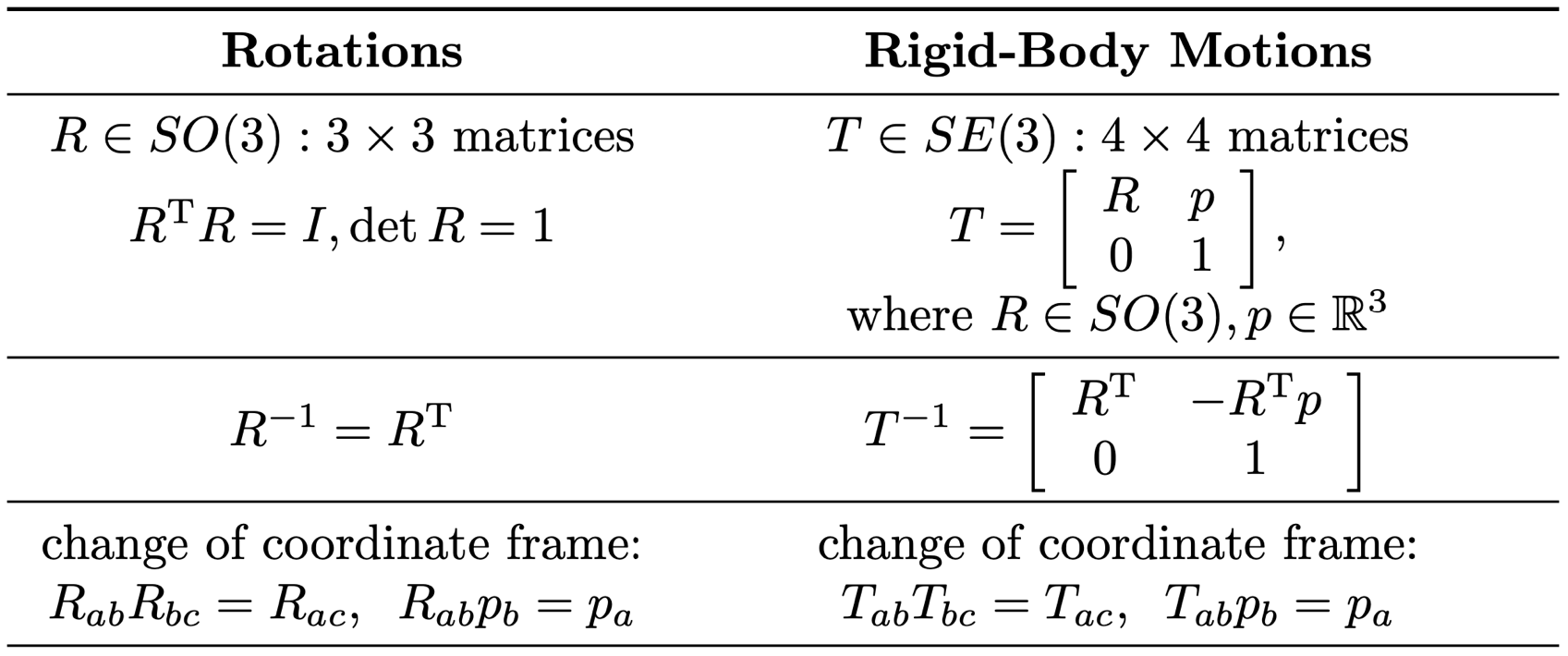
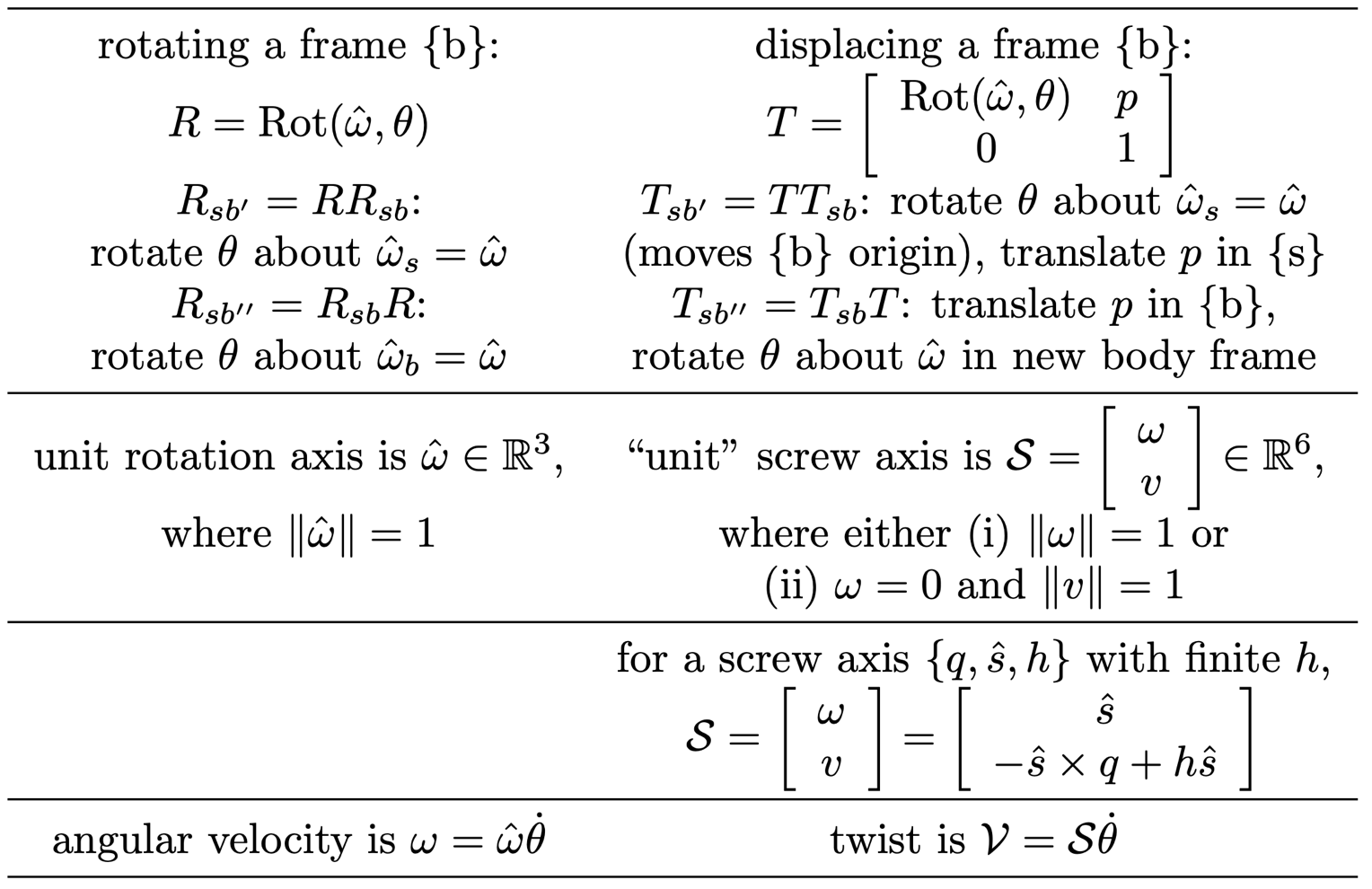
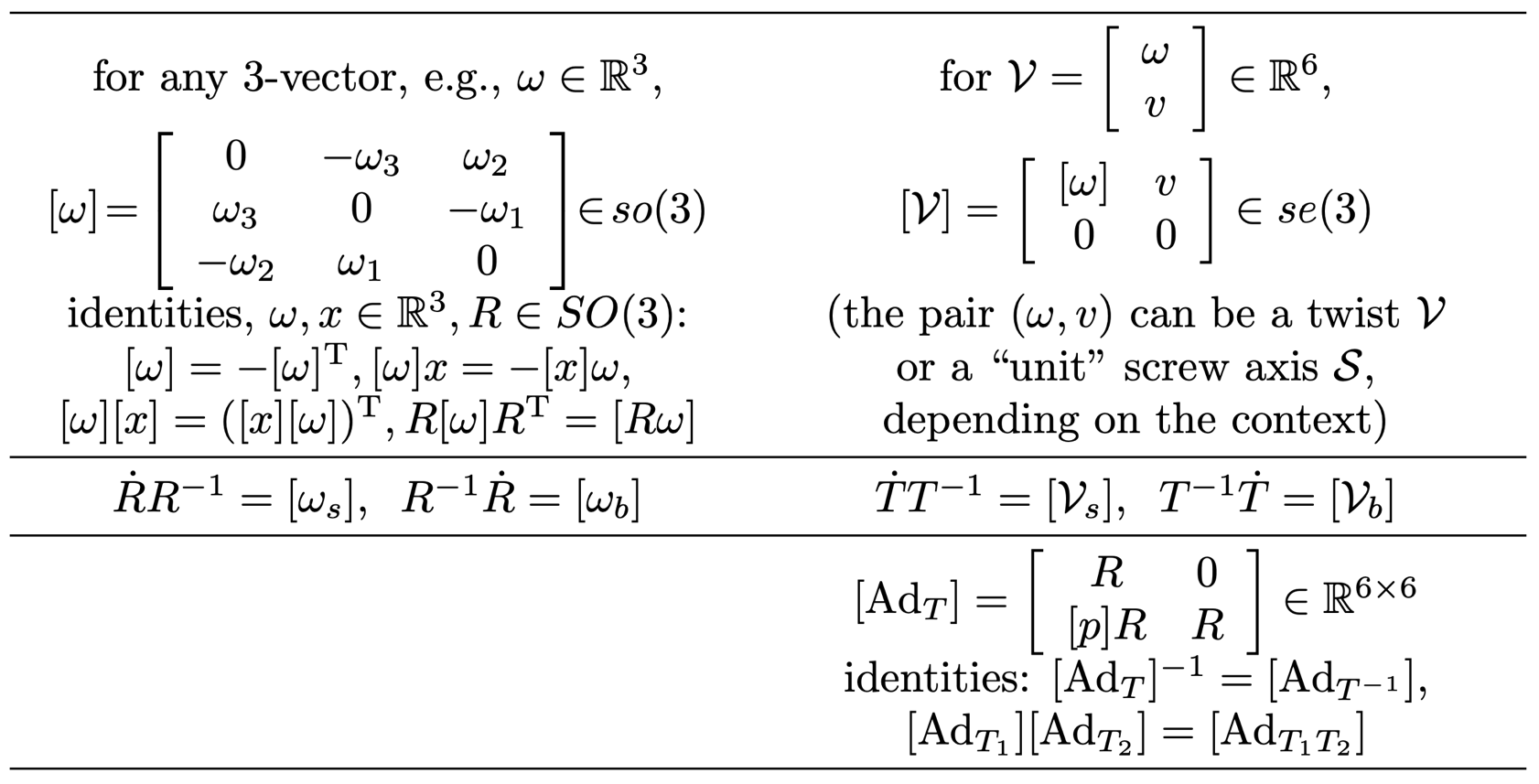
A 4×4 homogeneous transformation matrix represents a rigid-body configuration. A rotation matrix $R \in SO(3)$ represents orientation. A six-dimensional twist describes spatial velocity. A six-dimensional wrench represents spatial force.
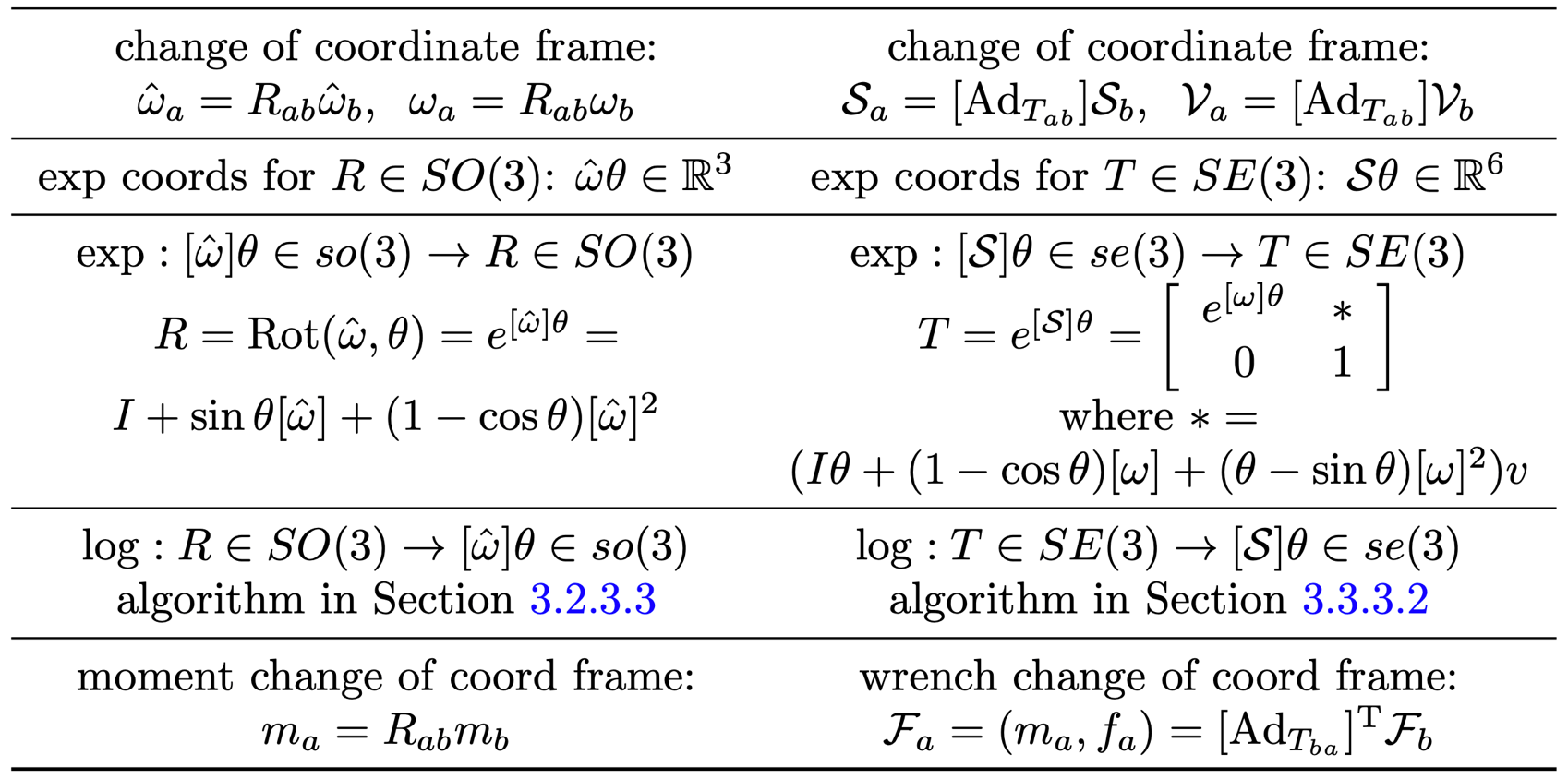
The table uses the rigid-body motion notation of Lynch and Park (Kevin M. Lynch, 2017).
| Space | Elements | Dimension | Represents |
| - | - | - | - |
| $SO(2)$ | $2 \times 2$ matrices $R$ with $R^T R = I$, $\det R = 1$ | 1 | Planar orientation |
| $\mathfrak{so}(2)$ | $2 \times 2$ skew-symmetric matrices $\begin{bmatrix} 0 & -\omega \\ \omega & 0 \end{bmatrix}$ | 1 | Planar angular velocity |
| $SE(2)$ | $3 \times 3$ matrices $\begin{bmatrix} R & \mathbf{p} \\ 0 & 1 \end{bmatrix}$, $R \in SO(2)$, $\mathbf{p} \in \mathbb{R}^2$ | 3 | Planar configuration $(x, y, \theta)$ |
| $\mathfrak{se}(2)$ | $3 \times 3$ matrices $\begin{bmatrix} [\omega] & v \\ 0 & 0 \end{bmatrix}$, $[\omega] \in \mathfrak{so}(2)$, $v \in \mathbb{R}^2$ | 3 | Planar twist |
| $SO(3)$ | $3 \times 3$ matrices $R$ with $R^T R = I$, $\det R = 1$ | 3 | Orientation in 3D |
| $\mathfrak{so}(3)$ | $3 \times 3$ skew-symmetric matrices $[\omega]$ | 3 | Angular velocity, exponential coordinates $[\hat{\omega}]\theta$ |
| $SE(3)$ | $4 \times 4$ matrices $T = \begin{bmatrix} R & \mathbf{p} \\ 0 & 1 \end{bmatrix}$, $R \in SO(3)$, $\mathbf{p} \in \mathbb{R}^3$ | 6 | Configuration (pose) in 3D |
| $\mathfrak{se}(3)$ | $4 \times 4$ matrices $[V] = \begin{bmatrix} [\omega] & v \\ 0 & 0 \end{bmatrix}$, $[\omega] \in \mathfrak{so}(3)$, $v \in \mathbb{R}^3$ | 6 | Twist, screw axis $[\mathcal{S}]\theta$ |
| $\mathbb{R}^3$ | Vectors | 3 | Position $\mathbf{p}$, angular velocity $\omega$, exponential coordinates $\hat{\omega}\theta$ |
| $\mathbb{R}^6$ | Vectors | 6 | Twist $V = (\omega, v)$, wrench $F = (\tau, f)$ |
| $S^3$ | Unit quaternions $q$ with $\lVert q \rVert = 1$ | 3 | Orientation; $q$ and $-q$ give the same rotation |
$SO(n)$ and $SE(n)$ are Lie groups. They are the curved spaces of configurations. Their Lie algebras, $\mathfrak{so}(n)$ and $\mathfrak{se}(n)$, are flat tangent spaces at the identity that contain velocities.
The matrix exponential maps a velocity to a configuration: $\exp: \mathfrak{so}(3) \to SO(3)$ and $\exp: \mathfrak{se}(3) \to SE(3)$. The matrix logarithm maps a configuration to a velocity that produces it in unit time: $\log: SO(3) \to \mathfrak{so}(3)$ and $\log: SE(3) \to \mathfrak{se}(3)$.
The exponential is many-to-one, so a rotation has many logarithms. In the plane, the angles $\theta$ and $\theta + 2\pi$ give the same rotation. Choosing the principal angle in $(-\pi, \pi]$ makes the planar logarithm a function. On that branch, it inverts the exponential.
In three dimensions, restricting the rotation angle to $[0, \pi]$ does not make the logarithm unique. A rotation by exactly $\pi$ has two logarithms because the axes $\hat{\omega}$ and $-\hat{\omega}$ give the same rotation. The logarithm is a single-valued inverse for angles below $\pi$. A rotation by $\pi$ requires a sign convention for the axis.
The $[\cdot]$ operator maps a vector in $\mathbb{R}^3$ or $\mathbb{R}^6$ to its matrix form in $\mathfrak{so}(3)$ or $\mathfrak{se}(3)$.
## Rotations and rigid-body motions side by side
Lynch and Park summarize chapter 3 in four tables (Kevin M. Lynch, 2017). Each row pairs a fact about rotation with its rigid-body counterpart.
 ## References
* Kevin M. Lynch, F. (2017). *Modern Robotics*.
***
Found an error on this page? [Report an issue](https://github.com/aegean-ai/eaia-feedback/issues/new?template=page-issue.yml\&page=/aiml-common/lectures/motion-algebras/lie-cheatsheet).
This documentation is built and hosted on [Mintlify](https://mintlify.com), a developer documentation platform.
## References
* Kevin M. Lynch, F. (2017). *Modern Robotics*.
***
Found an error on this page? [Report an issue](https://github.com/aegean-ai/eaia-feedback/issues/new?template=page-issue.yml\&page=/aiml-common/lectures/motion-algebras/lie-cheatsheet).
This documentation is built and hosted on [Mintlify](https://mintlify.com), a developer documentation platform.