> ## Documentation Index
> Fetch the complete documentation index at: https://aegean.ai/llms.txt
> Use this file to discover all available pages before exploring further.
# Motion representations
> Poses, twists, and screw motions in three dimensions, with the plane as a special case.
[Rotation representations](/aiml-common/lectures/motion-algebras/rotation-representations/index) described a body's orientation, angular velocity, and finite rotation. This section adds position. A pose pairs a rotation with a translation. A twist pairs an angular velocity with a linear velocity. A screw motion is the exponential of a twist. In [Lie I](/aiml-common/lectures/motion-algebras/lie-theory/index), these are the group $SE(3)$, its Lie algebra $\mathfrak{se}(3)$, and the exponential between them. The general case is in three dimensions. Paragraphs marked **In the plane.** give the special case. The presentation follows section 3.3 of Lynch and Park (Kevin M. Lynch, 2017).
## Poses in SE(3)
A homogeneous transformation matrix describes a pose:
$$
T = \begin{bmatrix} R & \mathbf{p} \\ 0 & 1 \end{bmatrix} \in SE(3) .
$$
The matrix encodes both rotation and translation. It acts on [homogeneous coordinates](/aiml-common/lectures/motion-algebras/homogeneous-coordinates/index). A point $(\mathbf{x}, 1)$ is rotated and then translated. A free vector $(\mathbf{v}, 0)$ is only rotated because its zero cancels $\mathbf{p}$. The same matrix therefore handles both kinds of object.
The inverse of a homogeneous transformation matrix is
$$
T^{-1} = \begin{bmatrix} R^T & -R^T \mathbf{p} \\ 0 & 1 \end{bmatrix} ,
$$
and transformations compose by matrix multiplication, $T_{ac} = T_{ab} T_{bc}$. Composing two poses shows the interaction between translation and rotation:
$$
T_1 T_2 =
\begin{bmatrix} R_1 & p_1 \\ 0 & 1 \end{bmatrix}
\begin{bmatrix} R_2 & p_2 \\ 0 & 1 \end{bmatrix}
=
\begin{bmatrix} R_1 R_2 & p_1 + R_1 p_2 \\ 0 & 1 \end{bmatrix} .
$$
The orientations combine by multiplying their rotations. The first rotation acts on the second translation, producing the term $R_1 p_2$. As a manifold, SE(3) looks like $\mathbb{R}^3 \times SO(3)$, a position paired with an orientation. Its group structure also includes the action of rotation on translation. This structure is called a *semidirect product* and is written $SE(3) = \mathbb{R}^3 \rtimes SO(3)$.
**In the plane.** The pose is a $3 \times 3$ matrix, and the configuration is the triple $(\theta, x, y)$:
$$
T = \begin{bmatrix} R(\theta) & \mathbf{p} \\ 0 & 1 \end{bmatrix} = \begin{bmatrix} \cos\theta & -\sin\theta & x \\ \sin\theta & \cos\theta & y \\ 0 & 0 & 1 \end{bmatrix} \in SE(2) .
$$
For a differential-drive robot such as the TurtleBot, $(x, y)$ is the position of the chassis and $\theta$ is its heading. The headings $\theta$ and $\theta + 2\pi$ are identical. The matrix $R(\theta)$ converts coordinates between the robot and world frames. A velocity $v_b = (v, 0)$ along the robot's heading becomes $v_s = R(\theta)\,v_b = (v\cos\theta, v\sin\theta)$ in the world frame. SE(2) is the semidirect product $\mathbb{R}^2 \rtimes SO(2)$.
## Twists
A *twist* combines the angular and linear velocity of a body in one six-dimensional vector:
$$
\mathcal{V} = \begin{bmatrix} \omega \\ v \end{bmatrix} \in \mathbb{R}^6 , \qquad
[\mathcal{V}] = \begin{bmatrix} [\omega] & v \\ 0 & 0 \end{bmatrix} \in \mathfrak{se}(3) .
$$
$\mathfrak{se}(3)$ is the Lie algebra of $SE(3)$. As with [angular velocity](/aiml-common/lectures/motion-algebras/rotation-representations/index#angular-velocity), you can express a twist in two frames. The *body twist* comes from $[\mathcal{V}_b] = T^{-1}\dot{T}$. The *space twist* comes from $[\mathcal{V}_s] = \dot{T} T^{-1}$.
* $v_b = R^\top \dot{\mathbf{p}}$ is the velocity of the body-frame origin, written in the coordinates of $\{b\}$.
* $v_s = \dot{\mathbf{p}} - \omega_s \times \mathbf{p}$ is the velocity of the point of the body currently at the origin of $\{s\}$, written in $\{s\}$. That point may lie outside the physical body. You can imagine extending the body far enough to contain it.
The adjoint converts between the two:
$$
[\mathrm{Ad}_T] = \begin{bmatrix} R & 0 \\ [\mathbf{p}]R & R \end{bmatrix} , \qquad \mathcal{V}_s = [\mathrm{Ad}_T]\,\mathcal{V}_b .
$$
[Calculus on Lie groups](/aiml-common/lectures/motion-algebras/lie-calculus/index#where-the-modern-robotics-formulas-come-from) derives this matrix.
Spatial-velocity conventions differ across systems, so integration may require conversion. [Warp](https://nvidia.github.io/warp/stable/language_reference/builtins.html#spatial-math) orders a spatial vector as (angular, linear). [PhysX](https://nvidia-omniverse.github.io/PhysX/physx/5.6.0/docs/Articulations.html#joint-positions-and-velocities) reports the linear velocity of the center of mass and the angular velocity, both in the world frame. The [Newton twist conventions](https://newton-physics.github.io/newton/stable/concepts/conventions.html#twist-conventions) compare these and other engines side by side.
**In the plane.** A twist has three numbers, $\mathcal{V} = (\omega, v_x, v_y) \in \mathbb{R}^3$, and both matrix forms belong to $\mathfrak{se}(2)$:
$$
T^{-1} \dot T = \begin{bmatrix} [\omega_b] & \mathbf{v}_b \\ 0 & 0 \end{bmatrix}, \qquad
\dot T T^{-1} = \begin{bmatrix} [\omega_s] & \mathbf{v}_s \\ 0 & 0 \end{bmatrix}, \qquad
\omega_b = \omega_s = \dot\theta .
$$
The linear parts are $\mathbf{v}_b = R^\top \dot{\mathbf{p}}$ and $\mathbf{v}_s = \dot{\mathbf{p}} - [\omega]\mathbf{p} = (\dot x + \dot\theta\, y,\ \dot y - \dot\theta\, x)$. The body twist is related to the rate of change of the configuration $q = (\theta, x, y)$ by
$$
\mathcal{V}_b = \begin{bmatrix} \omega_b \\ v_{bx} \\ v_{by} \end{bmatrix} = \begin{bmatrix} 1 & 0 & 0 \\ 0 & \cos\theta & \sin\theta \\ 0 & -\sin\theta & \cos\theta \end{bmatrix} \begin{bmatrix} \dot\theta \\ \dot x \\ \dot y \end{bmatrix} .
$$
## Screw motion
[Exponential coordinates](/aiml-common/lectures/motion-algebras/rotation-representations/index#exponential-coordinates) extend from rotations to poses. Let $\mathcal{S} = (\omega, v) \in \mathbb{R}^6$ be a screw axis. The displacement by $\theta$ along it is
$$
e^{[\mathcal{S}]\theta} = \begin{bmatrix} e^{[\omega]\theta} & G(\theta)v \\ 0 & 1 \end{bmatrix} ,
\qquad
G(\theta) = I\theta + (1 - \cos\theta)[\omega] + (\theta - \sin\theta)[\omega]^2 .
$$
Here $G(\theta)$ is Lynch and Park's notation. It is unrelated to the generator $G$ of Lie I. Given a transformation $T = (R, \mathbf{p})$, the matrix logarithm reverses this map. First, $\log R$ gives $[\omega]\theta$. Then $v = G(\theta)^{-1} \mathbf{p}$. Thus $[\mathcal{S}]\theta = \log T$. Every pose can be reached by one screw motion, a rotation about an axis combined with a translation along it.
**In the plane.** Any planar displacement is a rotation about a fixed point $\mathbf{s}$. The figure shows such a motion.
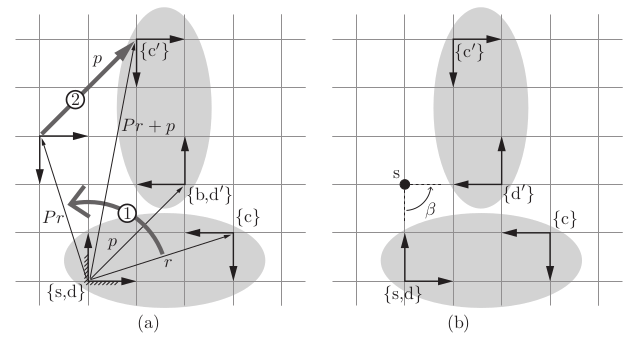 (a) The frame $\{d\}$ is fixed to an elliptical rigid body and initially coincides with $\{s\}$. A rotation by $R$ followed by a translation by $\mathbf{p}$ moves it to $\{d'\}$, which coincides with the stationary frame $\{b\}$. The pair $(R, \mathbf{p})$ represents $\{b\}$ in $\{s\}$. The same transformation takes the frame $\{c\}$, also attached to the rigid body, to $\{c'\}$. Transformation 1 rotates $\{c\}$ about the origin of $\{s\}$. Transformation 2 translates the frame by $\mathbf{p}$, expressed in $\{s\}$.
(b) The rotation and translation can occur simultaneously. The displacement is then a rotation of $\beta = 90^\circ$ about a fixed point $\mathbf{s}$.
*Two motions produce the same displacement. In the first, the body rotates by $R$ about the origin of $\{s\}$ and then translates by $\mathbf{p}$. In the second, it rotates by $\beta = 90^\circ$ about $\mathbf{s} = (0, 2)$. Both motions end at the same pose.*
The three screw coordinates $(\beta, s_x, s_y)$ parametrize the displacement. Here, $(s_x, s_y) = (0, 2)$ gives the coordinates of the point $\mathbf{s}$ in the fixed frame $\{s\}$. This point is the screw axis out of the page.
## From velocity to motion
For rotations, [angular velocity](/aiml-common/lectures/motion-algebras/rotation-representations/index#angular-velocity) and the [exponential](/aiml-common/lectures/motion-algebras/rotation-representations/index#exponential-coordinates) form this sequence:
$$
R(t) \xrightarrow{\;\text{differentiate}\;} \dot R \xrightarrow{\;R^{-1}\;} [\omega] \xrightarrow{\;\exp([\omega]\Delta t)\;} R(t + \Delta t) .
$$
Multiplication by $R^{-1}$ extracts the local motion. The exponential converts that motion into a finite rotation. In [rotation representations](/aiml-common/lectures/motion-algebras/rotation-representations/index#exponential-coordinates), an animation of a tangent plane on a sphere depicts the same wrapping process for the sphere $S^2$. For poses, the corresponding quantities are $T$, the twist $[\mathcal{V}_b]$, and $e^{[\mathcal{V}_b]\Delta t}$. A body with a constant twist moves along a screw.
**In the plane.** Consider the TurtleBot pose from [poses in SE(3)](#poses-in-se-3).
1. **Velocity.** The robot travels forward at speed $v$ and turns at rate $\omega$. Its wheels cannot slide sideways, so its velocity in the body frame is the twist $\mathcal{V}_b = (\omega, v, 0)$. This order follows Lynch and Park: turning rate comes first, forward speed second, and sideways speed last. The sideways component is zero. In matrix form, the twist is
$$
[\mathcal{V}_b] = \begin{bmatrix} 0 & -\omega & v \\ \omega & 0 & 0 \\ 0 & 0 & 0 \end{bmatrix} \in \mathfrak{se}(2) .
$$
This matrix belongs to the Lie algebra. In the notation of [Lie I](/aiml-common/lectures/motion-algebras/lie-theory/index), $[\mathcal{V}_b]$ is $\tau^\wedge$.
2. **Motion.** During a short time interval $\Delta t$, update the pose with
$$
T_{k+1} = T_k \exp\big([\mathcal{V}_b]\,\Delta t\big) .
$$
[Wheeled robots](/aiml-common/lectures/kinematics/wheeled-robots/index) derives $(v, \omega)$ from the wheel speeds and applies this update to odometry. The chassis can point in any direction and reach any position. At each instant, the constraint $v_{by} = 0$ allows it to move only forward, backward, or turn.
The TurtleBot runs ROS 2, which stores the same quantities in a different form.
* **Pose.** A [`geometry_msgs/Pose`](https://github.com/ros2/common_interfaces/blob/rolling/geometry_msgs/msg/Pose.msg) contains a position and an orientation [quaternion](/aiml-common/lectures/motion-algebras/quaternions/index) instead of a matrix $T$. A planar heading $\theta$ becomes the unit quaternion $(x, y, z, w) = (0, 0, \sin\tfrac{\theta}{2}, \cos\tfrac{\theta}{2})$. ROS lists the scalar part $w$ last.
* **Twist.** A [`geometry_msgs/Twist`](https://github.com/ros2/common_interfaces/blob/rolling/geometry_msgs/msg/Twist.msg) lists the linear velocity before the angular velocity, which reverses the Lynch and Park order. A drive command sets `linear.x` to $v$ and `angular.z` to $\omega$ and leaves the other four components at zero.
* **Odometry.** A [`nav_msgs/Odometry`](https://github.com/ros2/common_interfaces/blob/rolling/nav_msgs/msg/Odometry.msg) message gives the pose in a fixed frame and the twist in the robot's frame. Its twist is therefore the body twist $\mathcal{V}_b$.
* **Frames.** [REP 103](https://www.ros.org/reps/rep-0103.html) makes every frame right handed, with $x$ forward, $y$ left, and $z$ up on the robot.
## References
* Kevin M. Lynch, F. (2017). *Modern Robotics*.
***
Found an error on this page? [Report an issue](https://github.com/aegean-ai/eaia-feedback/issues/new?template=page-issue.yml\&page=/aiml-common/lectures/motion-algebras/motion-representations).
This documentation is built and hosted on [Mintlify](https://mintlify.com), a developer documentation platform.
(a) The frame $\{d\}$ is fixed to an elliptical rigid body and initially coincides with $\{s\}$. A rotation by $R$ followed by a translation by $\mathbf{p}$ moves it to $\{d'\}$, which coincides with the stationary frame $\{b\}$. The pair $(R, \mathbf{p})$ represents $\{b\}$ in $\{s\}$. The same transformation takes the frame $\{c\}$, also attached to the rigid body, to $\{c'\}$. Transformation 1 rotates $\{c\}$ about the origin of $\{s\}$. Transformation 2 translates the frame by $\mathbf{p}$, expressed in $\{s\}$.
(b) The rotation and translation can occur simultaneously. The displacement is then a rotation of $\beta = 90^\circ$ about a fixed point $\mathbf{s}$.
*Two motions produce the same displacement. In the first, the body rotates by $R$ about the origin of $\{s\}$ and then translates by $\mathbf{p}$. In the second, it rotates by $\beta = 90^\circ$ about $\mathbf{s} = (0, 2)$. Both motions end at the same pose.*
The three screw coordinates $(\beta, s_x, s_y)$ parametrize the displacement. Here, $(s_x, s_y) = (0, 2)$ gives the coordinates of the point $\mathbf{s}$ in the fixed frame $\{s\}$. This point is the screw axis out of the page.
## From velocity to motion
For rotations, [angular velocity](/aiml-common/lectures/motion-algebras/rotation-representations/index#angular-velocity) and the [exponential](/aiml-common/lectures/motion-algebras/rotation-representations/index#exponential-coordinates) form this sequence:
$$
R(t) \xrightarrow{\;\text{differentiate}\;} \dot R \xrightarrow{\;R^{-1}\;} [\omega] \xrightarrow{\;\exp([\omega]\Delta t)\;} R(t + \Delta t) .
$$
Multiplication by $R^{-1}$ extracts the local motion. The exponential converts that motion into a finite rotation. In [rotation representations](/aiml-common/lectures/motion-algebras/rotation-representations/index#exponential-coordinates), an animation of a tangent plane on a sphere depicts the same wrapping process for the sphere $S^2$. For poses, the corresponding quantities are $T$, the twist $[\mathcal{V}_b]$, and $e^{[\mathcal{V}_b]\Delta t}$. A body with a constant twist moves along a screw.
**In the plane.** Consider the TurtleBot pose from [poses in SE(3)](#poses-in-se-3).
1. **Velocity.** The robot travels forward at speed $v$ and turns at rate $\omega$. Its wheels cannot slide sideways, so its velocity in the body frame is the twist $\mathcal{V}_b = (\omega, v, 0)$. This order follows Lynch and Park: turning rate comes first, forward speed second, and sideways speed last. The sideways component is zero. In matrix form, the twist is
$$
[\mathcal{V}_b] = \begin{bmatrix} 0 & -\omega & v \\ \omega & 0 & 0 \\ 0 & 0 & 0 \end{bmatrix} \in \mathfrak{se}(2) .
$$
This matrix belongs to the Lie algebra. In the notation of [Lie I](/aiml-common/lectures/motion-algebras/lie-theory/index), $[\mathcal{V}_b]$ is $\tau^\wedge$.
2. **Motion.** During a short time interval $\Delta t$, update the pose with
$$
T_{k+1} = T_k \exp\big([\mathcal{V}_b]\,\Delta t\big) .
$$
[Wheeled robots](/aiml-common/lectures/kinematics/wheeled-robots/index) derives $(v, \omega)$ from the wheel speeds and applies this update to odometry. The chassis can point in any direction and reach any position. At each instant, the constraint $v_{by} = 0$ allows it to move only forward, backward, or turn.
The TurtleBot runs ROS 2, which stores the same quantities in a different form.
* **Pose.** A [`geometry_msgs/Pose`](https://github.com/ros2/common_interfaces/blob/rolling/geometry_msgs/msg/Pose.msg) contains a position and an orientation [quaternion](/aiml-common/lectures/motion-algebras/quaternions/index) instead of a matrix $T$. A planar heading $\theta$ becomes the unit quaternion $(x, y, z, w) = (0, 0, \sin\tfrac{\theta}{2}, \cos\tfrac{\theta}{2})$. ROS lists the scalar part $w$ last.
* **Twist.** A [`geometry_msgs/Twist`](https://github.com/ros2/common_interfaces/blob/rolling/geometry_msgs/msg/Twist.msg) lists the linear velocity before the angular velocity, which reverses the Lynch and Park order. A drive command sets `linear.x` to $v$ and `angular.z` to $\omega$ and leaves the other four components at zero.
* **Odometry.** A [`nav_msgs/Odometry`](https://github.com/ros2/common_interfaces/blob/rolling/nav_msgs/msg/Odometry.msg) message gives the pose in a fixed frame and the twist in the robot's frame. Its twist is therefore the body twist $\mathcal{V}_b$.
* **Frames.** [REP 103](https://www.ros.org/reps/rep-0103.html) makes every frame right handed, with $x$ forward, $y$ left, and $z$ up on the robot.
## References
* Kevin M. Lynch, F. (2017). *Modern Robotics*.
***
Found an error on this page? [Report an issue](https://github.com/aegean-ai/eaia-feedback/issues/new?template=page-issue.yml\&page=/aiml-common/lectures/motion-algebras/motion-representations).
This documentation is built and hosted on [Mintlify](https://mintlify.com), a developer documentation platform.