> ## Documentation Index
> Fetch the complete documentation index at: https://aegean.ai/llms.txt
> Use this file to discover all available pages before exploring further.
# Layer Normalization
> Layer Normalization for recurrent networks and transformers where Batch Normalization falls short.
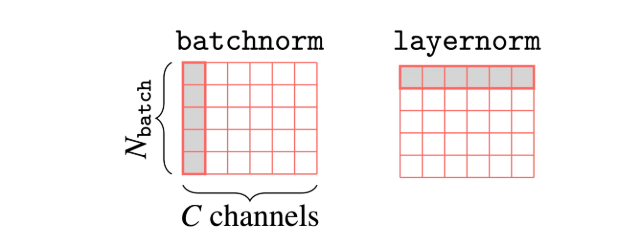 ## Limitations of Batch Normalization
Batch Normalization (BN) helps training efficiency by positioning activations in a trainable way. However, it has limitations with small batch sizes since it operates across the batch dimension and normalizes activations for each feature/channel across the batch.
Smaller batch sizes result in inaccurate statistics. This is particularly problematic in LLMs that require small mini-batches due to memory constraints.
## Layer Normalization
For architectures such as recurrent networks and transformers, we apply **Layer Normalization**. The layer normalization of an input vector $x \in \mathbb{R}^d$ is computed as:
$$
\text{LayerNorm}(x) = \gamma \odot \frac{x - \mu}{\sqrt{\sigma^2 + \epsilon}} + \beta
$$
where the mean $\mu$ and variance $\sigma^2$ are:
$$
\mu = \frac{1}{d} \sum_{i=1}^{d} x_i, \quad \sigma^2 = \frac{1}{d} \sum_{i=1}^{d} (x_i - \mu)^2
$$
Here:
* $\gamma$ and $\beta$ are learnable parameters (of shape $d$)
* $\epsilon$ is a small constant for numerical stability
* $\odot$ denotes element-wise multiplication
## Key Difference from Batch Normalization
Layer Normalization operates **across the feature dimensions** for each sample independently, normalizing the activations in a trainable way. This is effectively the transpose of Batch Normalization:
| Aspect | Batch Normalization | Layer Normalization |
| --------------------- | ------------------- | --------------------------------- |
| Normalizes across | Batch dimension | Feature dimension |
| Depends on | Batch size | Independent of batch |
| Best for | CNNs, large batches | RNNs, Transformers, small batches |
| Training vs Inference | Different behavior | Same behavior |
## When to Use Layer Normalization
* **Recurrent Neural Networks (RNNs)**: Variable sequence lengths make BN difficult
* **Transformers**: Self-attention mechanisms benefit from LN
* **Small batch training**: When memory constraints limit batch size
* **Online learning**: Single-sample updates
## References
* [Ba et al., 2016 - Layer Normalization](https://arxiv.org/abs/1607.06450)
## PyTorch reference
| PyTorch class | Description |
| -------------------------------------------------------------------------------------- | -------------------------------------------------------- |
| [`nn.LayerNorm`](https://docs.pytorch.org/docs/2.12/generated/torch.nn.LayerNorm.html) | Applies Layer Normalization over a mini-batch of inputs. |
***
[Edit this page on GitHub](https://github.com/aegean-ai/eaia/edit/main/src/aiml-common/lectures/optimization/layer-normalization/index.mdx) or [file an issue](https://github.com/aegean-ai/eaia/issues/new/choose).
## Limitations of Batch Normalization
Batch Normalization (BN) helps training efficiency by positioning activations in a trainable way. However, it has limitations with small batch sizes since it operates across the batch dimension and normalizes activations for each feature/channel across the batch.
Smaller batch sizes result in inaccurate statistics. This is particularly problematic in LLMs that require small mini-batches due to memory constraints.
## Layer Normalization
For architectures such as recurrent networks and transformers, we apply **Layer Normalization**. The layer normalization of an input vector $x \in \mathbb{R}^d$ is computed as:
$$
\text{LayerNorm}(x) = \gamma \odot \frac{x - \mu}{\sqrt{\sigma^2 + \epsilon}} + \beta
$$
where the mean $\mu$ and variance $\sigma^2$ are:
$$
\mu = \frac{1}{d} \sum_{i=1}^{d} x_i, \quad \sigma^2 = \frac{1}{d} \sum_{i=1}^{d} (x_i - \mu)^2
$$
Here:
* $\gamma$ and $\beta$ are learnable parameters (of shape $d$)
* $\epsilon$ is a small constant for numerical stability
* $\odot$ denotes element-wise multiplication
## Key Difference from Batch Normalization
Layer Normalization operates **across the feature dimensions** for each sample independently, normalizing the activations in a trainable way. This is effectively the transpose of Batch Normalization:
| Aspect | Batch Normalization | Layer Normalization |
| --------------------- | ------------------- | --------------------------------- |
| Normalizes across | Batch dimension | Feature dimension |
| Depends on | Batch size | Independent of batch |
| Best for | CNNs, large batches | RNNs, Transformers, small batches |
| Training vs Inference | Different behavior | Same behavior |
## When to Use Layer Normalization
* **Recurrent Neural Networks (RNNs)**: Variable sequence lengths make BN difficult
* **Transformers**: Self-attention mechanisms benefit from LN
* **Small batch training**: When memory constraints limit batch size
* **Online learning**: Single-sample updates
## References
* [Ba et al., 2016 - Layer Normalization](https://arxiv.org/abs/1607.06450)
## PyTorch reference
| PyTorch class | Description |
| -------------------------------------------------------------------------------------- | -------------------------------------------------------- |
| [`nn.LayerNorm`](https://docs.pytorch.org/docs/2.12/generated/torch.nn.LayerNorm.html) | Applies Layer Normalization over a mini-batch of inputs. |
***
[Edit this page on GitHub](https://github.com/aegean-ai/eaia/edit/main/src/aiml-common/lectures/optimization/layer-normalization/index.mdx) or [file an issue](https://github.com/aegean-ai/eaia/issues/new/choose).