> ## Documentation Index
> Fetch the complete documentation index at: https://aegean.ai/llms.txt
> Use this file to discover all available pages before exploring further.
# SARSA
> On-policy TD control with Q-value learning.
SARSA implements a $Q(s,a)$ value-based GPI and naturally follows as an enhancement from the $\epsilon-greedy$ policy improvement step of MC control.
We meet also here the familiar two steps:
1. The first is a technique for learning the Q-function via TD-learning that we have seen in the prediction section.
2. The second is a method for evolving the policy using the learned Q-function.
## SARSA - TD Learning
In the TD prediction section, we have met the TD prediction step for $V(s)$ but for control we need to predict the $Q(s,a)$.
The TD(0), also known as single-step TD, tree for SARSA is shown below:
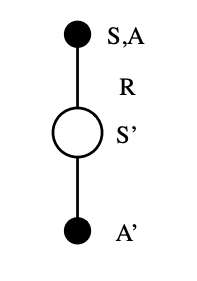 *SARSA action-value backup update tree. Its name is attributed to the fact that we need to know the State-Action-Reward-State-Action before performing an update.*
Following the value estimate of *temporal difference (TD) learning*, we can write the value update equation as:
$Q(S,A) = Q(S,A) + \alpha (R + \gamma Q(S^\prime, A^\prime)-Q(S,A))$
Effectively the equation above updates the Q function by $\alpha$ times the direction of the TD error. What SARSA does is basically the policy iteration diagram we have seen in the control above but with a twist. Instead of trying to evaluate the policy using episodes as in MC, SARSA does policy improvement on an estimate obtained **over each time step** significantly increasing the iteration rate - this is figuratively shown below:
*SARSA action-value backup update tree. Its name is attributed to the fact that we need to know the State-Action-Reward-State-Action before performing an update.*
Following the value estimate of *temporal difference (TD) learning*, we can write the value update equation as:
$Q(S,A) = Q(S,A) + \alpha (R + \gamma Q(S^\prime, A^\prime)-Q(S,A))$
Effectively the equation above updates the Q function by $\alpha$ times the direction of the TD error. What SARSA does is basically the policy iteration diagram we have seen in the control above but with a twist. Instead of trying to evaluate the policy using episodes as in MC, SARSA does policy improvement on an estimate obtained **over each time step** significantly increasing the iteration rate - this is figuratively shown below:
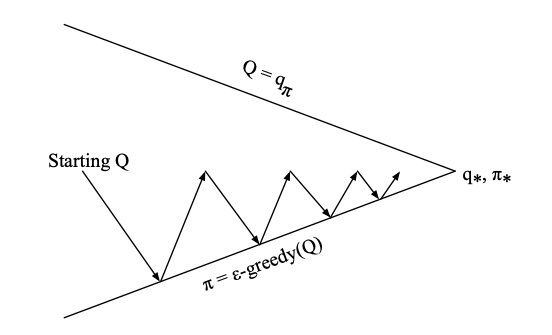 *SARSA on-policy control*
The idea is to increase the frequency of the so called $\epsilon$-greedy policy improvement step where we select with probability $\epsilon$ a random action instead of the action that maximizes the $Q(s,a)$ function (greedy). We do so, in order to "hit" new states and therefore improve on the degree of exploration of our agent and as a result giving opportunities to the agent to reduce its variance *and* its bias.
The SARSA algorithm is summarized below:
*SARSA on-policy control*
The idea is to increase the frequency of the so called $\epsilon$-greedy policy improvement step where we select with probability $\epsilon$ a random action instead of the action that maximizes the $Q(s,a)$ function (greedy). We do so, in order to "hit" new states and therefore improve on the degree of exploration of our agent and as a result giving opportunities to the agent to reduce its variance *and* its bias.
The SARSA algorithm is summarized below:
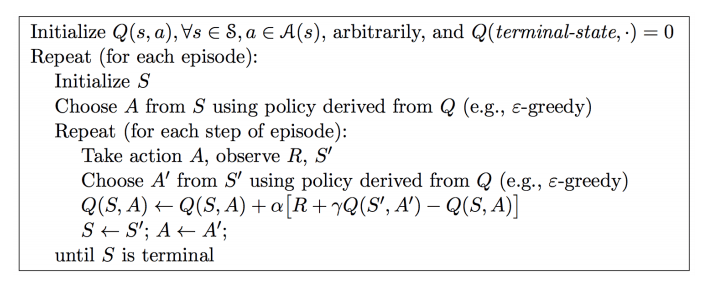 *SARSA algorithm for on-policy control*
**Key references**: (Rafati & Noelle, 2019; Szepesvári et al., 2010; Tu & Recht, 2018; O'Donoghue et al., 2016; Ma & Yu, 2016)
## References
* Ma, S., Yu, J. (2016). *Transition-based versus State-based Reward Functions for MDPs with Value-at-Risk*.
* O'Donoghue, B., Munos, R., Kavukcuoglu, K., Mnih, V. (2016). *Combining policy gradient and Q-learning*.
* Rafati, J., Noelle, D. (2019). *Learning sparse representations in reinforcement learning*.
* Szepesvári, C., Cochran, J., Cox, L., Keskinocak, P., Kharoufeh, J., et al. (2010). *Reinforcement Learning Algorithms for MDPs*. Wiley Encyclopedia of Operations Research and Management Science.
* Tu, S., Recht, B. (2018). *The Gap Between Model-Based and Model-Free Methods on the Linear Quadratic Regulator: An Asymptotic Viewpoint*.
***
[Edit this page on GitHub](https://github.com/aegean-ai/eaia/edit/main/src/aiml-common/lectures/reinforcement-learning/value-based-algorithms/control/sarsa/index.mdx) or [file an issue](https://github.com/aegean-ai/eaia/issues/new/choose).
*SARSA algorithm for on-policy control*
**Key references**: (Rafati & Noelle, 2019; Szepesvári et al., 2010; Tu & Recht, 2018; O'Donoghue et al., 2016; Ma & Yu, 2016)
## References
* Ma, S., Yu, J. (2016). *Transition-based versus State-based Reward Functions for MDPs with Value-at-Risk*.
* O'Donoghue, B., Munos, R., Kavukcuoglu, K., Mnih, V. (2016). *Combining policy gradient and Q-learning*.
* Rafati, J., Noelle, D. (2019). *Learning sparse representations in reinforcement learning*.
* Szepesvári, C., Cochran, J., Cox, L., Keskinocak, P., Kharoufeh, J., et al. (2010). *Reinforcement Learning Algorithms for MDPs*. Wiley Encyclopedia of Operations Research and Management Science.
* Tu, S., Recht, B. (2018). *The Gap Between Model-Based and Model-Free Methods on the Linear Quadratic Regulator: An Asymptotic Viewpoint*.
***
[Edit this page on GitHub](https://github.com/aegean-ai/eaia/edit/main/src/aiml-common/lectures/reinforcement-learning/value-based-algorithms/control/sarsa/index.mdx) or [file an issue](https://github.com/aegean-ai/eaia/issues/new/choose).