> ## Documentation Index
> Fetch the complete documentation index at: https://aegean.ai/llms.txt
> Use this file to discover all available pages before exploring further.
# The Seminal World Model
> Ha & Schmidhuber's original World Models architecture, a VAE for vision, an MDN-RNN for memory, and a tiny linear controller trained inside the dream.
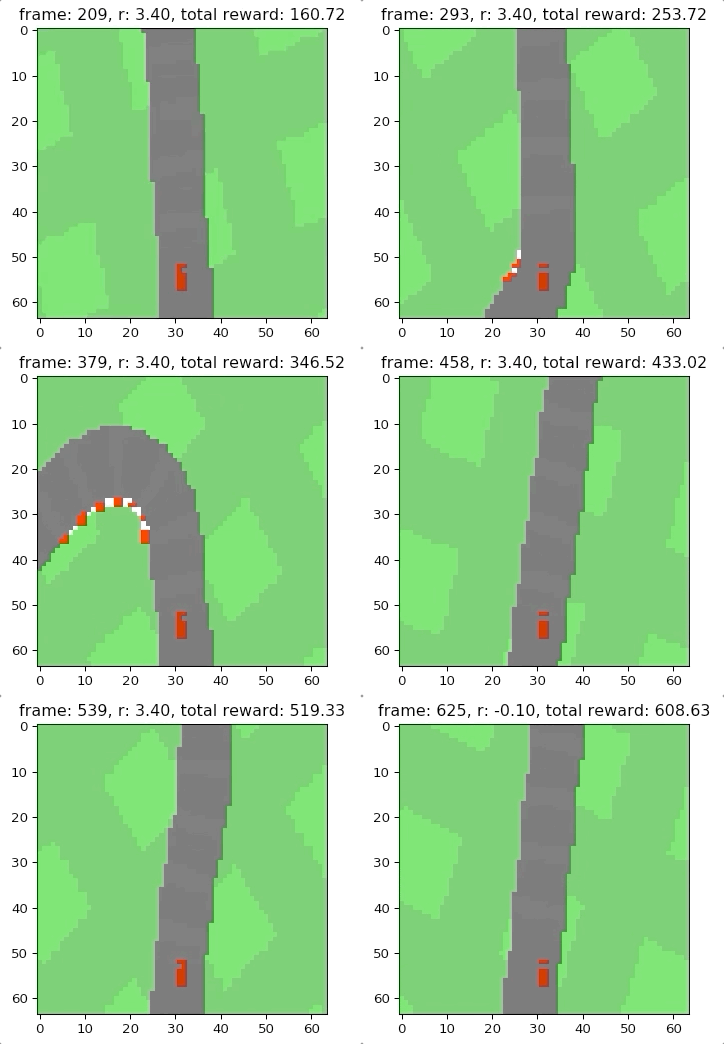
The original [World Models](https://worldmodels.github.io/) paper by Ha & Schmidhuber (2018) is the seminal demonstration that an agent can learn to act inside its own learned simulator of the environment. It is the conceptual reference point for almost every modern world-model architecture, and the cleanest place to build intuition.
 ## The core architecture
The agent is decomposed into three components:
```mermaid theme={null}
graph TB
O[Observation] -->|"x: 64×64×3 pixels"| V[V, Vision
## The core architecture
The agent is decomposed into three components:
```mermaid theme={null}
graph TB
O[Observation] -->|"x: 64×64×3 pixels"| V[V, Vision
VAE]
V -->|"z: 32-d latent"| M[M, Memory
MDN-RNN]
M -->|"z + h: latent + hidden state"| C[Controller]
C -->|"a: 3-d action"| A[Action]
```
**V, Vision model (VAE).** A variational autoencoder compresses each high-dimensional observation (e.g., a 64x64 RGB frame from CarRacing) into a compact latent vector **z**. This is the agent's "visual perception", it reduces a 12,288-dimensional pixel input to \~32 latent dimensions while preserving the information needed for control.
**M, Memory model (MDN-RNN).** A recurrent neural network with a mixture density output predicts the *next* latent state given the current latent state and action. This is the world model proper, it captures the environment's dynamics in latent space. The mixture density network (MDN) output models uncertainty: the future is not deterministic, so the model predicts a distribution over possible next states.
**C, Controller.** A small linear controller maps the current latent state **z** and the RNN hidden state **h** to an action. Because V and M have already compressed the observation and learned the dynamics, the controller can be very simple, often just a single linear layer optimized with evolutionary strategies (CMA-ES).
## Why this decomposition works
The architecture's value comes from **separation of concerns**:
* **V** handles dimensionality reduction, the controller never sees raw pixels
* **M** handles temporal prediction, the controller doesn't need to learn dynamics
* **C** handles action selection, it operates in a low-dimensional, temporally structured space
This means the controller can be trained *inside the world model* without any environment interaction. Generate dream trajectories by rolling out M from a starting state, and optimize C against those dream trajectories. The agent learns to drive by dreaming about driving.
## The CarRacing experiment
The original paper demonstrates the approach on [CarRacing](https://gymnasium.farama.org/environments/box2d/car_racing/), the same environment used in the [behavioral cloning tutorial](/aiml-common/lectures/imitation-learning/behavioral-cloning/index), so you can run all three approaches (BC, PPO, world model) on the same task and compare them directly.
The training pipeline:
1. **Collect data.** Run a random or partially trained policy in CarRacing to collect 10,000 frames of (observation, action, next\_observation) tuples.
2. **Train V.** Train the VAE on the collected frames to learn the latent representation.
3. **Train M.** Train the MDN-RNN on sequences of (z, action, z\_next) to learn the dynamics model.
4. **Train C.** Using CMA-ES, evolve the controller parameters by evaluating candidate controllers inside M's dream rollouts. No environment interaction needed.
5. **Deploy.** Run V + M + C in the real environment: observe → encode → predict → act.
## Further reading
* Ha & Schmidhuber (2018). [World Models](https://worldmodels.github.io/), the original paper with interactive visualizations
* Ha & Schmidhuber (2018). [Recurrent World Models Facilitate Policy Evolution](https://arxiv.org/abs/1809.01999), the NeurIPS version
* An accessible [implementation](https://github.com/zacwellmer/WorldModels) for reproducing the CarRacing experiment
***
[Edit this page on GitHub](https://github.com/aegean-ai/eaia/edit/main/src/book/world-models/seminal-model/index.mdx) or [file an issue](https://github.com/aegean-ai/eaia/issues/new/choose).