

LLaVA fine-tuning
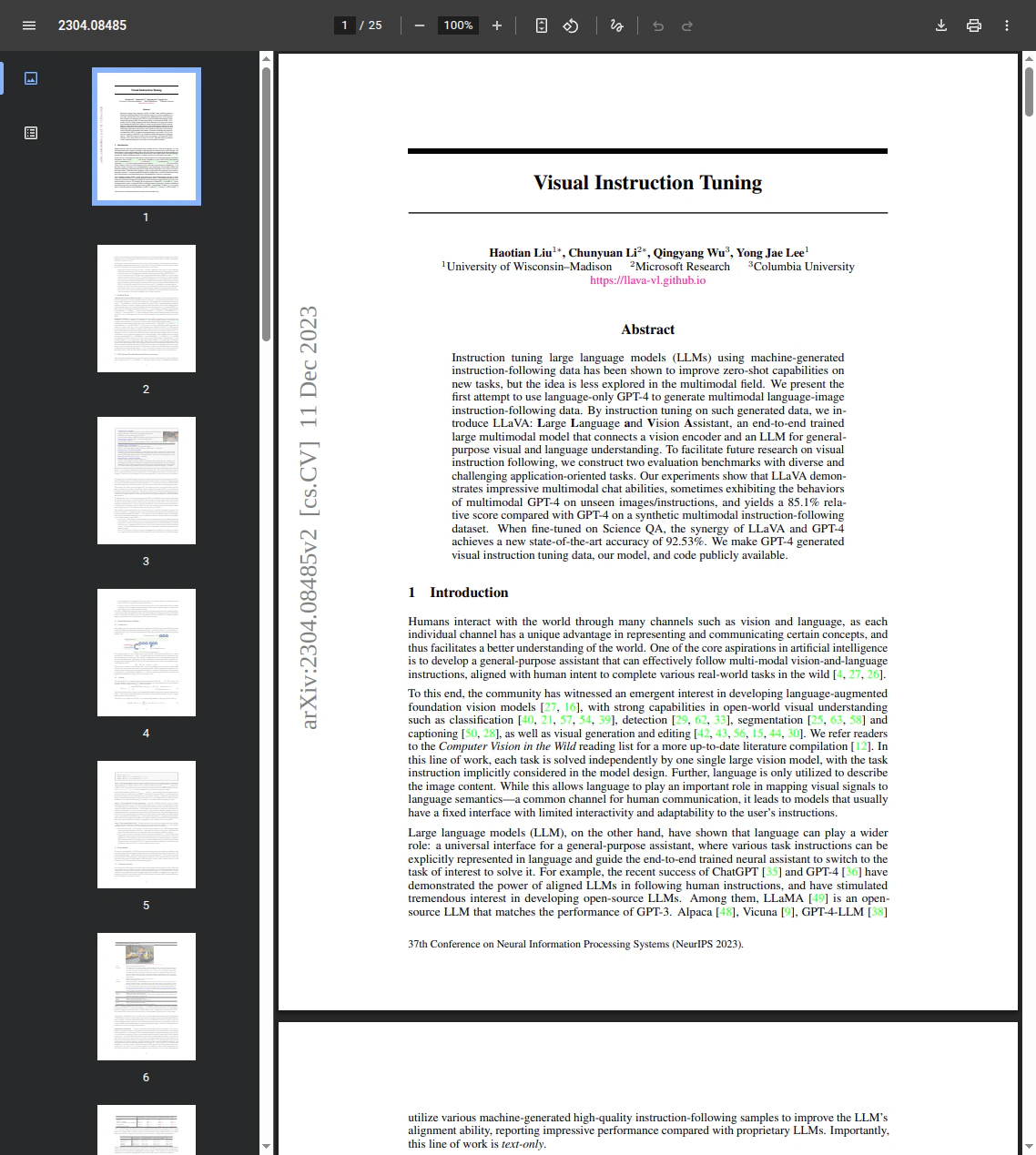
The original LLaVA paper introduced the LLaVA-Instruct-150K dataset to fine-tune the model on visual instruction following. It contains approximately 150K GPT-generated instruction–answer pairs grounded in COCO images, formatted as multi-turn conversations. Each sample pairs a COCO image with a conversation between a human and a GPT assistant:
This dataset can be used directly with the Hugging Face Transformers LLaVA pipeline for supervised fine-tuning.
PyTorch reference
References
- Anderson, P., He, X., Buehler, C., Teney, D., Johnson, M., et al. (2017). Bottom-Up and Top-Down Attention for Image Captioning and Visual Question Answering. arXiv [cs.CV].
- Johnson, J., Hariharan, B., Maaten, L., Fei-Fei, L., Lawrence Zitnick, C., et al. (2016). CLEVR: A Diagnostic Dataset for Compositional Language and Elementary Visual Reasoning. arXiv [cs.CV].
- Lu, J., Xiong, C., Parikh, D., Socher, R. (2016). Knowing When to Look: Adaptive Attention via A Visual Sentinel for Image Captioning. arXiv [cs.CV].
- Vinyals, O., Toshev, A., Bengio, S., Erhan, D. (2016). Show and Tell: Lessons learned from the 2015 MSCOCO Image Captioning Challenge. arXiv [cs.CV].
- Xu, K., Ba, J., Kiros, R., Cho, K., Courville, A., et al. (2015). Show, Attend and Tell: Neural Image Caption Generation with Visual Attention. arXiv [cs.LG].
Found an error on this page? Report an issue.