

3Blue1Brown
You can watch these videos for a more elementary treatment of the topic.Deep Learning Book
The linear algebra chapter of Ian Goodfellow’s Deep Learning book is what you need to know as data scientists.Gilbert Strang
Let me introduce you MIT prof G Strang - probably the best educator in America. He has published this playlist of youtube videos on Linear Algebra.Modern Robotics linear algebra review
Kevin Lynch and Frank Park wrote a linear algebra refresher as Appendix E of Modern Robotics: Mechanics, Planning, and Control. It covers most of the linear algebra the robotics lectures use, with a glossary of terms and examples drawn from feedback control. It is short and written for readers who studied these ideas once and need a review.- Appendix E: linear algebra review (PDF, 28 pages, version of December 20, 2019), a copy kept by this course.
- The original page on the Modern Robotics site, by K. M. Lynch and F. C. Park, Northwestern University.
Recitation Video
Linear Algebra recitation for my classes. Recitation was delivered by my TA Shweta Selvaraj Achary.
Key Points
We can now summarize the points to pay attention to, for ML applications. In the following we assume a data matrix with rows and columns. We also assume that the matrix is such that it has independent rows or columns, called the matrix rank.Projections
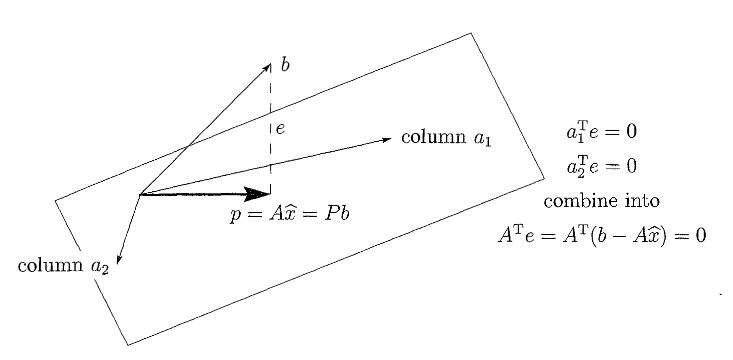
Its important to understand this basic operator and its geometric interpretation as it is met in problems like Ordinary Least Squares but also all over ML and other fields such as compressed sensing. In the following we assume that the reader is familiar with the concept of vector spaces and subspaces. Let be a vector subspace of . For example in , are the lines and planes going through the origin. The projection operator onto implements a linear transformation: . We will stick to to maintain the ability to plot the operations involved. We also define the orthogonal subspace, The transformation projects onto space in the sense that when you apply this operator, every vector in any other space results in the subspace . In our example above, This means that any components of the vector that belonged to are gone when applying the projection operator. Effectively, the original space is decomposed into Now we can treat projections onto specific subspaces such as lines and planes passing through the origin. For a line defined by a direction vector we can define the projection onto the line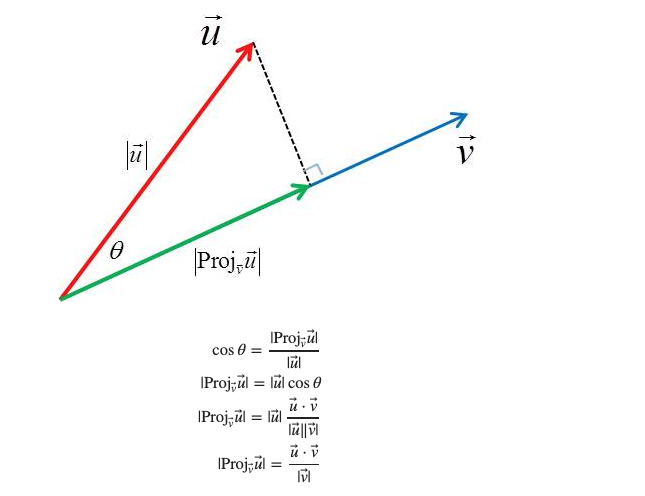
The Four Fundamental Subspaces
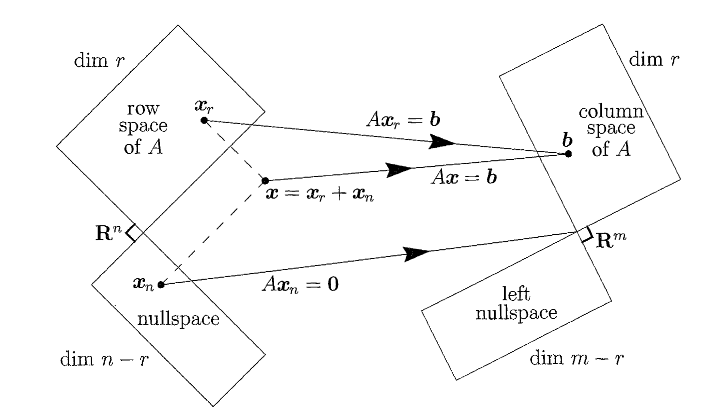
- The column space of , denoted by , with dimension .
- The nullspace of , denoted by , with dimension .
- The row space of which is the column space of , with dimension
- The left nullspace of , which is the nullspace of , denoted by , with dimension .

The determinant
A matrix sends the basis vector to its first column and to its second column. So it sends the unit square, with sides and , to the parallelogram with the two columns as sides. For that parallelogram has signed area , which is . The unit square has area 1, so is the factor by which scales area. The same factor applies to any region, because you can fill a region with small squares. The sign tells you about orientation. Going from to is a counterclockwise turn. If the images of the two vectors keep that order, the determinant is positive. If the matrix reflects the square, the turn becomes clockwise and the determinant is negative. A determinant of zero means the square is flattened onto a line, and the matrix has no inverse. The determinant says nothing about lengths. The matrix stretches one direction by 3 and shrinks the other by 3, so its determinant is 1. Its effect on lengths shows up in its norm or its singular values instead.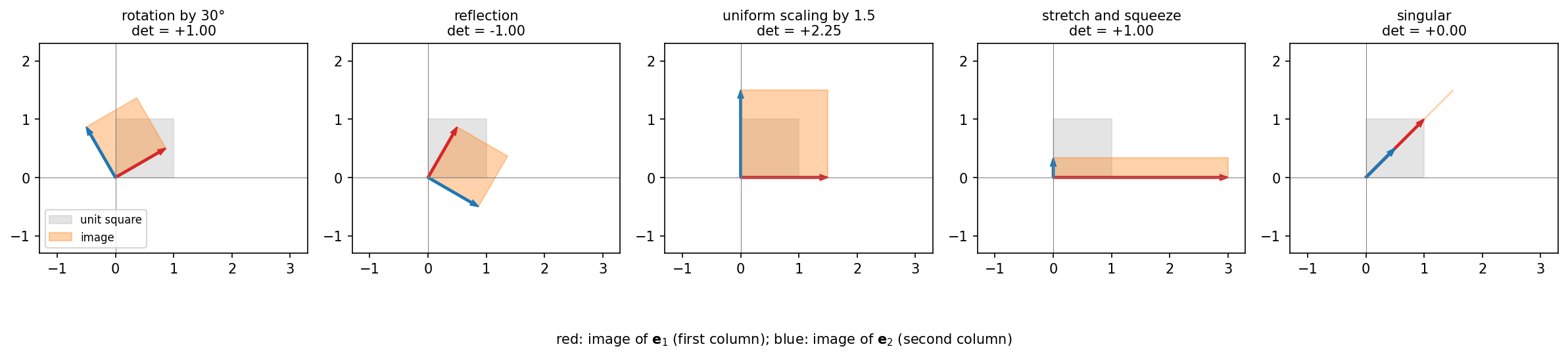
Eigenvalues and Eigenvectors
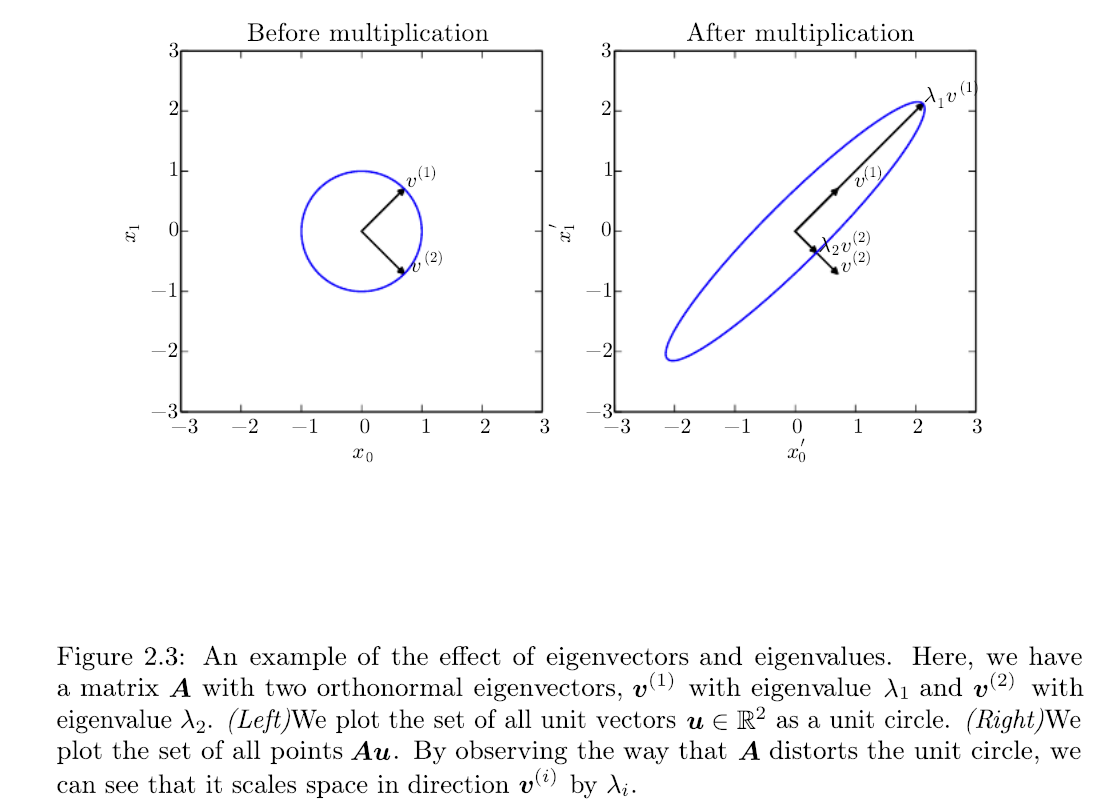
The following video gives an intuitive explanation of eigenvalues and eigenvectors and its included here due to its visualizations that it offers. The video must be viewed in conjunction with Strang’s introduction
A geometric interpretation of the eigenvectors and eigenvalues is given in the following figure:
Found an error on this page? Report an issue.