

 In the recursive state estimation section we have seen the formulation of the Bayes filter and its application in a simple problem of trying to maintain a latent (internal to the agent) belief about the state of the environment given measurements and agent actions . Here we are closing the loop: we started with the perception system giving us poses of objects it detects, effectively localizing the objects at the pixel coordinate system (within the image). Now we need to use the Bayes filter to localize the object globally as well as to be able to track it, since it can also move across space, so that we can recognize it over time as the same unique object and be able to assign a symbol to it.
In order to localize the object globally we need to localize the agent globally and so we will focus here on a situation where the initial pose of the agent is unknown as it is initially placed somewhere in its environment, but it lacks knowledge of where it is. When we have the global pose of the sensor, for example a camera, we can use straightforward techniques for the global localization of objects, such as calibrated stereo reconstruction or triangulation.
Even without global localization we can track an object as it moves within the viewpoint of the agent for the sole purpose to predict its subsequent location within the image and assign a local instance identity to it. For example as an agent moves in the space surrounding the object, its perception subsystem makes a memoryless detection decision but its probabilistic reasoning subsystem should stitch such decisions together to reason as to the object’s identity over time: is it the same object that was seen a frame ago? By knowing the pose of the agents sensors (a camera) we should be able to make such inferences.
Localization with a known map

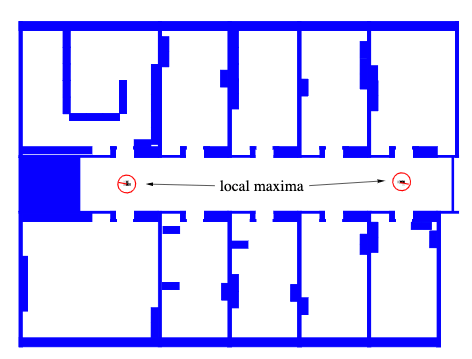
Global localization and tracking
What distinguishes localization from tracking is that for localization, the initial belief is: where is the number of states (poses) that the robot can have. To illustrate the localization problem solution with probabilistic reasoning let’s consider a simple environment with a corridor and three doors.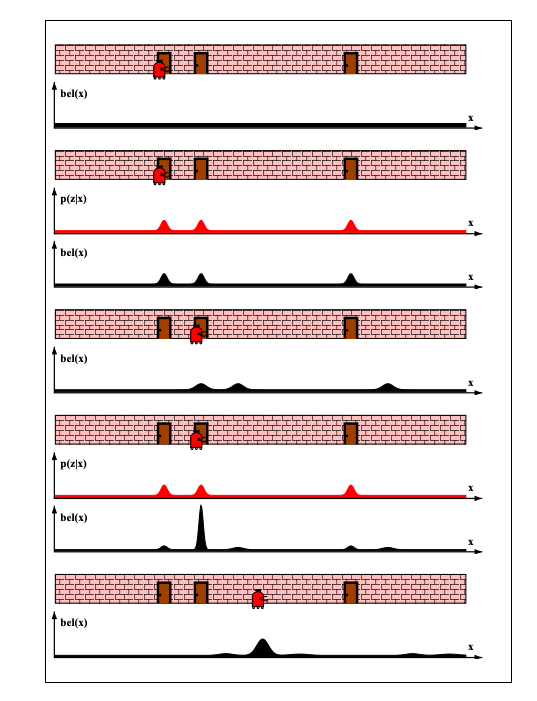
- Our initial belief is obviously uniform over all poses, as illustrated in row 1.
- The agent uses its perception that indicates that it is adjacent to one of the doors, which in effect means that the shape of is as shown in the 2nd row.
- It multiplies its previous belief with this distribution during measurement update producing the new belief as shown in the 2nd row (black pdf). The resulting belief is multi-modal, reflecting the residual uncertainty of the agent at this point.
- As the agent moves to the right, it convolves (the integral in the Bayes filter is a convolution) its belief with the transition (motion) model . It still does not know where it is - all it knows that its belief needs to follow what its odometry sensors told it which is a move to the right by so many meters. The effect is visualized in row 3 that shows a shifted (by the odometric information) and slightly less peaked (movement reduces confidence) belief.
- The final measurement update that multiplies with results into obtaining a belief where most of the probability mass is focused on the correct pose.
- As the agent moves further to the right, the transition (motion) model convolutions reduce the confidence of the agent as the perception system is effectively inactive due to the lack of distinguishing features in its locale.
Found an error on this page? Report an issue.