

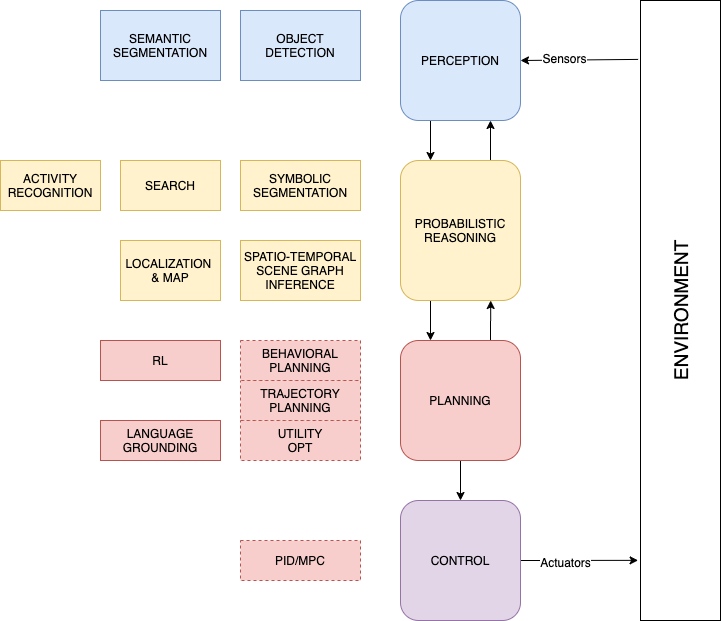
- It introduces a state that gathers many random variables, and considers dynamical systems whose state evolves over time, often with nonlinear dynamics, as is common in robotics.
- It makes the time index explicit, so the evolution of the state can be drawn as a graphical model.
The Bayes filter
Consider an embodied agent, such as a robot, that moves in an environment.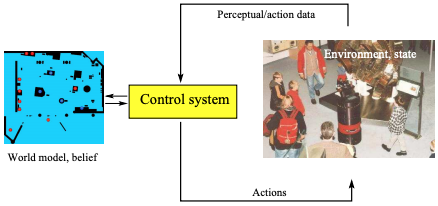
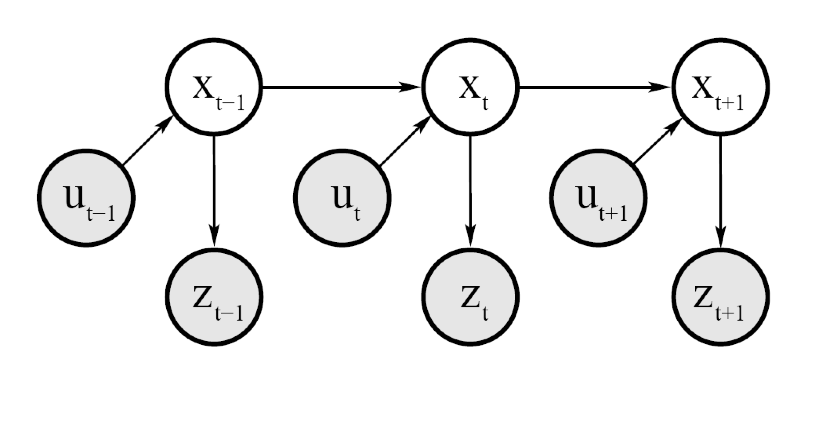
- The prediction step computes from the previous belief and the transition model.
- The measurement update step weighs by the probability of the measurement that was actually observed.
Door state estimation
This example is from Thrun, Burgard and Fox, Probabilistic Robotics (MIT Press, 2005), section 2.4.2. A robot with a camera has to estimate whether a door is open or closed.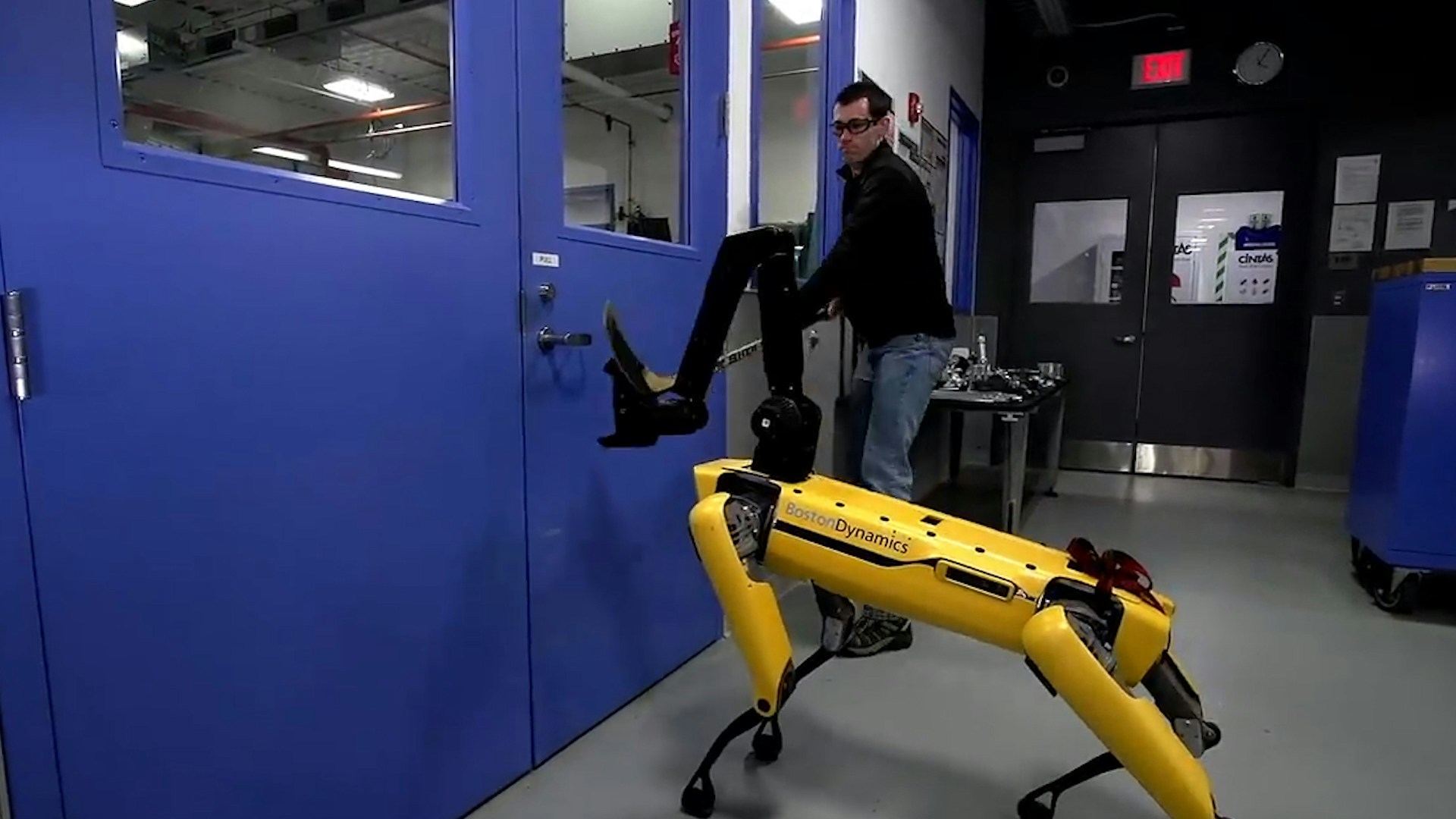
Measurement model
No real sensor is perfect. Assume the measurement model is:
The asymmetry is realistic. A closed door is easier to recognize than an open one. Through an open door, a camera sees the clutter of the room behind it, and a LIDAR may mistake the returns from that clutter for a closed door.
Transition model
The robot can use its manipulator to push the door, or it can do nothing. The transition model is:
Recall the convention: the robot first acts and then senses. Reversing the order gives the same equations with shifted indices.
At , the robot does nothing and then senses that the door is open. The two steps of the Bayes filter are as follows.
Prediction at time 1
The state is discrete, so the integral in the prediction step becomes a sum. In the second line, is short for . Evaluating it for both values of : The predicted belief equals the prior. Doing nothing does not change the door, and the door does not change by itself.Measurement update at time 1
The measurement now reweighs the predicted belief: For the two possible states: The two beliefs must sum to one, so , andPrediction at time 2
At , the robot pushes the door and again senses that it is open. The prediction step givesMeasurement update at time 2
With , the posterior belief at is The example is small, but it shows how the Bayes filter combines action and perception in one framework. The action is optional. A phone localizes itself from radio signals with the same recursion, even though it is carried rather than commanded. Its prediction step then uses a motion model without a control input. Key references: (Burgard & Thrun, n.d.)References
- Burgard, W., Thrun, S. (n.d.). Probabilistic Robotics.
Found an error on this page? Report an issue.