

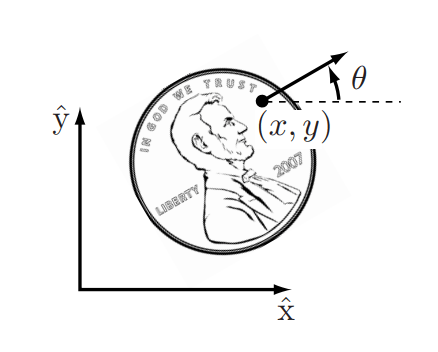
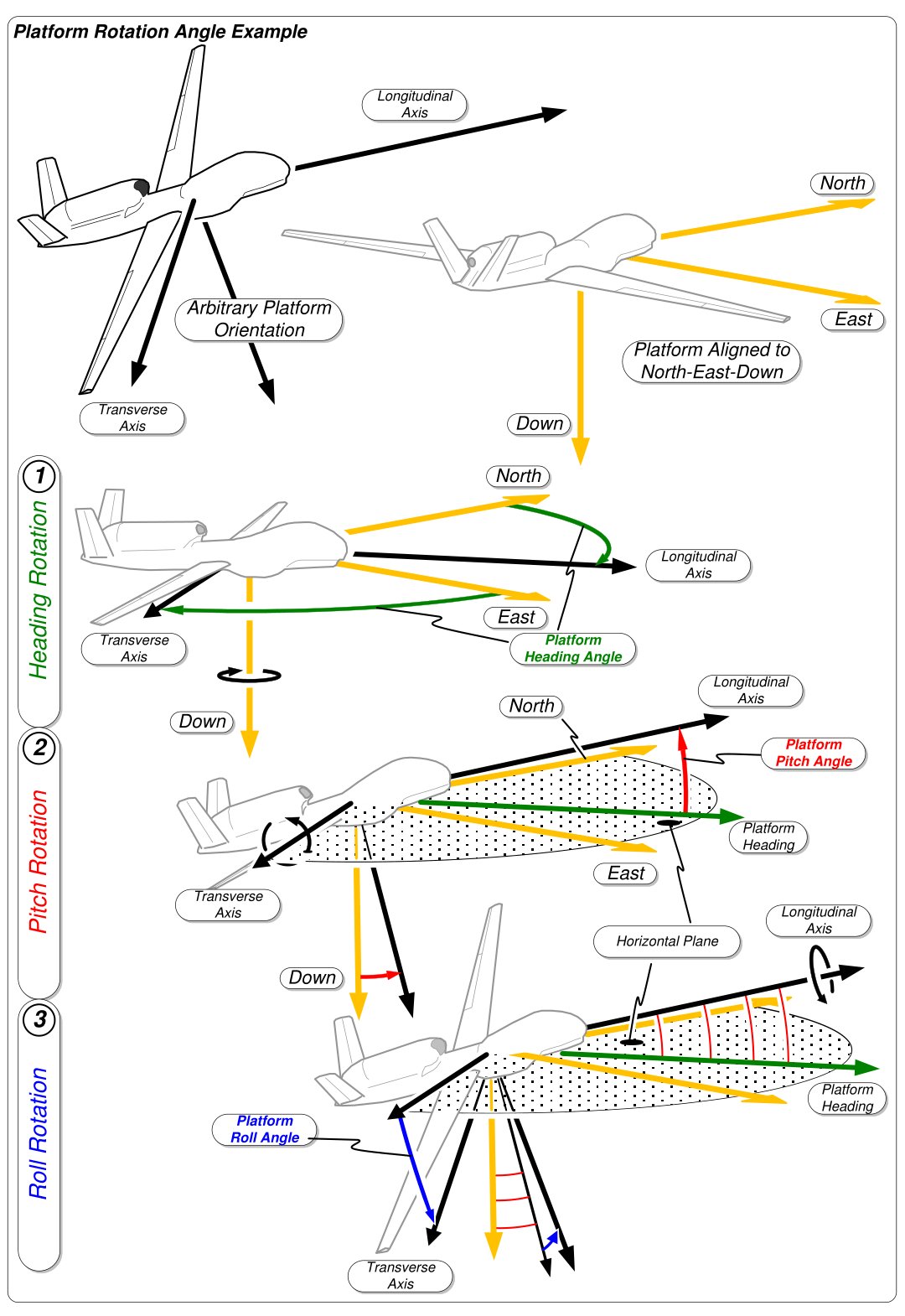
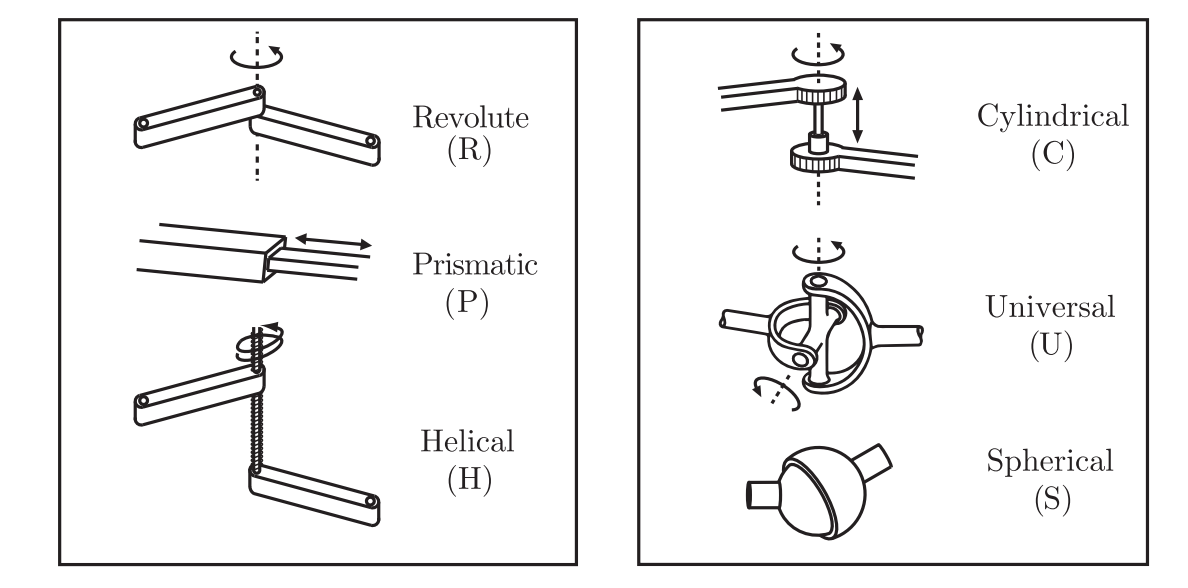
Grübler’s rule gives the degrees of freedom of a robot:
where for planar mechanisms and for spatial mechanisms, is the number of links (including the ground link), is the number of joints, and is the number of degrees of freedom of joint . The formula assumes that the constraints imposed by the joints are independent. When they are dependent, as can occur in closed chains, the formula gives only a lower bound on the degrees of freedom.
Example: the human arm
How many degrees of freedom does your arm have? Count from your torso to your palm. Keep the center of your shoulder fixed and exclude your fingers.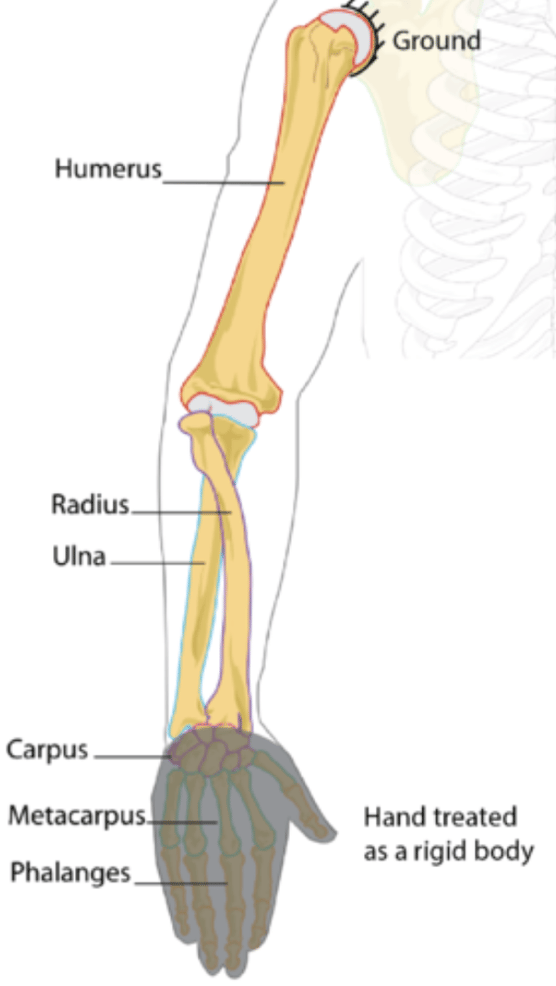
The four links give , and the three joints give . The joint freedoms sum to . Grübler’s rule with gives
Configuration space topology
Consider a point moving on the surface of a sphere. Its C-space is two-dimensional because two coordinates, latitude and longitude, describe its configuration. A point moving on a plane also has a two-dimensional C-space, with coordinates . The two spaces have different shapes. The plane extends forever, while the sphere wraps around. An oval-shaped American football wraps around like a sphere. You can obtain its shape by stretching a sphere in one direction. Topology describes the sense in which the surfaces of a small sphere, a large sphere and a football have the same kind of shape, while a plane has a different shape. The figure shows several example topologies.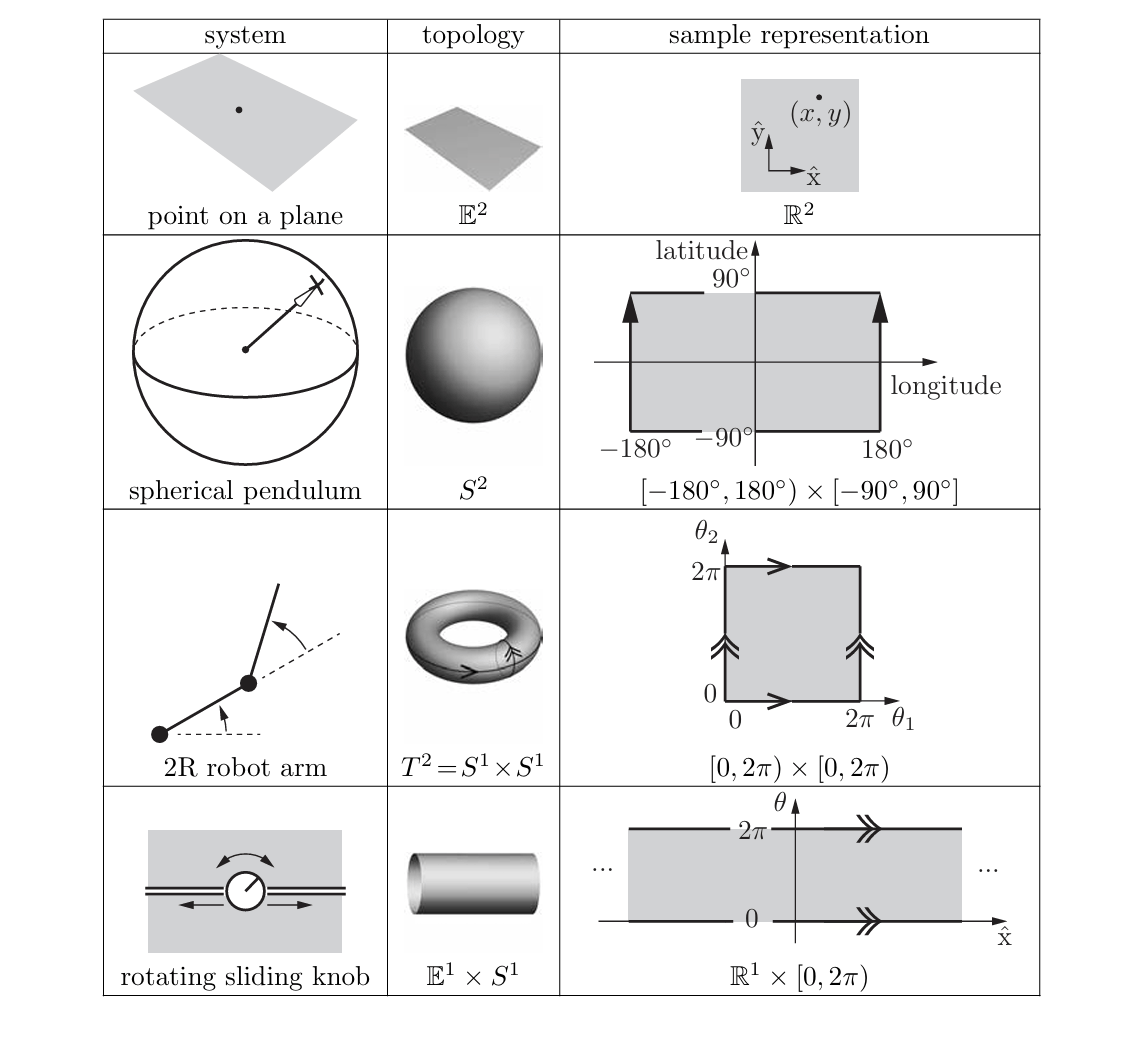
C-space representation
A choice of coordinates for an -dimensional space is an explicit parametrization of the space. For a point on a sphere, the familiar choice is the pair used for navigation on Earth:- Latitude (ϕ): angle from the equator (−90° at South Pole to +90° at North Pole)
- Longitude (λ): angle around the equator (from −180° to +180°)
You can avoid such singularities with an implicit representation. This representation treats an -dimensional space as embedded in a Euclidean space of more than dimensions. For example, a two-dimensional unit sphere is a surface embedded in three-dimensional Euclidean space. An implicit representation uses the coordinates of the higher-dimensional space, such as , with constraints that reduce the number of degrees of freedom. For the unit sphere, the constraint equation is:
An implicit representation uses more numbers than there are degrees of freedom, but it has no singularities. Rotation matrices are the main example in this chapter. A rotation matrix describes an orientation in space with nine numbers subject to six constraints. It also acts on vectors as a linear operator, so you can work with it using matrix algebra.
A rigid body’s configuration space also has an algebraic structure. Its elements are motions that you can compose and invert. Lie groups and tangent spaces develops this structure.
Task space
The task space is a space in which you can express the robot’s task naturally. Consider incremental sheet forming, shown below. A metal sheet is clamped in a frame. The robot pushes a tool with a spherical tip into the sheet and follows a path that gradually forms the part. The path of the tip’s center determines the formed surface. Rotation of the tool about that center does not change the surface. The task space is therefore , the position of the tip. If the part is formed in layers of constant depth, each layer is a contour in a plane. The task space of one layer is . If the tool must tilt so that its shank does not hit the wall of a deep part, its direction becomes part of the task. The task space is then . You choose the task space when describing the task, and it does not depend on the robot. A 6-dof arm performing a task in has three degrees of freedom left. You can use them for other purposes, such as avoiding singularities or the clamping frame.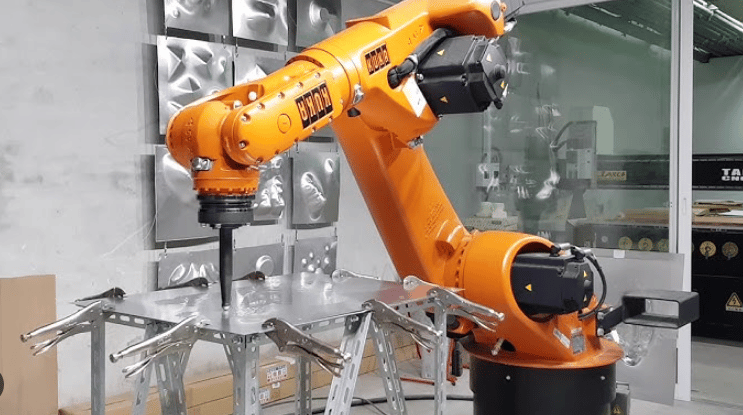
Workspace
The workspace specifies the end-effector configurations that the robot can reach. The robot’s structure primarily determines its workspace, independently of the task.References
Lynch and Park, Modern Robotics: Mechanics, Planning, and Control (2017)Found an error on this page? Report an issue.