

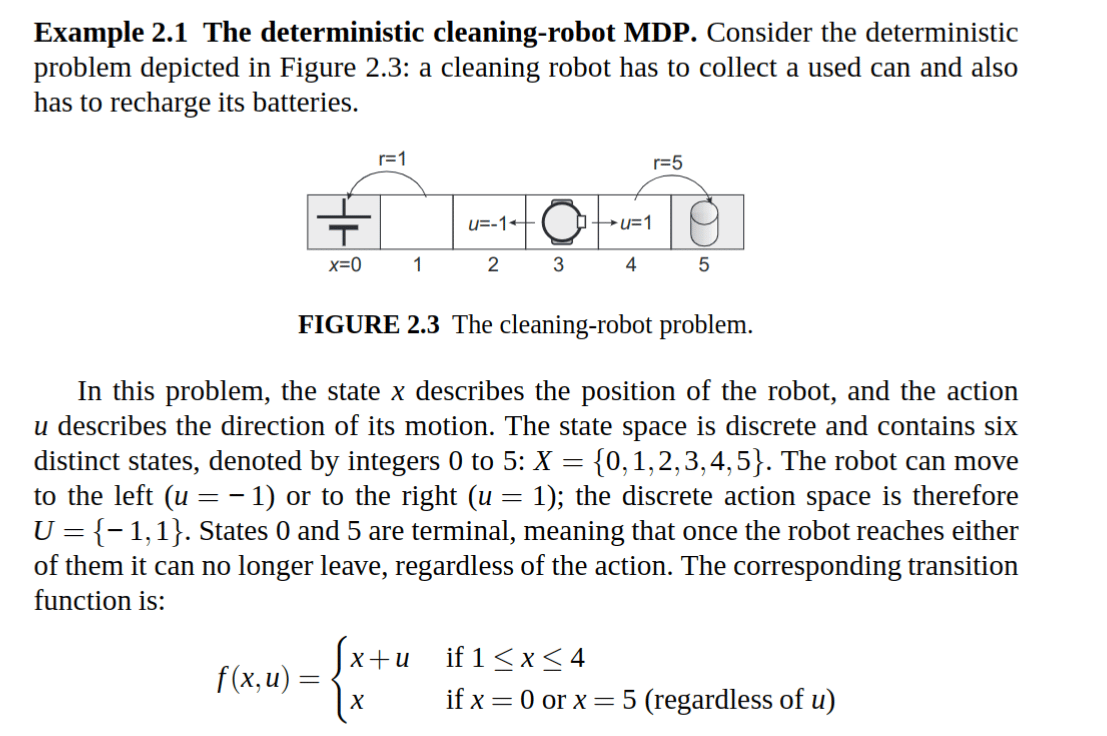
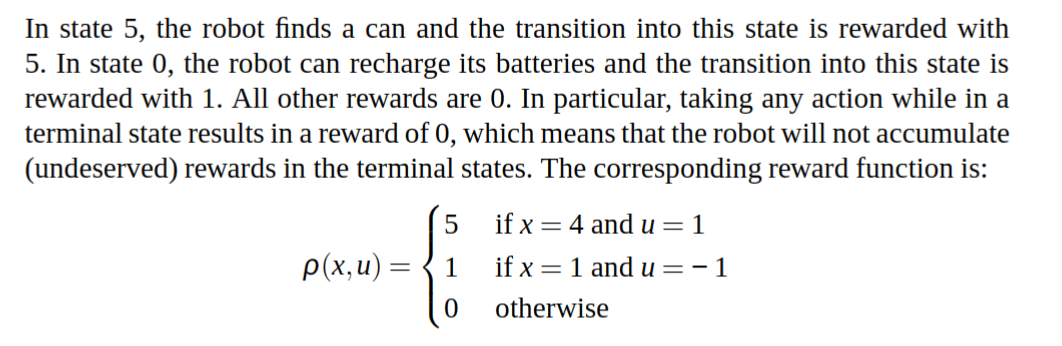
import numpy as np


def deterministic_robot_cleaning_v1():
    # Initialization
    state = [1, 2, 3, 4, 5, 6]  # Set of states
    action = [-1, 1]  # Set of actions
    Q = np.zeros((len(state), len(action)))  # Initial Q can be chosen arbitrarily
    Qold = Q.copy()  # Save a backup to compare later
    L = 15  # Number of iterations
    gamma = 0.5  # Discounting factor
    epsilon = 0.001  # Final error to stop the algorithm

    # Deterministic Q-iteration algorithm
    for l in range(1, L + 1):
        print(f"iteration: {l}")
        for ii in range(len(state)):
            for jj in range(len(action)):
                Q[ii, jj] = (
                    reward(state[ii], action[jj])
                    + gamma * Q[model(state[ii], action[jj]) - 1, jj]
                )

        if np.abs(np.sum(Q - Qold)) < epsilon:
            print("Epsilon criteria satisfied!")
            break
        else:
            # print(Q)                            # Show Q matrix in each iteration
            Qold = Q.copy()

    # Show the final Q matrix
    print("Q matrix (optimal):")
    print(Q)

    C = np.argmax(Q, axis=1)  # Finding the max values
    print("Q(optimal):")
    print(C)
    print("Optimal Policy:")
    print("*")
    print([action[C[1]], action[C[2]], action[C[3]], action[C[4]]])
    print("*")


# This function is the transition model of the robot
# The inputs are: the current state, and the chosen action
# The output is the next state
def model(x, u):
    if 2 <= x <= 5:
        return x + u
    else:
        return x


# This function is the reward function for the task
# The inputs are: the current state, and the chosen action
# The output is the expected reward
def reward(x, u):
    if x == 5 and u == 1:
        return 5
    elif x == 2 and u == -1:
        return 1
    else:
        return 0


# Call the main function
deterministic_robot_cleaning_v1()
iteration: 1
iteration: 2
iteration: 3
iteration: 4
iteration: 5
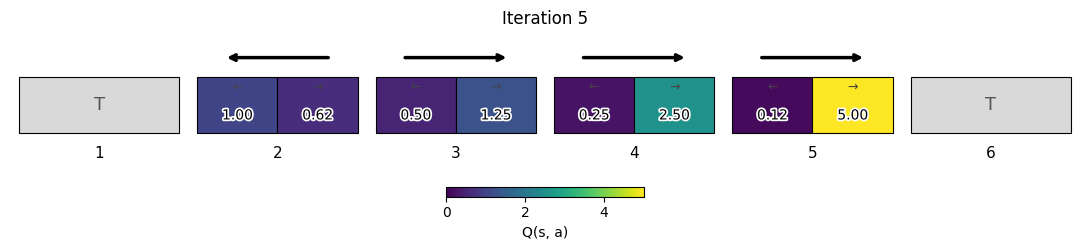
Epsilon criteria satisfied!
Q matrix (optimal):
[[0.    0.   ]
 [1.    0.625]
 [0.5   1.25 ]
 [0.25  2.5  ]
 [0.125 5.   ]
 [0.    0.   ]]
Q(optimal):
[0 0 1 1 1 0]
Optimal Policy:
*
[-1, 1, 1, 1]
*
import matplotlib.pyplot as plt
import matplotlib.patches as mpatches
from matplotlib import colormaps, patheffects
import matplotlib.cm as cm


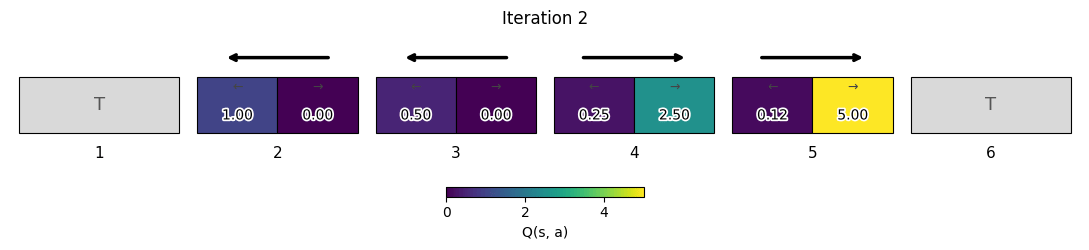
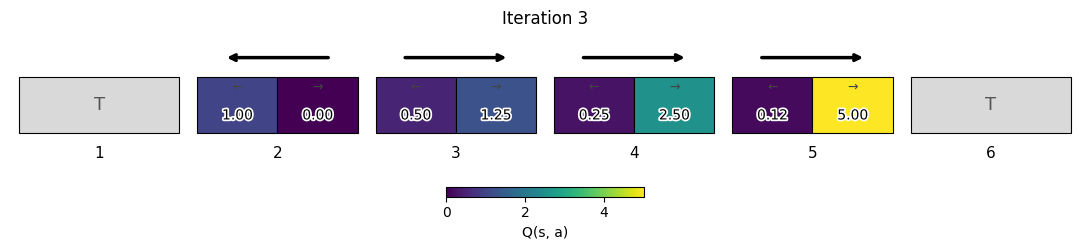
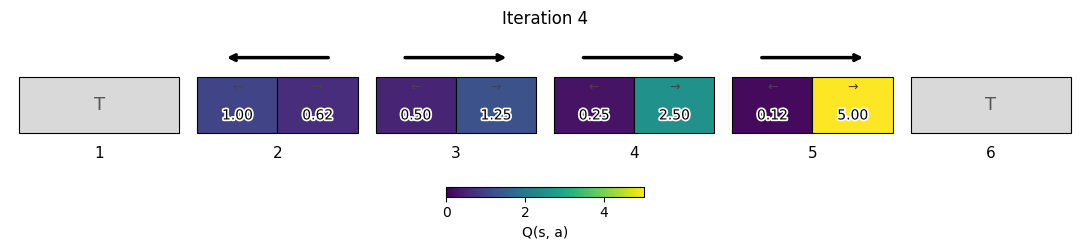
def _draw_panel(ax, Q, states, terminals, vmin, vmax, cmap, panel_title):
    ax.set_xlim(-0.5, len(states) - 0.5)
    ax.set_ylim(-1.1, 1.3)
    ax.axis("off")
    ax.set_title(panel_title, fontsize=12)
    stroke = [patheffects.withStroke(linewidth=2.5, foreground="white")]
    denom = max(vmax - vmin, 1e-9)
    for i, s in enumerate(states):
        if s in terminals:
            ax.add_patch(mpatches.Rectangle(
                (i - 0.45, -0.5), 0.9, 1.0,
                facecolor="#d9d9d9", edgecolor="black", linewidth=0.8))
            ax.text(i, 0, "T", ha="center", va="center", fontsize=13, color="#555")
        else:
            q_left, q_right = float(Q[i, 0]), float(Q[i, 1])
            ax.add_patch(mpatches.Rectangle(
                (i - 0.45, -0.5), 0.45, 1.0,
                facecolor=cmap((q_left - vmin) / denom),
                edgecolor="black", linewidth=0.8))
            ax.add_patch(mpatches.Rectangle(
                (i, -0.5), 0.45, 1.0,
                facecolor=cmap((q_right - vmin) / denom),
                edgecolor="black", linewidth=0.8))
            ax.text(i - 0.225, 0.32, "←", ha="center", va="center",
                    fontsize=9, color="#444")
            ax.text(i + 0.225, 0.32, "→", ha="center", va="center",
                    fontsize=9, color="#444")
            ax.text(i - 0.225, -0.18, f"{q_left:.2f}", ha="center", va="center",
                    fontsize=10, color="black", path_effects=stroke)
            ax.text(i + 0.225, -0.18, f"{q_right:.2f}", ha="center", va="center",
                    fontsize=10, color="black", path_effects=stroke)
            if q_left > 0 or q_right > 0:
                if q_right >= q_left:
                    ax.annotate("", xy=(i + 0.3, 0.85), xytext=(i - 0.3, 0.85),
                                arrowprops=dict(arrowstyle="->", color="black", lw=2.5))
                else:
                    ax.annotate("", xy=(i - 0.3, 0.85), xytext=(i + 0.3, 0.85),
                                arrowprops=dict(arrowstyle="->", color="black", lw=2.5))
        ax.text(i, -0.85, f"{s}", ha="center", va="center", fontsize=11)


def plot_q_panel(Q, states, terminals, vmin, vmax, title):
    fig, ax = plt.subplots(figsize=(11, 2.6))
    cmap = colormaps["viridis"]
    _draw_panel(ax, Q, states, terminals, vmin, vmax, cmap, title)
    sm = cm.ScalarMappable(cmap=cmap, norm=plt.Normalize(vmin=vmin, vmax=vmax))
    sm.set_array([])
    fig.colorbar(sm, ax=ax, orientation="horizontal",
                 fraction=0.06, pad=0.12, shrink=0.6, label="Q(s, a)")
    plt.tight_layout()
    plt.show()


def deterministic_robot_cleaning_traced():
    state = [1, 2, 3, 4, 5, 6]
    action = [-1, 1]
    Q = np.zeros((len(state), len(action)))
    Qold = Q.copy()
    L = 15
    gamma = 0.5
    epsilon = 0.001
    history = [Q.copy()]
    for _ in range(1, L + 1):
        for ii in range(len(state)):
            for jj in range(len(action)):
                Q[ii, jj] = (
                    reward(state[ii], action[jj])
                    + gamma * Q[model(state[ii], action[jj]) - 1, jj]
                )
        history.append(Q.copy())
        if np.abs(np.sum(Q - Qold)) < epsilon:
            break
        Qold = Q.copy()
    return history


history = deterministic_robot_cleaning_traced()
states_list = [1, 2, 3, 4, 5, 6]
terminals = {1, 6}
suptitle = "Q-value iteration (deterministic cleaning robot)"
vmax = max(1e-6, float(np.ceil(max(Q.max() for Q in history) * 10) / 10))
vmin = 0.0
print(suptitle)
for k, Q in enumerate(history):
    panel_title = "Initial (Q = 0)" if k == 0 else f"Iteration {k}"
    plot_q_panel(Q, states=states_list, terminals=terminals,
                 vmin=vmin, vmax=vmax, title=panel_title)
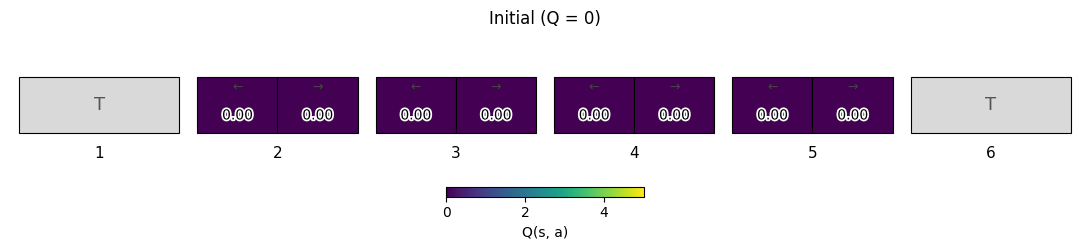
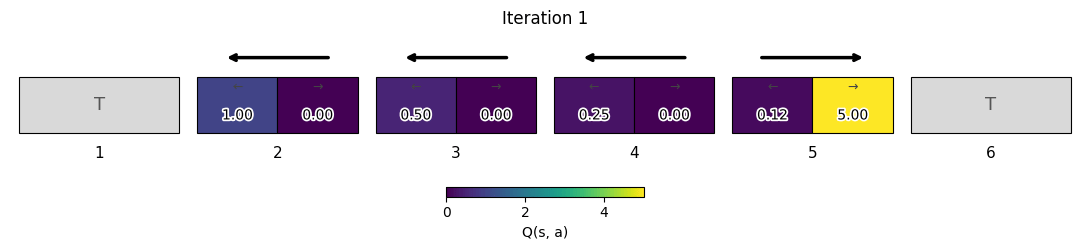
Q-value iteration (deterministic cleaning robot)
Found an error on this page? Report an issue.