

 A matrix has four entries, so you can treat it as a point in . Most of these points are not rotations. A rotation matrix has columns of unit length (two constraints) that are perpendicular (one more constraint). Four entries minus three constraints leaves one free number, the angle :
As changes, moves along a curve in . That curve is . This section draws it, shows that it is a circle, and finds its tangent at the identity, which is the Lie algebra . These two objects are the first two rows of the Lie cheatsheet.
Sampling the curve
Each angle gives one rotation matrix. Write its entries in a row, , and you get a point in . The code also checks that every sample is a rotation.The shape of the curve
The point for angle is . Two entries repeat the others: and . These two equations keep the curve in a plane. Inside that plane, , which is a circle. Every point is from the origin, and the circle closes because and give the same matrix.Drawing the curve
You cannot draw . But always equals , so you can drop it. The plot uses and colors each point by . The result is a tilted circle around the origin.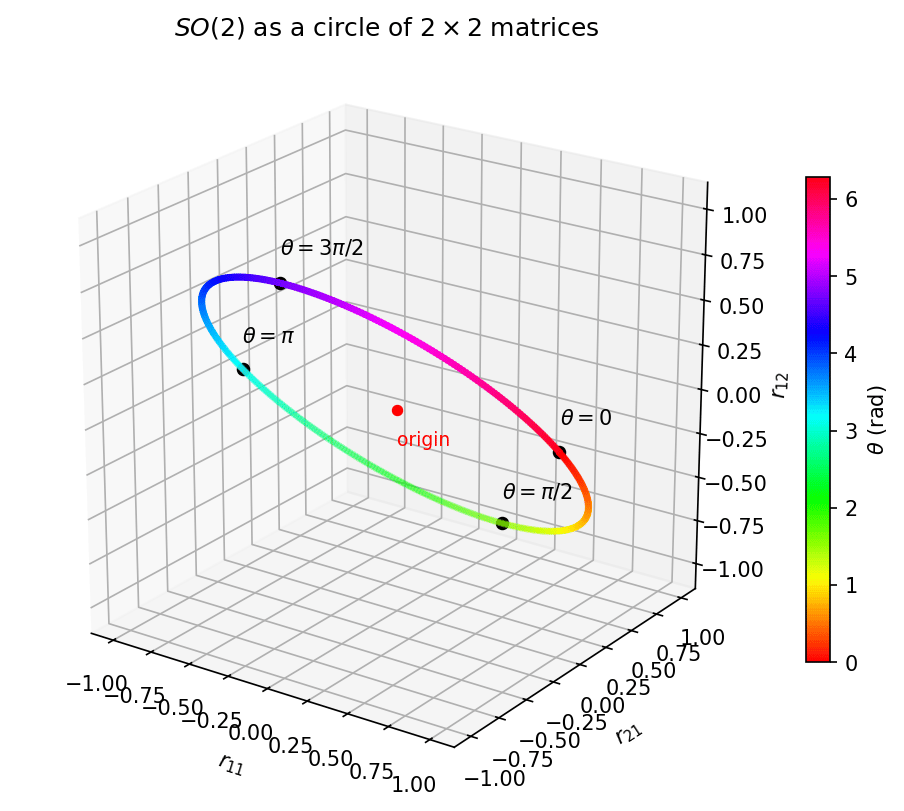
Rotations and reflections
Perpendicular unit columns are not enough to make a rotation. The matrices have them too, but their determinant is . Each one is a reflection across a line through the origin. The reflections form a second circle in . Together the two circles make up , the group of all orthogonal matrices. Along any path of orthogonal matrices the determinant would have to jump from to to reach a reflection, and it cannot jump. So is the circle that contains the identity.One column is enough
The first column of is , a point on the unit circle in the plane. The second column is the first one turned by counterclockwise, so it adds nothing new. Each rotation matches one point on the unit circle, and each point matches one rotation. This is another way to see that is a circle. The top panel follows the first column as grows. The row below shows the whole rotated frame at the same angles.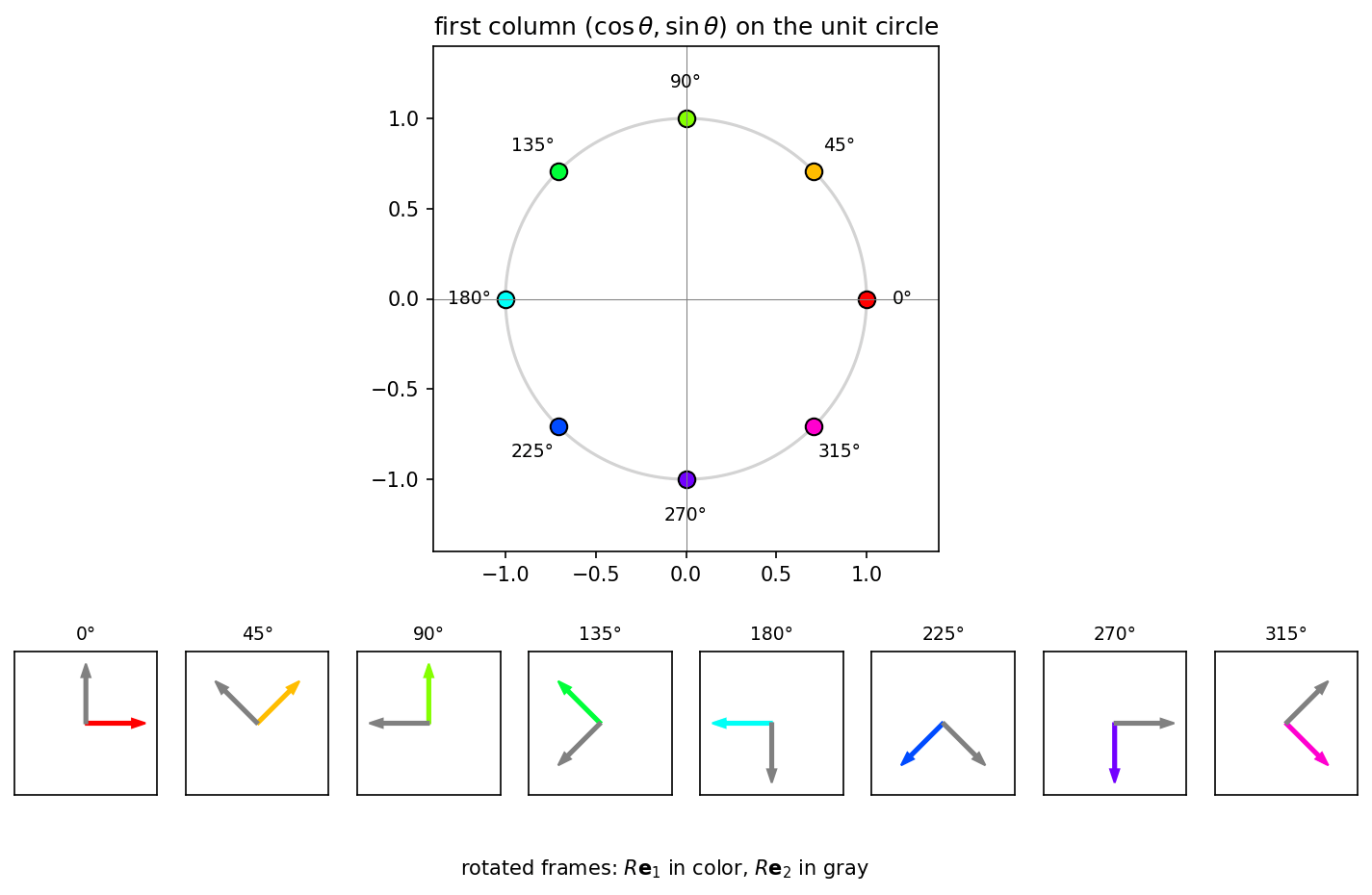
The tangent at the identity
Seen up close, a curve looks like a straight line. At the identity, , that line points along the derivative of : The matrix is skew-symmetric. Every velocity at the identity is for some angular rate : So is one-dimensional, like , and is its single generator. The matrix exponential leads back to the curve: . The code below checks the derivative, the skew symmetry and the exponential. Lie I covers tangent spaces and the exponential map in general. Appendix D of Corke (Corke, 2023) repeats this construction for , which has three generators.References
- Corke, P. (2023). Robotics, vision and control: Fundamental algorithms in python.
Found an error on this page? Report an issue.