

Vectors and Reference Frames
A free vector is a geometric quantity with magnitude and direction and is independent of any coordinate system. It acquires numerical values only when expressed in a coordinate frame. For example, a velocity vector may be in frame and have different coordinates in frame . Points are also represented as vectors. Their coordinates are defined relative to the origin of a reference frame, as shown below. A point and a free vector behave differently when the frame changes. A point moves with the origin, while a free vector ignores translation and only rotates. Homogeneous coordinates make this distinction explicit by appending a 1 to a point and a 0 to a free vector.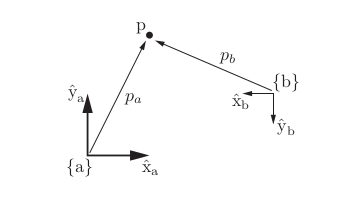
Thomas the train.Picture a coffee mug on a table in a train. Two people watch it: a passenger sitting in the train, and a person standing on the platform. The passenger’s frame moves with the train. The platform is (close enough to) an inertial frame. Whether the train’s frame is inertial depends on what the train is doing.
- The train moves at a steady speed on a straight track. The mug sits still on the table. The passenger sees nothing happening. The person on the platform sees the mug gliding along with the train. Both descriptions are simple, and neither person needs any force beyond gravity and the table holding the mug up. A frame that moves at constant velocity is also inertial. You cannot tell you are moving without looking out the window.
- The train brakes. The mug slides forward across the table.
- Platform view: nothing pushed the mug. It simply kept going at the speed it had, while the train slowed down underneath it. The only real horizontal force is friction from the table, which tries to drag the mug along with the slowing train. If friction is too weak, the mug keeps moving forward relative to the table.
- Passenger view: the mug was at rest, and now it moves forward. Nobody touched it. To explain that with ordinary physics, the passenger has to invent a force pushing the mug forward. This is the inertial force. It is not caused by any object; it appears only because the passenger’s frame is slowing down.
- The train speeds up. The same thing happens in reverse. The mug slides toward the back. The platform observer says the train pulled away from the mug. The passenger says a force pushed the mug backward.
- The train goes around a curve. The mug slides toward the outside of the curve.
- Platform view: the mug tried to keep going straight while the train turned away from it. The only thing that can make the mug follow the curve is friction pulling it inward.
- Passenger view: a force pushed the mug outward. This is the centrifugal force. As with braking, it exists only in the turning frame.
- You roll a marble across the aisle while the train is turning. The marble’s path curves as it rolls.
- Platform view: the marble goes in a straight line. The train rotates underneath it.
- Passenger view: the marble seems to be steered sideways while it moves. This is the Coriolis force. It acts only on things that are moving relative to the turning frame. That is why the mug sitting still does not feel it, but the rolling marble does.
Planar Rigid-Body Motions
We define a single fixed frame, called space frame , with unit axes and .Sometimes we refer to this as the world frame. We also define a fixed at each instance body frame, denoted , associated with the body with unit axes and . This frame is coincident with the body at any instant. In the plane, a rotation matrix and a translation vector describe a rigid-body configuration. The pair represents a body in the space frame.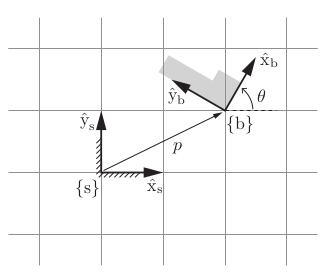
The groups and , and their algebras and , are defined in SO(2) as a manifold. That section also has a table of every manifold used in robotics. Read it before you continue.
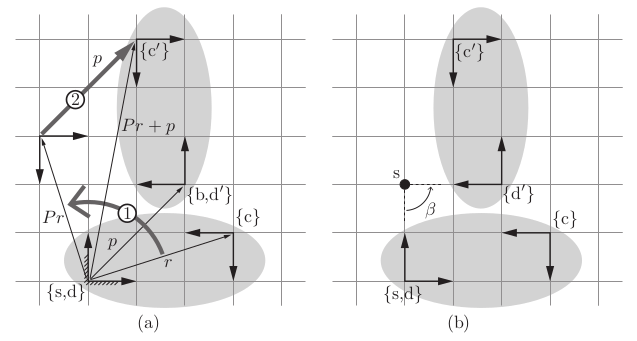
\{d0\}, which coincides with the stationary frame . The pair (P, p) represents in . The same transformation takes the frame , also attached to the rigid body, to \{c0\}. Transformation 1 rotates about the origin of . Transformation 2 then translates the frame by p expressed in .
(b) The rotation and translation can also occur simultaneously. In this view, the displacement is a rotation of β = 90° about a fixed point s.
This is a planar example of a screw motion. The three screw coordinates parametrize the displacement. Here, gives the coordinates of point s, which is the screw axis out of the page, in the fixed frame .
Planar velocities and twists
Collect the rotation and the translation into one matrix: The matrix acts on the homogeneous coordinates of the plane. A point is rotated and then translated, while a free vector is only rotated. The configuration of a planar rigid body is the triple , one number per degree of freedom. In the plane every rotation happens about the axis perpendicular to the plane, so the angular velocity is a single number, . Differentiating gives , where is the same skew-symmetric matrix that appears as the tangent at the identity in SO(2) as a manifold. A twist packs the angular and linear velocity of the body into one object. As with frames, there are two ways to express it. The body twist comes from , and the space twist comes from : Both matrices belong to . Each is described by three numbers, collected in a twist vector :- is the velocity of the body-frame origin, written in the coordinates of .
- is the velocity of the point of the body that is currently at the origin of , written in . That point may lie outside the physical body; imagine the body extended far enough to contain it.