

 Rotation representations described a body’s orientation. Angular velocity described how it changes, and exponential coordinates showed how a finite rotation follows from it. This section adds position. A pose pairs a rotation with a translation. A twist pairs an angular velocity with a linear velocity. A screw motion is the exponential of a twist. In Lie I, these are the group , its Lie algebra , and the exponential between them.
The section starts in the plane. There every object is a matrix you can compute by hand, and a TurtleBot serves as the running example. It then takes the same steps in three dimensions. The presentation follows sections 3.1 and 3.3 of Lynch and Park (Kevin M. Lynch, 2017).
Motion in the plane
Poses in SE(2)
A pose in the plane is a position and a heading . Moving a point by a pose takes two steps: rotate it by , then shift it by . The result is . The rotation is a matrix product, but the shift is an addition, so the two steps do not combine into one matrix. Homogeneous coordinates fix this with one extra number. Write the point as . A matrix can then do both steps in one product: The 1 in the last row of the point multiplies , which adds the shift. This matrix is the homogeneous transformation matrix of the pose: The configuration is the triple . For a differential-drive robot such as the TurtleBot, is the position of the chassis and is its heading. The headings and are identical. The matrix converts coordinates between the robot and world frames. A velocity along the robot’s heading becomes in the world frame. The last coordinate tells the matrix what kind of object it is moving. A point, such as the position of a wheel, has a 1 there, so it is rotated and shifted. A direction, such as a velocity, has a 0 there. The 0 multiplies , so the direction is only rotated. This matches what happens to the robot: driving it somewhere else moves the points on it, but a direction has no position to move, so it only turns with the robot. For example, take and . The point goes to , while the direction goes to . The inverse of a homogeneous transformation matrix is and transformations compose by matrix multiplication, . Composing two poses shows the interaction between translation and rotation: The headings combine by multiplying their rotations, which adds the angles. The first rotation acts on the second translation, producing the term . As a manifold, SE(2) looks like , a position paired with a heading. Its group structure also includes the action of rotation on translation. This structure is called a semidirect product and is written .Twists in the plane
A planar body turns at a rate , and its origin moves with a linear velocity . A twist collects the three numbers in one vector, . This order follows Lynch and Park: turning rate first, then the linear velocity. The matrix form of the twist belongs to , the Lie algebra of : As with angular velocity, you can express a twist in two frames. The body twist comes from . The space twist comes from . Both have the same turning rate, , because every rotation in the plane is about the same axis, out of the page. The linear parts differ:- is the velocity of the body-frame origin, written in the coordinates of .
- is the velocity of the point of the body currently at the origin of , written in . That point may lie outside the physical body. You can imagine extending the body far enough to contain it.
Planar screw motion
Any planar displacement that includes a rotation is a rotation about a fixed point . A pure translation is the exception, because its fixed point has moved off to infinity. The figure shows such a motion.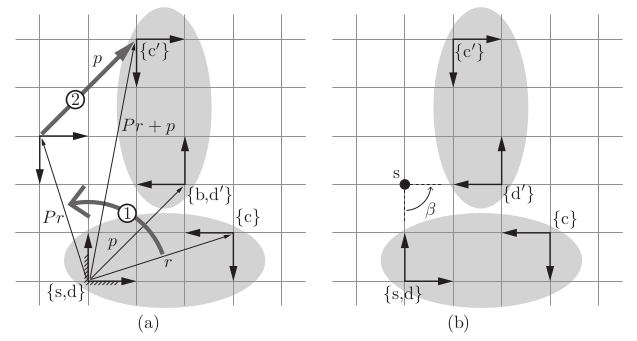
From velocity to motion
For rotations, angular velocity and the exponential form this sequence: Multiplication by extracts the local motion. The exponential converts that motion into a finite rotation. In exponential coordinates, an animation of a tangent plane on a sphere depicts the same wrapping process for the sphere . For poses, the corresponding quantities are , the twist , and . Consider the TurtleBot pose from poses in SE(2).- Velocity. The robot travels forward at speed and turns at rate . Its wheels cannot slide sideways, so its velocity in the body frame is the twist . The sideways component is zero. In matrix form, the twist is This matrix belongs to the Lie algebra. In the notation of Lie I, is .
- Motion. During a short time interval , update the pose with
Code
Code
Code
Code
Twists live in a vector space, so you can add and scale them. Poses live on SE(2), a curved space where they can only be composed. The exponential maps the first into the second.
The product updates the position and the heading together, and the result is always a valid pose. Two commands in sequence give . The order matters, because the product of two exponentials is in general not the exponential of the sum.
Parallel parking chains three such commands. The robot starts at the origin, facing . It drives an arc to the left, then an arc to the right, then straight back. Each command keeps the twist constant, so each one is a single exponential.
Code
Code
The parallel-parking path in the Rerun viewer. Drag the time slider to move the robot along the path, and drag in the 3D view to orbit it. The robot’s frame moves with it: the red axis points forward and the green axis to its left. The path never runs along the green axis.
Nonholonomic robots derives from the wheel speeds and applies this update to odometry. The chassis can point in any direction and reach any position. At each instant, the constraint allows it to move only forward, backward, or turn.
The TurtleBot runs ROS 2, which stores the same quantities in a different form.
-
Pose. A
geometry_msgs/Posecontains a position and an orientation quaternion instead of a matrix . A planar heading becomes the unit quaternion . ROS lists the scalar part last. -
Twist. A
geometry_msgs/Twistlists the linear velocity before the angular velocity, which reverses the Lynch and Park order. A drive command setslinear.xto andangular.zto and leaves the other four components at zero. -
Odometry. A
nav_msgs/Odometrymessage gives the pose in a fixed frame and the twist in the robot’s frame. Its twist is therefore the body twist . - Frames. REP 103 makes every frame right handed, with forward, left, and up on the robot.
Motion in space
Poses in SE(3)
In three dimensions, the rotation is a matrix in and the position has three coordinates. The pose is a matrix: Everything in poses in SE(2) carries over unchanged. The matrix acts on homogeneous coordinates in the same way, the inverse has the same form, and composition again produces the term . As a manifold, SE(3) looks like , a position paired with an orientation. Its group is the semidirect product .Twists
In three dimensions, the angular velocity is a vector . A twist combines it with the linear velocity in one six-dimensional vector: is the Lie algebra of . The body twist and the space twist come from the same products as in the plane, and . Their linear parts have the same meaning:- is the velocity of the body-frame origin, written in the coordinates of .
- is the velocity of the point of the body currently at the origin of , written in .
Spatial-velocity conventions differ across systems, so integration may require conversion. Warp orders a spatial vector as (angular, linear). PhysX reports the linear velocity of the center of mass and the angular velocity, both in the world frame. The Newton twist conventions compare these and other engines side by side.
Screw motion
Exponential coordinates extend from rotations to poses. Let be a screw axis. The displacement by along it is Here is Lynch and Park’s notation. It is unrelated to the generator of Lie I. Given a transformation , the matrix logarithm reverses this map. First, gives . Then . Thus . Every pose can be reached by one screw motion, a rotation about an axis combined with a translation along it. This is the three-dimensional form of the planar screw motion, where the axis points out of the page and the translation along it is zero. A body with a constant twist moves along a screw, and the update from velocity to motion holds unchanged with matrices.References
- Kevin M. Lynch, F. (2017). Modern Robotics. Link
- Solà, J., Deray, J., Atchuthan, D. (2018). A micro Lie theory for state estimation in robotics. arXiv [cs.RO]. DOI
Found an error on this page? Report an issue.