

Vectors and reference frames
A free vector is a geometric quantity with magnitude and direction. It does not depend on a coordinate system. It acquires numerical values when you express it in a coordinate frame. For example, a velocity vector may be in frame and have different coordinates in frame . If vectors are new to you, watch two short Khan Academy videos first: adding and subtracting vectors and unit vector notation. You can also represent points as vectors. Their coordinates are measured from the origin of a reference frame, as shown below. A point and a free vector behave differently when the frame changes. The coordinates of a point depend on the frame’s origin. A free vector is unaffected by translation and only rotates. Homogeneous coordinates show this distinction by appending a 1 to a point and a 0 to a free vector.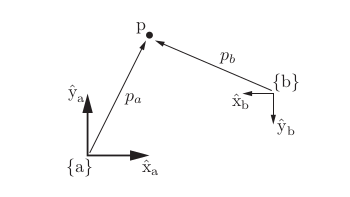
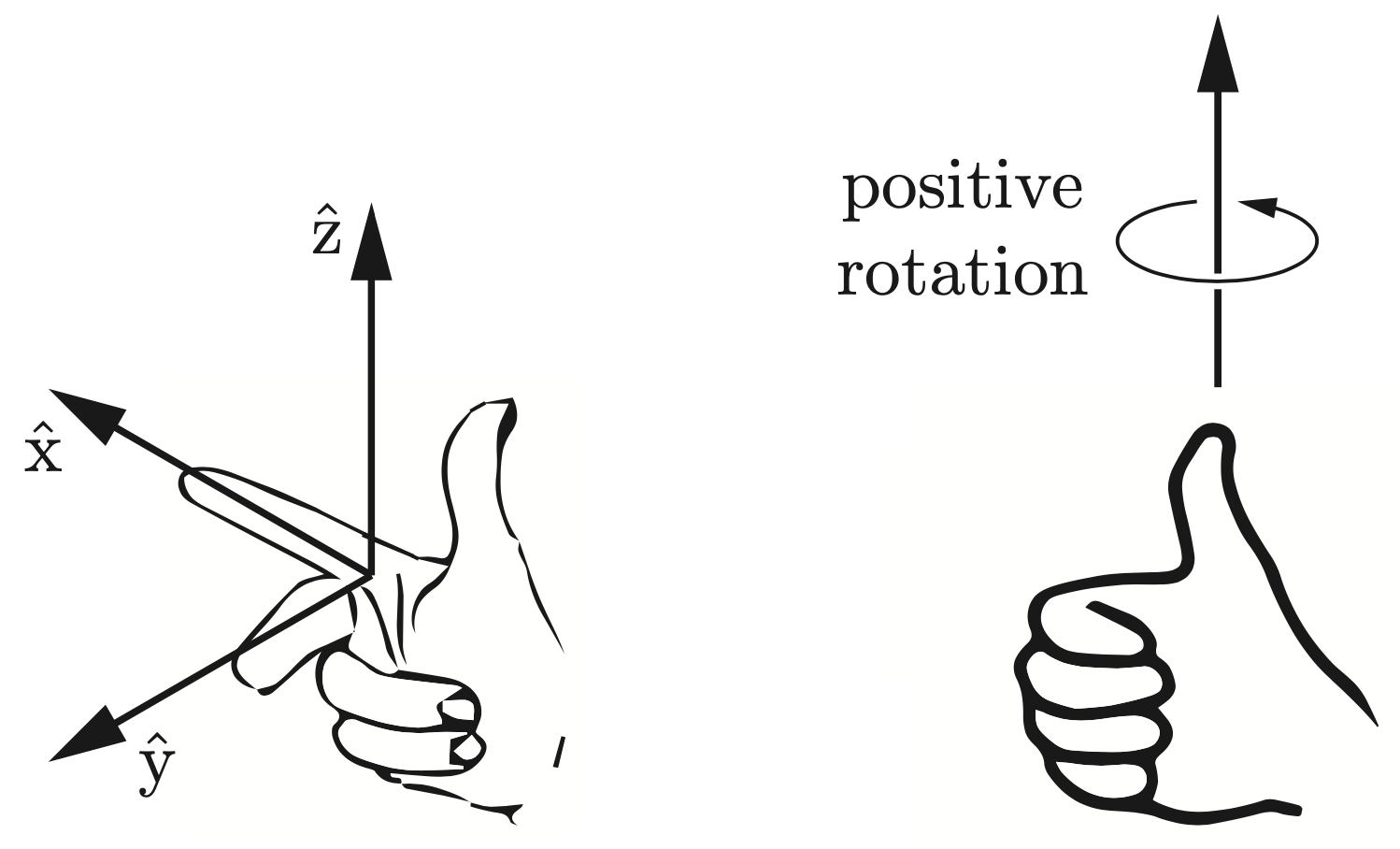
- The body can accelerate, and its attached frame moves with it.
- Velocities are always measured relative to inertial space.
- Each instant uses a new stationary body frame. This frame is aligned with the body at that instant.
Rotation matrices
The rotation matrices form the special orthogonal group . The product of two rotation matrices is another rotation matrix, . Every rotation matrix has an inverse, . Rotations preserve lengths, .Rotations in the plane
Representing the configuration of a planar rigid body
Begin in the plane, where a frame has two axes. In the figure below, the body frame has its origin at and is rotated by an angle relative to the space frame .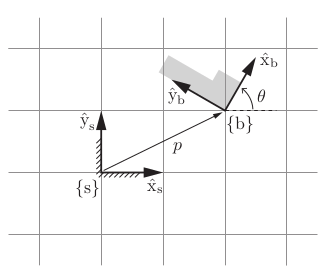
Changing the reference frame
The second use of a rotation matrix is to change the frame in which you write a vector or another frame. When several frames are in play, a matrix needs to say which frame it describes and which frame it is written in. Two subscripts carry that information. The first names the reference frame and the second names the frame being described, so is the orientation of written in , and is the orientation of written in . The rotation matrix above is . Figure 3.4 of Lynch and Park (book page 64) shows three frames on a grid of unit squares:- in is , with and .
- in is , with . The vector runs from the origin of to the origin of , measured along the axes of : .
- in is , with and .
Displacing a frame
The third use of a rotation matrix is to move a vector or a frame. Figure 3.5(a) of Lynch and Park (book page 66) reuses the frames of Figure 3.4. This time stays fixed in space, given by . A rigid body carries two frames. The frame starts on top of , and the frame starts at , with . Move the body so that lands on , in two steps. First rotate it by about the origin of . Then translate it by . The frame rides along and ends at a new frame , given by (Lynch and Park eqs. 3.10 and 3.11): This animation follows Figure 3.5(a) of Lynch and Park. Step ① rotates the body by about the origin of , which takes the origin of to . Step ② translates the body by . The frame lands on , and lands on at . Compare this with the change of frame, . There, the second subscript of matches the first subscript of . The result is still the frame , now written in . Here the product is . The middle subscripts are and , so they do not cancel. Both matrices are written in , and the result is a different frame, . You can also reach with a single rotation about a fixed point. Motion representations covers this as a planar screw motion.Rotations in space (3D)
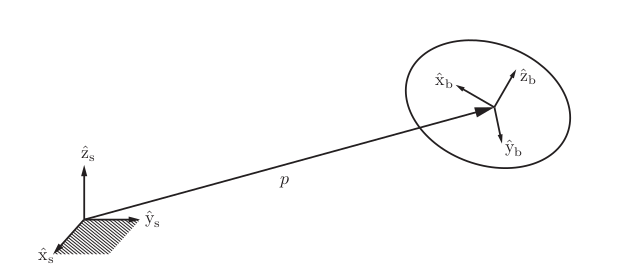
A frame in space has three axes, but the construction is unchanged. Let denote the vector from the fixed-frame origin to the body-frame origin. In fixed-frame coordinates, You can also express the axes of the body frame in the fixed frame: Place these three vectors side by side as columns. The result is a rotation matrix: The pair contains 12 parameters and fully describes the body’s position and orientation relative to the fixed frame. Similarly to the planar case, a rotation matrix represents an orientation, changes the frame in which a vector or frame is written, and displaces a vector or frame. Its columns must be perpendicular unit vectors. These requirements give six equations for the nine entries and can be written as (Lynch and Park eq. 3.19). A right-handed frame also requires (eq. 3.21). A matrix with describes a reflection. The six constraints leave three free numbers, matching the three degrees of freedom of an orientation in space. The planar is a rotation about with the third row and column removed.Angular velocity and exponential coordinates
How orientation changes over time is the topic of angular velocity. That section derives the angular velocity from a point turning about a fixed axis, and writes it as a skew-symmetric matrix in . Exponential coordinates then turn a constant angular velocity into a finite rotation.Other representations
A rotation matrix uses nine numbers for three degrees of freedom. Other representations use fewer numbers. Exponential coordinates are one. Appendix B of Lynch and Park (book pages 575 to 584) covers the rest:- Euler angles (B.1)
- Roll-pitch-yaw angles (B.2)
- Unit quaternions (B.3). Quaternions derives them from complex numbers.
- Cayley-Rodrigues parameters (B.4)
References
- Kevin M. Lynch, F. (2017). Modern Robotics.
Found an error on this page? Report an issue.