
Open In Colab In the EM for MoG tutorial you saw the Expectation-Maximization algorithm fit a Mixture of Gaussians: given data, recover the three component means, covariances, and weights. Here you do the opposite. You generate new samples from the same MoG using Denoising Diffusion Probabilistic Models (DDPM, Ho et al. 2020), without ever telling the model that the target distribution has three components, or what their parameters are. The model only sees data points and must learn to produce more. The 2D MoG is the cleanest place to build intuition: every step of the forward and reverse processes can be plotted directly. The same recipe scales to images, audio, and trajectories by swapping the small MLP below for a U-Net and using more diffusion steps.

The target distribution

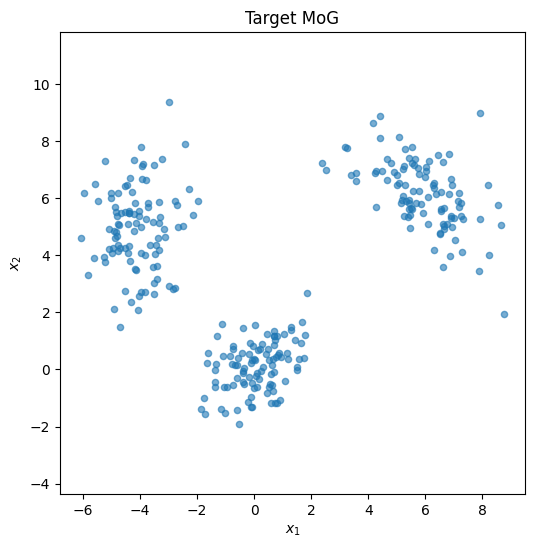
Same three-cluster MoG as the EM tutorial: 100 points each from three anisotropic Gaussians with random seed 42. To DDPM, this is just a tensor of 300 points in R2\mathbb{R}^2, it has no idea three Gaussians produced it.
import numpy as np
import torch
import torch.nn as nn
import torch.nn.functional as F
import matplotlib.pyplot as plt

# Reproducibility: identical seed across runs so this MoG matches the one
# used in the EM tutorial.
torch.manual_seed(42)
np.random.seed(42)
device = torch.device("cuda" if torch.cuda.is_available() else "cpu")

# Build the target distribution as 300 i.i.d. samples from a 3-component MoG.
# DDPM never sees the cluster labels, means, or covariances - only the
# 300x2 tensor of points. Recovering the structure from raw points alone
# is the whole point.
n_samples = 300
cluster1 = np.random.multivariate_normal([0, 0],   [[1, 0.5],   [0.5, 1]],   n_samples // 3)
cluster2 = np.random.multivariate_normal([6, 6],   [[1.5, -0.7], [-0.7, 1.5]], n_samples // 3)
cluster3 = np.random.multivariate_normal([-4, 5],  [[0.8, 0],   [0, 2.0]],   n_samples // 3)
data_np = np.vstack([cluster1, cluster2, cluster3]).astype(np.float32)
data = torch.from_numpy(data_np).to(device)
Output from cell 2

The forward (noising) process

DDPM defines a fixed Markov chain that gradually adds Gaussian noise to a data point until, after TT steps, it is indistinguishable from pure noise: q(xtxt1)=N ⁣(xt;  1βtxt1,  βtI)q(x_t \mid x_{t-1}) = \mathcal{N}\!\left(x_t;\; \sqrt{1-\beta_t}\, x_{t-1},\; \beta_t I\right) β1,,βT\beta_1, \dots, \beta_T is the variance schedule. With αt=1βt\alpha_t = 1 - \beta_t and αˉt=s=1tαs\bar\alpha_t = \prod_{s=1}^t \alpha_s, the chain has a closed-form jump from any x0x_0 directly to xtx_t: q(xtx0)=N ⁣(xt;  αˉtx0,  (1αˉt)I)q(x_t \mid x_0) = \mathcal{N}\!\left(x_t;\; \sqrt{\bar\alpha_t}\, x_0,\; (1-\bar\alpha_t) I\right) This shortcut is what makes DDPM training cheap: you never simulate the chain step by step during training, you sample tt, jump straight to xtx_t, and learn from there.
# Forward-process hyperparameters. T is the number of noising steps;
# `betas` is the variance schedule beta_1..beta_T (small at t=0, larger at t=T-1).
# Linear schedule from 1e-4 to 0.02 is the original DDPM choice (Ho et al. 2020).
T = 500
betas = torch.linspace(1e-4, 0.02, T, device=device)
alphas = 1.0 - betas                          # alpha_t = 1 - beta_t
alpha_bars = torch.cumprod(alphas, dim=0)     # bar_alpha_t = prod_{s=1}^t alpha_s


def q_sample(x0, t, eps=None):
    """Closed-form jump from x_0 directly to x_t.

    Because every forward step is linear-Gaussian, the marginal q(x_t | x_0)
    has a closed form and we never have to simulate the chain step by step:
        x_t = sqrt(bar_alpha_t) * x_0 + sqrt(1 - bar_alpha_t) * eps,   eps ~ N(0, I).
    """
    if eps is None:
        eps = torch.randn_like(x0)
    # Index the schedule at each example's timestep, then unsqueeze so the
    # scalar coefficient broadcasts across the 2-D point dimension.
    sqrt_ab   = alpha_bars[t].sqrt().unsqueeze(-1)
    sqrt_omab = (1 - alpha_bars[t]).sqrt().unsqueeze(-1)
    return sqrt_ab * x0 + sqrt_omab * eps
Output from cell 4

The reverse (denoising) process

Generation is the forward process run backwards. We learn a Gaussian transition pθ(xt1xt)=N ⁣(xt1;  μθ(xt,t),  σt2I)p_\theta(x_{t-1} \mid x_t) = \mathcal{N}\!\left(x_{t-1};\; \mu_\theta(x_t, t),\; \sigma_t^2 I\right) Ho et al. reparameterize the mean by training a network ϵθ(xt,t)\epsilon_\theta(x_t, t) to predict the noise that was added when producing xtx_t from x0x_0. The mean is then μθ(xt,t)=1αt(xt1αt1αˉtϵθ(xt,t))\mu_\theta(x_t, t) = \frac{1}{\sqrt{\alpha_t}} \left( x_t - \frac{1-\alpha_t}{\sqrt{1-\bar\alpha_t}}\, \epsilon_\theta(x_t, t) \right) and the entire variational lower bound collapses to a simple denoising objective: Lsimple=Ex0,t,ϵ ⁣[ϵϵθ ⁣(αˉtx0+1αˉtϵ,  t)2]L_{\text{simple}} = \mathbb{E}_{x_0, t, \epsilon}\!\left[\,\left\| \epsilon - \epsilon_\theta\!\left(\sqrt{\bar\alpha_t}\, x_0 + \sqrt{1-\bar\alpha_t}\, \epsilon,\; t\right) \right\|^2\,\right] No KL divergence to manage, no encoder, no posterior approximation, pure regression on noise.

The noise predictor

For 2D data, ϵθ\epsilon_\theta is a small MLP. The only non-obvious piece is the time embedding: the network must condition on which timestep tt we are denoising. The conventional trick is sinusoidal positional features (same idea as transformers).
class SinusoidalTimeEmbedding(nn.Module):
    """Transformer-style positional encoding of the diffusion timestep.

    A single network handles every t in {0, ..., T-1}, so it needs to know
    *which* noise level it is denoising. The sin/cos embedding (used in
    transformers and the original DDPM paper) gives a smooth, continuous
    representation of t at many frequencies.
    """
    def __init__(self, dim):
        super().__init__()
        self.dim = dim

    def forward(self, t):
        half = self.dim // 2
        # Geometric series of frequencies spanning short to long timescales.
        freqs = torch.exp(-np.log(10000) * torch.arange(half, device=t.device) / half)
        emb = t.float().unsqueeze(-1) * freqs
        return torch.cat([emb.sin(), emb.cos()], dim=-1)


class NoisePredictor(nn.Module):
    """eps_theta(x_t, t): predicts the noise that produced x_t.

    The network output is NOT the reverse-step mean mu_theta; it is the
    estimated 2-D noise vector eps_hat. The mean is computed analytically
    from eps_hat in the sampling loop via the Ho et al. reparameterisation
    (see the formula in the sampling cell). Equivalent parameterisations
    exist (predict mu directly, or predict x_0), but eps-prediction is
    better-conditioned because eps ~ N(0, I) at every timestep.

    A small MLP suffices for 2-D data; for images this becomes a U-Net.
    """
    def __init__(self, time_dim=64, hidden=128):
        super().__init__()
        # Project the raw sin/cos embedding through a tiny MLP (standard DDPM trick).
        self.time_emb = nn.Sequential(
            SinusoidalTimeEmbedding(time_dim),
            nn.Linear(time_dim, time_dim), nn.SiLU(),
            nn.Linear(time_dim, time_dim),
        )
        # Concatenate (x_t, time-embedding) -> 4-layer MLP. Output is the
        # 2-D noise estimate eps_hat (same shape as x_t), NOT the reverse-step mean.
        self.net = nn.Sequential(
            nn.Linear(2 + time_dim, hidden), nn.SiLU(),
            nn.Linear(hidden, hidden),       nn.SiLU(),
            nn.Linear(hidden, hidden),       nn.SiLU(),
            nn.Linear(hidden, 2),            # eps_hat in R^2; reverse mean derived from it
        )

    def forward(self, x, t):
        # Concatenate the noisy point with its timestep embedding.
        h = torch.cat([x, self.time_emb(t)], dim=-1)
        return self.net(h)


model = NoisePredictor().to(device)

Training

The training loop is one of the simplest in modern generative modeling:
  1. Sample a batch from pdatap_{\text{data}}.
  2. Sample a random timestep tUniform(1,T)t \sim \text{Uniform}(1, T) for each example.
  3. Sample noise ϵN(0,I)\epsilon \sim \mathcal{N}(0, I) and form xtx_t via the closed-form forward jump.
  4. Predict ϵ^=ϵθ(xt,t)\hat\epsilon = \epsilon_\theta(x_t, t).
  5. Minimize ϵϵ^2\|\epsilon - \hat\epsilon\|^2.
That is the whole algorithm.
optim = torch.optim.Adam(model.parameters(), lr=1e-3)
batch_size = 256
n_steps = 4000
losses = []

# DDPM training is stochastic over (x_0, t, eps) triples.
# At each step we sample a clean point, a random diffusion timestep, and a
# noise vector, then ask the network to recover that noise.
for step in range(n_steps):
    # 1. Random minibatch of clean data points (with replacement; tiny dataset).
    idx = torch.randint(0, data.shape[0], (batch_size,), device=device)
    x0 = data[idx]

    # 2. Independent random timestep per example. Mixing all noise levels
    #    in one batch is what teaches the network ALL t in one model.
    t = torch.randint(0, T, (batch_size,), device=device)

    # 3. Form x_t = sqrt(bar_alpha_t) x_0 + sqrt(1 - bar_alpha_t) eps in closed form.
    eps = torch.randn_like(x0)
    xt = q_sample(x0, t, eps)

    # 4. Predict the noise and minimise MSE against the true eps.
    #    This is L_simple from Ho et al.: a reweighted ELBO that works
    #    dramatically better in practice than the raw variational bound.
    eps_hat = model(xt, t)
    loss = F.mse_loss(eps_hat, eps)

    optim.zero_grad()
    loss.backward()
    optim.step()
    losses.append(loss.item())
    if (step + 1) % 1000 == 0:
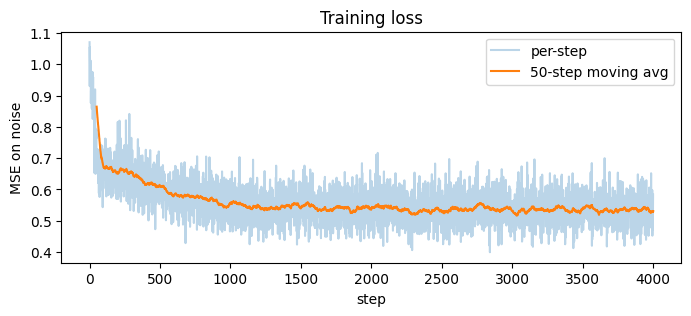
        print(f"step {step + 1:>5d}  loss {float(np.mean(losses[-500:])):.4f}")
step  1000  loss 0.5713
step  2000  loss 0.5401
step  3000  loss 0.5375
step  4000  loss 0.5341
Output from cell 7

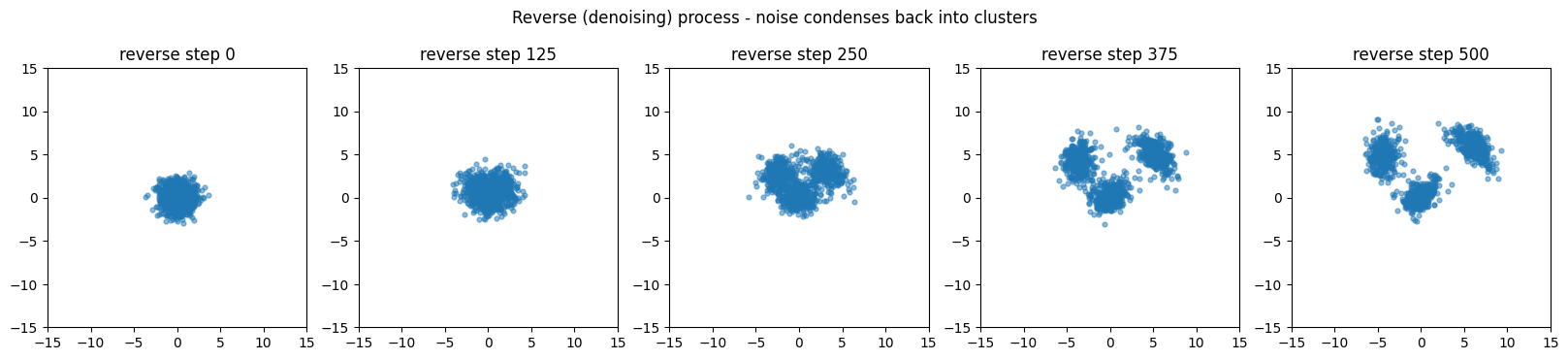
Sampling: the reverse process in action

Now run the chain backwards. Start with xTN(0,I)x_T \sim \mathcal{N}(0, I) and, for t=T,T1,,1t = T, T-1, \dots, 1, take a step: xt1=1αt ⁣(xt1αt1αˉtϵθ(xt,t))+σtzx_{t-1} = \frac{1}{\sqrt{\alpha_t}}\!\left( x_t - \frac{1-\alpha_t}{\sqrt{1-\bar\alpha_t}}\, \epsilon_\theta(x_t, t)\right) + \sigma_t z with zN(0,I)z \sim \mathcal{N}(0, I) for t>1t > 1 and z=0z = 0 at the final step. The standard variance choice is σt=βt\sigma_t = \sqrt{\beta_t}.
@torch.no_grad()
def sample(n=1000):
    """Run the reverse chain from pure noise back to data.

    Start at x_T ~ N(0, I) and iteratively denoise down to x_0 by applying
    the learned reverse transition p_theta(x_{t-1} | x_t).
    """
    # 1. Initialise n samples as pure standard Gaussian noise. This is x_T.
    x = torch.randn(n, 2, device=device)
    trajectory = [x.cpu().numpy().copy()]

    # 2. Loop t = T-1, T-2, ..., 0  (reversed range produces this order).
    for t_step in reversed(range(T)):
        t = torch.full((n,), t_step, device=device, dtype=torch.long)

        # Predicted noise at the current step.
        eps = model(x, t)
        beta_t  = betas[t_step]
        alpha_t = alphas[t_step]
        ab_t    = alpha_bars[t_step]

        # 3. Reverse-transition mean under the Ho et al. parameterisation:
        #    mu_theta(x_t, t) = (1/sqrt(alpha_t)) * (x_t - (1-alpha_t)/sqrt(1-bar_alpha_t) * eps_theta).
        coef = (1 - alpha_t) / (1 - ab_t).sqrt()
        mean = (x - coef * eps) / alpha_t.sqrt()

        # 4. Add Langevin noise scaled by sqrt(beta_t), except at the final
        #    step where we want a deterministic x_0 rather than a noisy draw.
        if t_step > 0:
            x = mean + beta_t.sqrt() * torch.randn_like(x)
        else:
            x = mean

        trajectory.append(x.cpu().numpy().copy())

    return x.cpu().numpy(), trajectory


generated, traj = sample(n=1000)
Output from cell 9

Did it work?

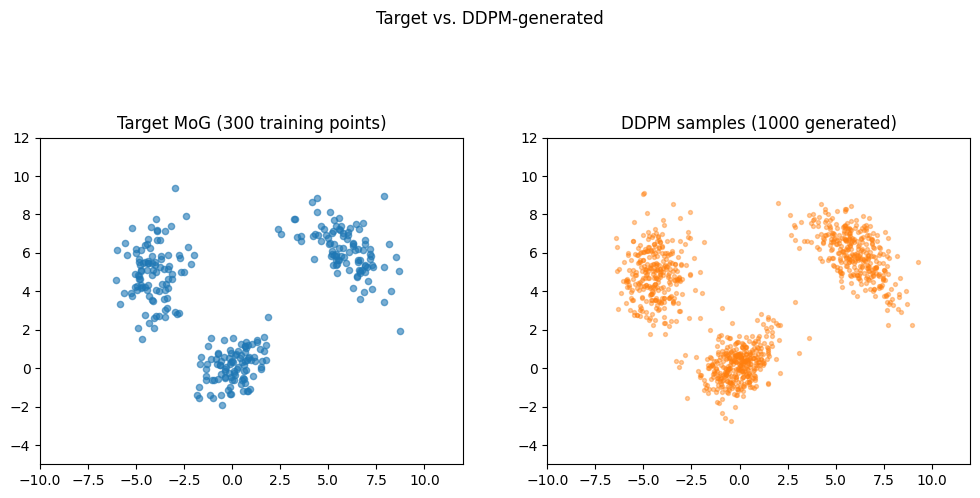
Compare the generated samples to the original training data. The model never learned that there are three components, that they are Gaussian, or where their centers are, it only saw 300 data points and a noise-prediction objective. If the three clusters reappear in the generated cloud, the diffusion model has captured the data distribution. Output from cell 10
Connections to other concepts

  • Black-box density modeling. DDPM treats pdatap_{\text{data}} as opaque. Compare with EM, which assumes a parametric mixture form and fits its parameters.
  • Same recipe, bigger backbone. Replace the 4-layer MLP with a U-Net and the same noise-prediction objective generates 256×256 images. The schedule, the closed-form forward jump, and the training loop do not change.
  • Conditional and guided generation. Condition ϵθ(xt,t,y)\epsilon_\theta(x_t, t, y) on a label, prompt, or class to obtain conditional models, and combine with classifier-free guidance to trade diversity for fidelity.
  • Latent diffusion. Run the entire chain inside a learned latent space (encode → diffuse in latents → decode) for orders-of-magnitude faster image generation.
  • Score-based unification. The Score MoG Tutorial trains sθ(x,σ)s_\theta(x, \sigma) directly, a network that approximates logpσ(x)\nabla \log p_\sigma(x). DDPM’s noise predictor ϵθ(xt,t)\epsilon_\theta(x_t, t) is, up to a known scaling, a score predictor at the variance-preserving SDE. Same network, different parameterization.
  • Faster, deterministic sampling. The DDIM tutorial reuses this same trained model with a different sampler that takes a fraction of the steps and is deterministic, opening the door to latent interpolation and editing.

References

  1. Ho, Jain, Abbeel. Denoising Diffusion Probabilistic Models. NeurIPS 2020. arxiv.org/abs/2006.11239
  2. Sohl-Dickstein et al. Deep Unsupervised Learning using Nonequilibrium Thermodynamics. ICML 2015. arxiv.org/abs/1503.03585
  3. Nichol, Dhariwal. Improved Denoising Diffusion Probabilistic Models. ICML 2021. arxiv.org/abs/2102.09672