Prerequisites. If ODEs and the Euler integration step feel unfamiliar, work through ODEs and the Euler method first. The discrete update you write there is the same one used here to track particles through the storm field.
You already have an intuition for velocity fields, even if you have never seen the term. A storm has the same three properties:
  • Wind has direction.
  • Wind has magnitude.
  • Different locations experience different winds.
A storm is, mathematically, a velocity field: v(x,y,t)\mathbf{v}(x, y, t) where the vector at each location (x,y)(x, y) at time tt tells you which way the air is moving and how fast.

A rotating storm

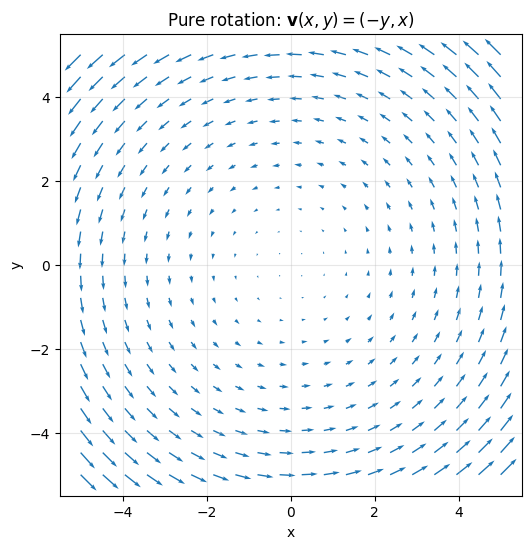
A simple 2D rotating storm centered at the origin is v(x,y)=[yx].\mathbf{v}(x, y) = \begin{bmatrix} -y \\ x \end{bmatrix}. This is a pure rotation. Two points pin down the picture:
  • At (1,0)(1, 0): v=(0,1)\mathbf{v} = (0, 1), the wind blows upward.
  • At (0,1)(0, 1): v=(1,0)\mathbf{v} = (-1, 0), the wind blows to the left.
So the field rotates counterclockwise around the origin.
import numpy as np
import matplotlib.pyplot as plt

x = np.linspace(-5, 5, 20)
y = np.linspace(-5, 5, 20)
X, Y = np.meshgrid(x, y)

U = -Y
V = X

fig, ax = plt.subplots(figsize=(6, 6))
ax.quiver(X, Y, U, V, color="C0")
ax.set_title("Pure rotation: $\\mathbf{v}(x, y) = (-y, x)$")
ax.set_xlabel("x"); ax.set_ylabel("y")
ax.set_aspect("equal")
ax.grid(alpha=0.3)
plt.show()
Output from cell 1

Velocity weakens with distance

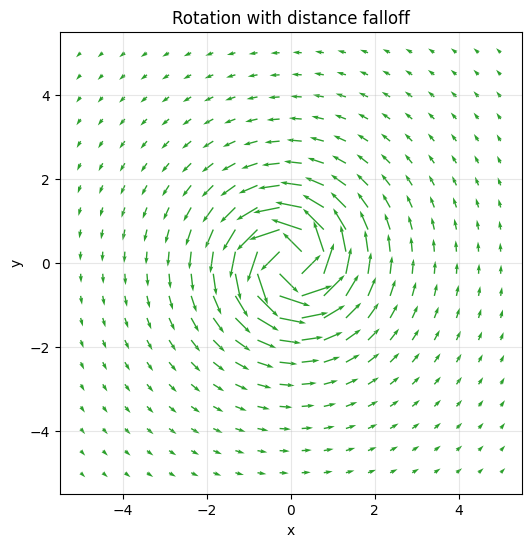
A real storm is strongest near the eye and weakens outward. A better model is v(x,y)=1x2+y2+ε[yx],\mathbf{v}(x, y) = \frac{1}{x^2 + y^2 + \varepsilon} \begin{bmatrix} -y \\ x \end{bmatrix}, where ε>0\varepsilon > 0 avoids the singularity at the origin. Near the center the field is strong; far from the center it decays. The same plotting machinery shows the new structure.
eps = 0.5
norm = X**2 + Y**2 + eps
U = -Y / norm
V = X / norm

fig, ax = plt.subplots(figsize=(6, 6))
ax.quiver(X, Y, U, V, color="C2")
ax.set_title("Rotation with distance falloff")
ax.set_xlabel("x"); ax.set_ylabel("y")
ax.set_aspect("equal")
ax.grid(alpha=0.3)
plt.show()
Output from cell 2

Particles in the storm

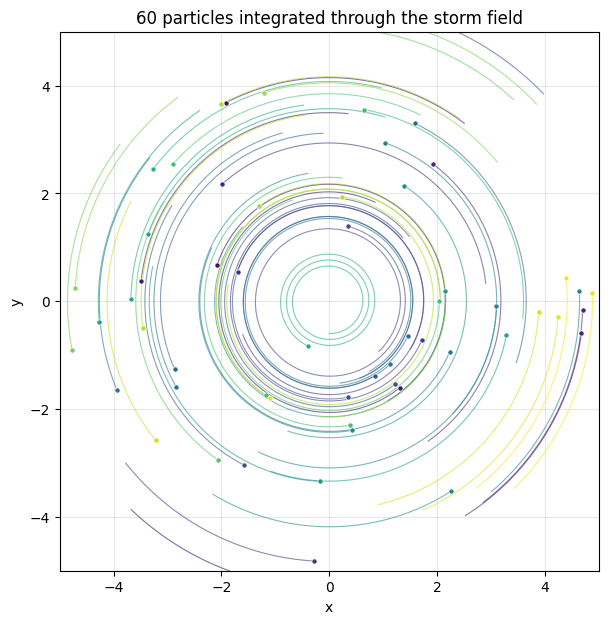
A velocity field becomes a dynamical system the moment you drop a particle in it. A particle at position x(t)\mathbf{x}(t) moves according to dxdt=v(x).\frac{d \mathbf{x}}{d t} = \mathbf{v}(\mathbf{x}). You can integrate this numerically. The simplest scheme is the Euler step, x(t+Δt)=x(t)+Δtv(x(t)),\mathbf{x}(t + \Delta t) = \mathbf{x}(t) + \Delta t \cdot \mathbf{v}(\mathbf{x}(t)), iterated for many steps. Release many particles at t=0t = 0 and follow them: this is what raindrops, leaves, and debris do in a storm.
def storm_v(p, eps=0.5):
    x, y = p[..., 0], p[..., 1]
    norm = x**2 + y**2 + eps
    return np.stack([-y / norm, x / norm], axis=-1)


rng = np.random.default_rng(0)
n_particles = 60
n_steps = 400
dt = 0.05

particles = rng.uniform(-4, 4, size=(n_particles, 2))
trajectories = np.empty((n_steps + 1, n_particles, 2))
trajectories[0] = particles

for step in range(n_steps):
    trajectories[step + 1] = trajectories[step] + dt * storm_v(trajectories[step])
fig, ax = plt.subplots(figsize=(7, 7))
colors = plt.cm.viridis(np.linspace(0, 1, n_particles))
for i in range(n_particles):
    ax.plot(trajectories[:, i, 0], trajectories[:, i, 1],
            color=colors[i], alpha=0.6, lw=0.8)
    ax.scatter(trajectories[-1, i, 0], trajectories[-1, i, 1],
               color=colors[i], s=14, zorder=3, edgecolor="white", linewidth=0.5)
ax.set_title(f"{n_particles} particles integrated through the storm field")
ax.set_xlabel("x"); ax.set_ylabel("y")
ax.set_xlim(-5, 5); ax.set_ylim(-5, 5)
ax.set_aspect("equal")
ax.grid(alpha=0.3)
plt.show()
Output from cell 4