
Introduction
In the so called classical NLP, words were treated as atomic symbols, e.g.hotel, conference, walk and they were represented with on-hot encoded (sparse) vectors e.g.
The size of the vectors is equal to the vocabulary size . These vocabularies are very long - for speech recognition we may be looking at 20K entries but for information retrieval on the web google has released vocabularies with 13 million words (1TB). In addition such representations are orthogonal to each other by construction - there is no way we can relate motel and hotel as their dot product is
One of key ideas that made NLP successful is the distributional semantics that originated from Firth’s work: a word’s meaning is given by the words that frequently appear close-by. When a word appears in a text, its context is the set of words that appear nearby (within a fixed-size window). Use the many contexts of to build up a representation of .

banking is represented by the words left and right across all sentences of our corpus.
This is the main idea behind word2vec word embeddings (representations) that we address next.
Before we deal with embeddings though its important to address a conceptual question:
Is there some ideal word-embedding space that would perfectly map human language and could be used for any natural-language-processing task? Possibly, but we have yet to compute anything of the sort. More pragmatically, what makes a good word-embedding space depends heavily on your task: the perfect word-embedding space for an English-language movie-review sentiment-analysis model may look different from the perfect embedding space for an English-language legal—document-classification model, because the importance of certain semantic relationships varies from task to task. It’s thus reasonable to learn a new embedding space with every new task.
Features of Word2Vec embeddings
In 2012, Thomas Mikolov, an intern at Microsoft, found a way to encode the meaning of words in a modest number of vector dimensions . Mikolov trained a neural network to predict word occurrences near each target word. In 2013, once at Google, Mikolov and his teammates released the software for creating these word vectors and called it word2vec.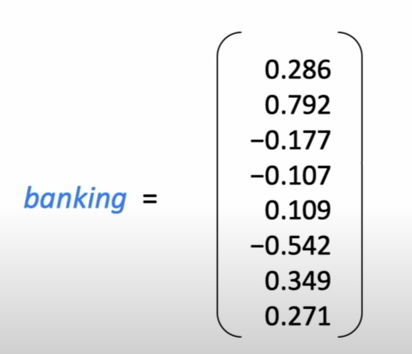
banking in d=8 dimensions
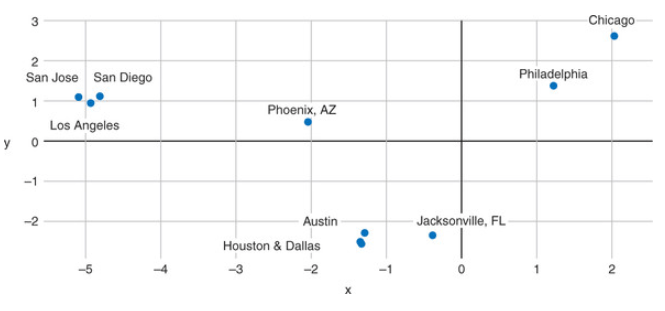
Here is a visualization of these embeddings in the re-projected 3D space (from to 3). Try searching for the word “truck” for the visualizer to show the distorted neighbors of this work - distorted because of the 3D re-projection. In another example, word2vec embeddings of US cities projected in the 2D space result in poor topological but excellent semantic mapping which is exactly what we are after.
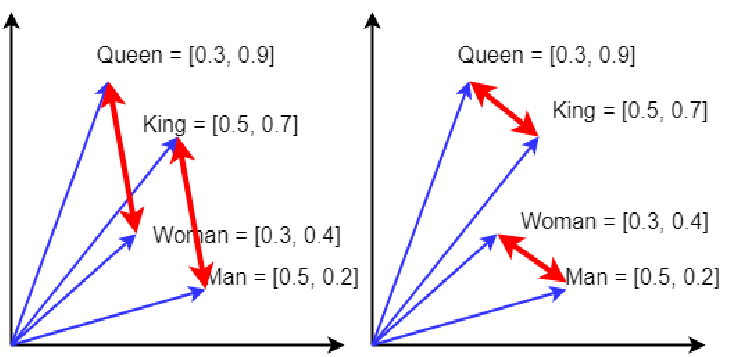
king − man ≈ queen − woman, and we can visually see that in the red arrows. There are 4 analogies one can construct, based on the parallel red arrows and their direction. This is slightly idealized; the vectors need not be so similar to be the most similar from all word vectors. The similar direction of the red arrows indicates similar relational meaning.
So what is the more formal description of the word2vec algorithm? We will focus on one of the two computational algorithms[^1] - the skip-gram method and use the following diagrams as examples to explain how it works.
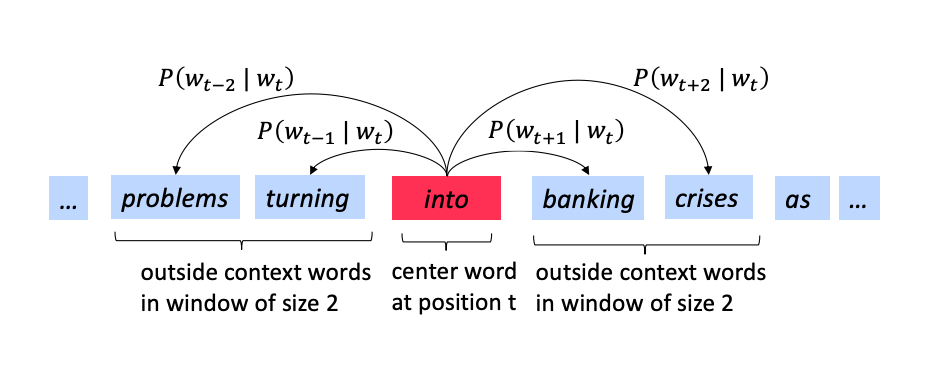
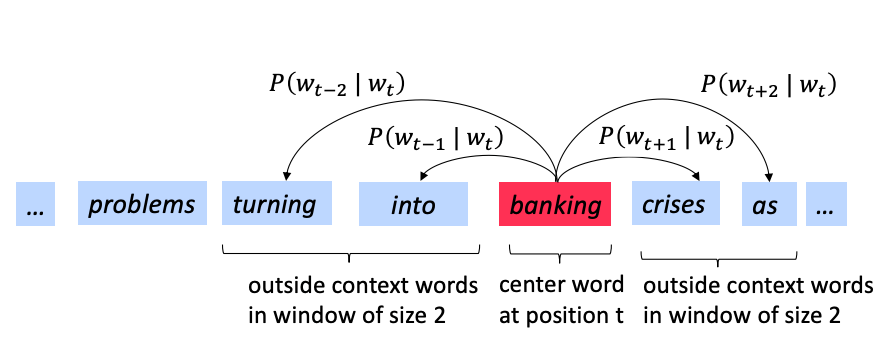
banking is predicting the context (the words around it) in which banking occurs across our corpus.
The term prediction points to the regression section and the maximum likelihood principle. We start from the familiar cross entropy loss and architect a neural estimator that will minimize the distance between and . The negative log likelihood was shown to be:
where is the size of the vocabulary (words). could be very large, e.g. 1 billion words. The ML principle, powered by a corresponding algorithm, will result in a model that for each word at the input (center) will predict the context words around it. The model parameters will be determined at the end of the training process that uses a training dataset easily generated from our corpus assuming we fix the context window . Lets see an example:
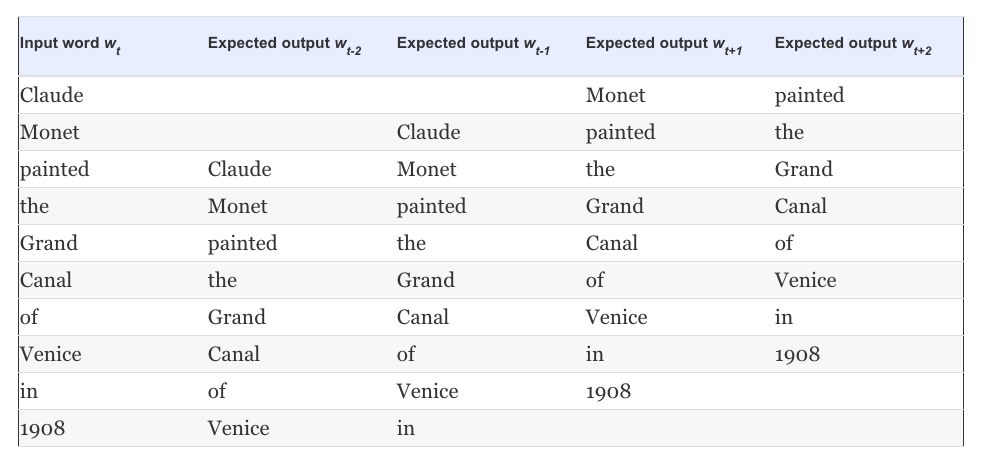
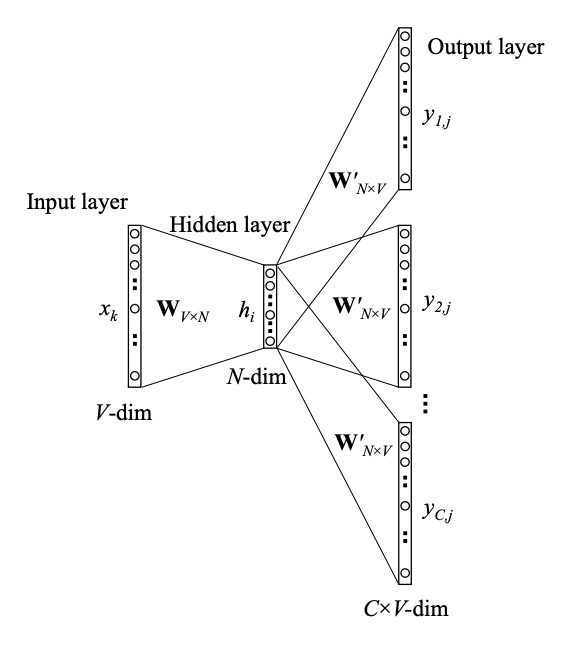
Mind the important difference between learning a representation that from the context across the corpus and the application of that representation. Word2Vec are applied context-free. After training, a single matrix will be used. This means that the word ‘bank’ will be encoded using the same dense vector irrespectively when it is located close to ‘river’ or ‘food’ or ‘deposit’.Contextual representations will be addressed in a separate section.