

Open In Colab

Batch Normalization in ResNets

Batch normalization (BN) is a critical ingredient of modern residual networks. In this notebook we:
  1. Build a minimal ResNet block with and without batch normalization
  2. Train both variants on CIFAR-10 and compare convergence speed, final accuracy, and gradient health
  3. Visualize how BN stabilizes the distribution of intermediate activations across training
The canonical ResNet block from He et al. (2016) is: y=f(x)+x,f(x)=W2ReLU(BN(W1x))y = f(x) + x, \quad f(x) = W_2 * \text{ReLU}(\text{BN}(W_1 * x)) where * denotes convolution and BN\text{BN} normalizes the pre-activation tensor to have zero mean and unit variance, then scales and shifts with learnable γ\gamma and β\beta: x^=xμBσB2+ϵ,y=γx^+β\hat x = \frac{x - \mu_B}{\sqrt{\sigma_B^2 + \epsilon}}, \quad y = \gamma \hat x + \beta
import torch
import torch.nn as nn
import torch.optim as optim
import torchvision
import torchvision.transforms as transforms
import matplotlib.pyplot as plt
import numpy as np
import os
from tqdm import tqdm

DEVICE = torch.device('cuda' if torch.cuda.is_available() else 'cpu')
print(f'Using device: {DEVICE}')
if DEVICE.type == 'cuda':
    print(f'  GPU: {torch.cuda.get_device_name(0)}')
Using device: cuda
  GPU: NVIDIA RTX A4500 Laptop GPU

CIFAR-10 data loaders

We use standard CIFAR-10 normalisation (channel mean and std computed from the training set).
BATCH_SIZE = 128

train_transform = transforms.Compose([
    transforms.RandomCrop(32, padding=4),
    transforms.RandomHorizontalFlip(),
    transforms.ToTensor(),
    transforms.Normalize((0.4914, 0.4822, 0.4465), (0.2470, 0.2435, 0.2616)),
])

test_transform = transforms.Compose([
    transforms.ToTensor(),
    transforms.Normalize((0.4914, 0.4822, 0.4465), (0.2470, 0.2435, 0.2616)),
])

train_dataset = torchvision.datasets.CIFAR10(
    root='/tmp/cifar10', train=True, download=True, transform=train_transform)
test_dataset = torchvision.datasets.CIFAR10(
    root='/tmp/cifar10', train=False, download=True, transform=test_transform)

train_loader = torch.utils.data.DataLoader(
    train_dataset, batch_size=BATCH_SIZE, shuffle=True,
    num_workers=2, pin_memory=True)
test_loader = torch.utils.data.DataLoader(
    test_dataset, batch_size=BATCH_SIZE, shuffle=False,
    num_workers=2, pin_memory=True)

print(f'Train batches: {len(train_loader)},  Test batches: {len(test_loader)}')
Train batches: 391,  Test batches: 79

ResNet building blocks

We implement two variants of the basic residual block:
  • ResBlock — with batch normalization (use_bn=True, default)
  • ResBlock — without batch normalization (use_bn=False)
The skip connection uses a 1×11\times 1 convolution when the spatial dimensions or channel count change (the projection shortcut).
class ResBlock(nn.Module):
    """Basic residual block (two 3x3 convs) with optional batch normalization."""

    def __init__(self, in_channels, out_channels, stride=1, use_bn=True):
        super().__init__()
        self.use_bn = use_bn

        self.conv1 = nn.Conv2d(in_channels, out_channels, 3,
                               stride=stride, padding=1, bias=not use_bn)
        self.bn1 = nn.BatchNorm2d(out_channels) if use_bn else nn.Identity()

        self.conv2 = nn.Conv2d(out_channels, out_channels, 3,
                               stride=1, padding=1, bias=not use_bn)
        self.bn2 = nn.BatchNorm2d(out_channels) if use_bn else nn.Identity()

        self.relu = nn.ReLU(inplace=True)

        # Projection shortcut when dimensions change
        self.shortcut = nn.Sequential()
        if stride != 1 or in_channels != out_channels:
            layers = [nn.Conv2d(in_channels, out_channels, 1, stride=stride, bias=not use_bn)]
            if use_bn:
                layers.append(nn.BatchNorm2d(out_channels))
            self.shortcut = nn.Sequential(*layers)

    def forward(self, x):
        out = self.relu(self.bn1(self.conv1(x)))
        out = self.bn2(self.conv2(out))
        out = self.relu(out + self.shortcut(x))
        return out

class SmallResNet(nn.Module):
    """Small ResNet for CIFAR-10 (6 residual blocks, 3 stages)."""

    def __init__(self, use_bn=True, num_classes=10):
        super().__init__()
        self.use_bn = use_bn

        self.stem = nn.Sequential(
            nn.Conv2d(3, 16, 3, stride=1, padding=1, bias=not use_bn),
            nn.BatchNorm2d(16) if use_bn else nn.Identity(),
            nn.ReLU(inplace=True),
        )

        self.layer1 = self._make_layer(16, 16, 2, stride=1, use_bn=use_bn)
        self.layer2 = self._make_layer(16, 32, 2, stride=2, use_bn=use_bn)
        self.layer3 = self._make_layer(32, 64, 2, stride=2, use_bn=use_bn)

        self.pool = nn.AdaptiveAvgPool2d(1)
        self.fc   = nn.Linear(64, num_classes)

    @staticmethod
    def _make_layer(in_ch, out_ch, n_blocks, stride, use_bn):
        layers = [ResBlock(in_ch, out_ch, stride=stride, use_bn=use_bn)]
        for _ in range(1, n_blocks):
            layers.append(ResBlock(out_ch, out_ch, stride=1, use_bn=use_bn))
        return nn.Sequential(*layers)

    def forward(self, x):
        x = self.stem(x)
        x = self.layer1(x)
        x = self.layer2(x)
        x = self.layer3(x)
        x = self.pool(x).flatten(1)
        return self.fc(x)

# Count parameters
model_bn    = SmallResNet(use_bn=True).to(DEVICE)
model_no_bn = SmallResNet(use_bn=False).to(DEVICE)
n_params = sum(p.numel() for p in model_bn.parameters())
print(f'SmallResNet parameters: {n_params:,}')
SmallResNet parameters: 175,258

Training loop

We train both variants for the same number of epochs with the same SGD + cosine-annealing schedule and compare:
  • Training loss and test accuracy per epoch
  • Gradient norms at the stem layer (a proxy for gradient health)
def train_one_epoch(model, loader, optimizer, criterion):
    model.train()
    total_loss, correct, total = 0.0, 0, 0
    for inputs, targets in loader:
        inputs, targets = inputs.to(DEVICE), targets.to(DEVICE)
        optimizer.zero_grad()
        outputs = model(inputs)
        loss = criterion(outputs, targets)
        loss.backward()
        optimizer.step()
        total_loss += loss.item() * inputs.size(0)
        correct    += outputs.argmax(1).eq(targets).sum().item()
        total      += inputs.size(0)
    return total_loss / total, 100.0 * correct / total

@torch.no_grad()
def evaluate(model, loader, criterion):
    model.eval()
    total_loss, correct, total = 0.0, 0, 0
    for inputs, targets in loader:
        inputs, targets = inputs.to(DEVICE), targets.to(DEVICE)
        outputs = model(inputs)
        loss = criterion(outputs, targets)
        total_loss += loss.item() * inputs.size(0)
        correct    += outputs.argmax(1).eq(targets).sum().item()
        total      += inputs.size(0)
    return total_loss / total, 100.0 * correct / total

def grad_norm(model):
    """L2 norm of gradients at the stem conv layer."""
    p = model.stem[0].weight
    return p.grad.norm().item() if p.grad is not None else 0.0

def run_experiment(use_bn, n_epochs=30):
    model = SmallResNet(use_bn=use_bn).to(DEVICE)
    optimizer = optim.SGD(model.parameters(), lr=0.1,
                          momentum=0.9, weight_decay=1e-4)
    scheduler = optim.lr_scheduler.CosineAnnealingLR(optimizer, T_max=n_epochs)
    criterion = nn.CrossEntropyLoss()

    history = {'train_loss': [], 'test_acc': [], 'grad_norm': []}
    label = 'with BN' if use_bn else 'no BN'

    for epoch in tqdm(range(n_epochs), desc=f'Training ({label})', leave=True):
        tr_loss, _ = train_one_epoch(model, train_loader, optimizer, criterion)
        # capture gradient norm after last training step
        gn = grad_norm(model)
        _, te_acc = evaluate(model, test_loader, criterion)
        scheduler.step()

        history['train_loss'].append(tr_loss)
        history['test_acc'].append(te_acc)
        history['grad_norm'].append(gn)

    return history

N_EPOCHS = 30
hist_bn    = run_experiment(use_bn=True,  n_epochs=N_EPOCHS)
hist_no_bn = run_experiment(use_bn=False, n_epochs=N_EPOCHS)

Results: training loss, test accuracy, and gradient norms

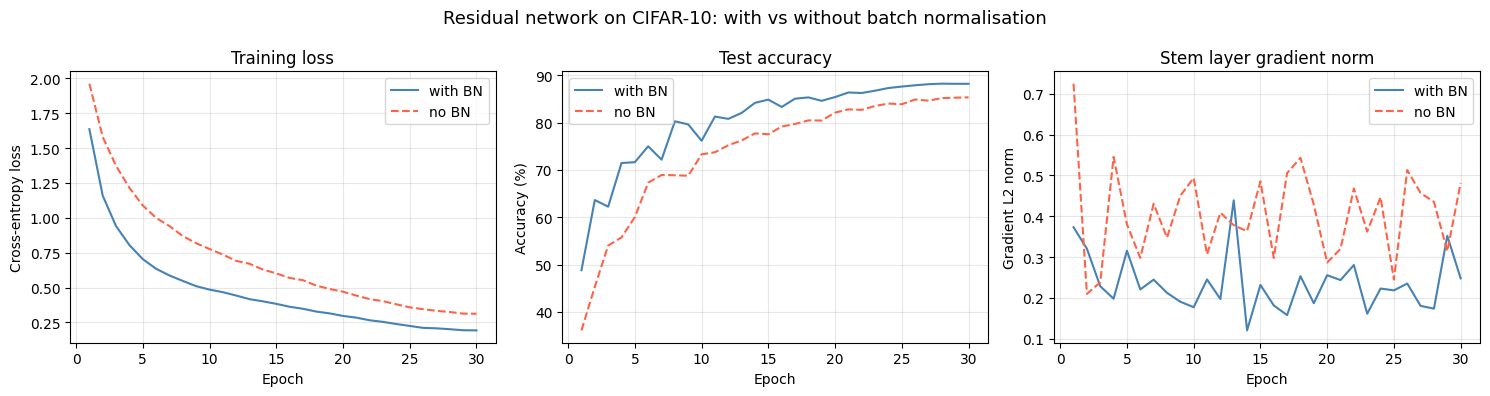
The three plots below summarise the effect of batch normalisation on a residual network trained on CIFAR-10.
epochs = range(1, N_EPOCHS + 1)

fig, axes = plt.subplots(1, 3, figsize=(15, 4))

# Training loss
axes[0].plot(epochs, hist_bn['train_loss'],    label='with BN',  color='steelblue')
axes[0].plot(epochs, hist_no_bn['train_loss'], label='no BN',    color='tomato', linestyle='--')
axes[0].set_xlabel('Epoch')
axes[0].set_ylabel('Cross-entropy loss')
axes[0].set_title('Training loss')
axes[0].legend()
axes[0].grid(True, alpha=0.3)

# Test accuracy
axes[1].plot(epochs, hist_bn['test_acc'],    label='with BN',  color='steelblue')
axes[1].plot(epochs, hist_no_bn['test_acc'], label='no BN',    color='tomato', linestyle='--')
axes[1].set_xlabel('Epoch')
axes[1].set_ylabel('Accuracy (%)')
axes[1].set_title('Test accuracy')
axes[1].legend()
axes[1].grid(True, alpha=0.3)

# Gradient norms at stem
axes[2].plot(epochs, hist_bn['grad_norm'],    label='with BN',  color='steelblue')
axes[2].plot(epochs, hist_no_bn['grad_norm'], label='no BN',    color='tomato', linestyle='--')
axes[2].set_xlabel('Epoch')
axes[2].set_ylabel('Gradient L2 norm')
axes[2].set_title('Stem layer gradient norm')
axes[2].legend()
axes[2].grid(True, alpha=0.3)

plt.suptitle('Residual network on CIFAR-10: with vs without batch normalisation', fontsize=13)
plt.tight_layout()
plt.savefig('bn_comparison.png', dpi=150, bbox_inches='tight')
plt.show()

print(f'Final test accuracy  —  with BN: {hist_bn["test_acc"][-1]:.1f}%  |  no BN: {hist_no_bn["test_acc"][-1]:.1f}%')
Training loss, test accuracy, and stem gradient norms for ResNets with and without batch normalization on CIFAR-10
Final test accuracy  —  with BN: 88.2%  |  no BN: 85.3%

Activation distribution across training

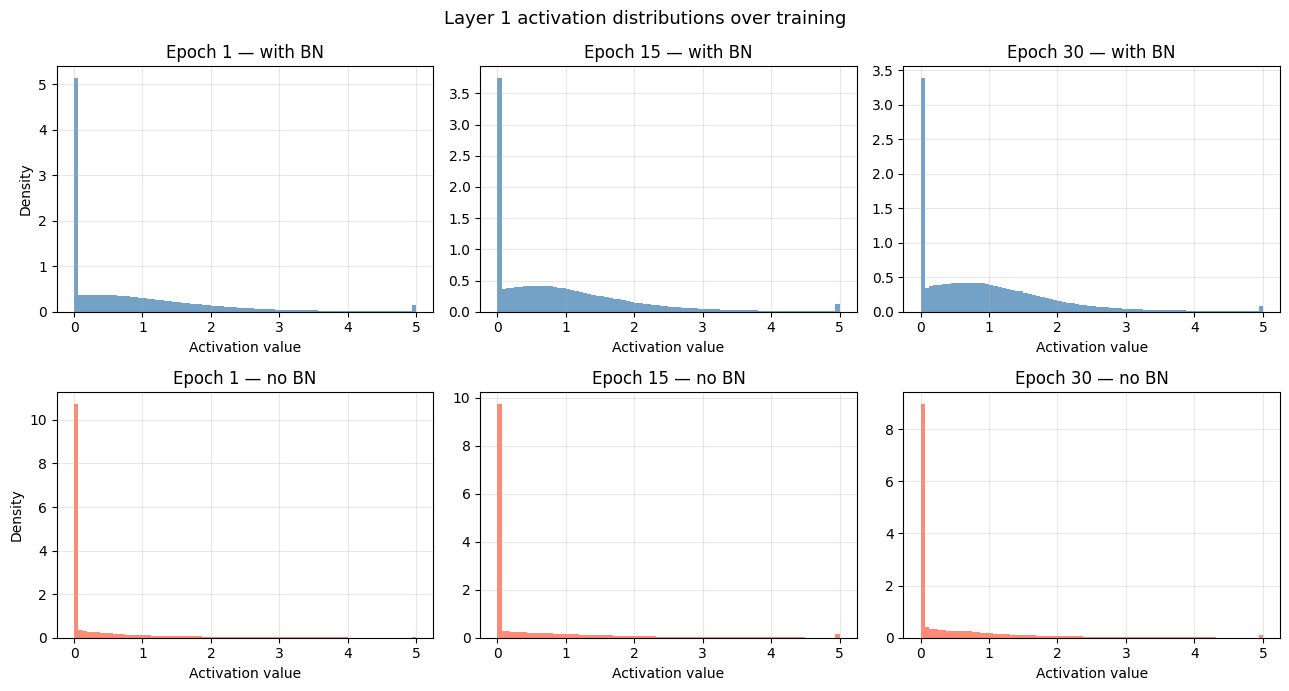
To see why BN helps, we capture the distribution of activations at the output of layer1 at epochs 1, 15, and 30. Without BN the distribution drifts and widens; with BN it stays anchored near zero.
def get_layer1_activations(model, loader, n_batches=3):
    """Collect a sample of layer1 output activations."""
    model.eval()
    acts = []
    with torch.no_grad():
        for i, (inputs, _) in enumerate(loader):
            if i >= n_batches:
                break
            x = inputs.to(DEVICE)
            x = model.stem(x)
            x = model.layer1(x)
            acts.append(x.cpu().numpy().flatten())
    return np.concatenate(acts)

def train_and_capture(use_bn, epochs_to_capture, n_epochs=30):
    model = SmallResNet(use_bn=use_bn).to(DEVICE)
    optimizer = optim.SGD(model.parameters(), lr=0.1, momentum=0.9, weight_decay=1e-4)
    scheduler = optim.lr_scheduler.CosineAnnealingLR(optimizer, T_max=n_epochs)
    criterion = nn.CrossEntropyLoss()

    captured = {}
    for epoch in range(1, n_epochs + 1):
        train_one_epoch(model, train_loader, optimizer, criterion)
        scheduler.step()
        if epoch in epochs_to_capture:
            captured[epoch] = get_layer1_activations(model, test_loader)
    return captured

CAPTURE_EPOCHS = {1, 15, 30}
acts_bn    = train_and_capture(use_bn=True,  epochs_to_capture=CAPTURE_EPOCHS)
acts_no_bn = train_and_capture(use_bn=False, epochs_to_capture=CAPTURE_EPOCHS)

fig, axes = plt.subplots(2, 3, figsize=(13, 7), sharey=False)

for col, ep in enumerate(sorted(CAPTURE_EPOCHS)):
    for row, (acts, label, color) in enumerate([
            (acts_bn,    'with BN',  'steelblue'),
            (acts_no_bn, 'no BN',    'tomato')]):
        ax = axes[row][col]
        ax.hist(np.clip(acts[ep], -5, 5), bins=80, color=color, alpha=0.75, density=True)
        ax.set_title(f'Epoch {ep}{label}')
        ax.set_xlabel('Activation value')
        if col == 0:
            ax.set_ylabel('Density')
        ax.grid(True, alpha=0.3)

plt.suptitle('Layer 1 activation distributions over training', fontsize=13)
plt.tight_layout()
plt.savefig('activation_distributions.png', dpi=150, bbox_inches='tight')
plt.show()
Layer 1 activation distributions at epochs 1, 15, and 30 for ResNets with and without batch normalization

Summary

AspectWithout BNWith BN
Convergence speedSlower, noisier lossFaster, smoother
Final test accuracyLowerHigher
Gradient normsErratic, can vanishStable throughout
Activation distributionDrifts and widensStays near N(0,1)\mathcal{N}(0,1)
Sensitivity to lrHigh (requires careful tuning)Low (tolerates higher lr)
These results confirm why every modern ResNet variant (ResNet-50, ResNeXt, Wide-ResNet) applies batch normalization after each convolution before the non-linearity.